How to Stop Binge Eating at Night — and Why Willpower Isn't the Answer


- Binge eating at night is different from typical late-night snacking. Binge eating is a disordered eating pattern, typically driven by underlying factors.
- Rather than simply having a snack, binge eating is characterized by eating a large amount of food in a short period and feeling significant distress over it.
- Underlying causes include daytime food restriction, hormonal issues, and more. Stopping nighttime binge eating requires addressing these underlying factors.
- Treatment for late-night binge eating is available and recovery is possible with the help of a knowledgeable care team.

Many people grab a late-night snack now and then to satisfy a craving, enjoy a favorite treat while catching up on a show, or calm unexpected hunger that crops up post-dinner. Late-night snacking, whether in response to factors like this or even as a general habit, (like always having something specific right before bed), is completely normal.
Nighttime binge eating is different. It involves eating large amounts of food quickly, feeling out of control around food, and experiencing distressing emotions, such as shame or guilt, afterward. This is a disordered eating pattern, but it isn’t about a lack of willpower or a personal shortcoming. And it’s not something you or a loved one can “just stop,” because underlying physiological and psychological mechanisms typically override any efforts to avoid or stop the behavior.
The good news is that when these underlying causes get addressed, recovery from nighttime binge eating is possible.
In this article, we explore how to stop binge eating at night, what binge eating disorder is, and more.
What is nighttime binge eating—and is it the same thing as late-night snacking?
Nighttime binge eating means eating large amounts of food in a short period of time late in the day, whether after dinner, before bed, or in the middle of the night. Intense urges bring on nighttime binge eating, and feelings of distress typically accompany an episode.
“Everyone has had an evening where they reach for a late-night snack,” says Jen Simmons, PhD, lead therapist at Equip. “This might be due to stress, trouble falling asleep because of excitement, or genuine hunger.”
She adds, “Late-night snacking is a completely normal part of life. It can cross the line into disordered eating when it begins to cause emotional distress, such as feeling an absolute need to eat every single night just to fall asleep. When food starts creating that kind of mental anxiety, it is well worth checking in with a professional.”
Nighttime binge eating is a disordered eating pattern. It has characteristics of binge eating disorder (BED) and could be a sign of BED or another eating disorder.
BED is a recognized mental health condition, as noted in the Diagnostic and Statistical Manual of Mental Disorder 5th Edition (DSM-5).
The following table explores the key differences between nighttime snacking, binge eating episodes, and binge eating disorder.
Behavior pattern | Nighttime snacking | Nighttime binge eating episodes | Binge eating disorder (BED) |
What it typically looks like | Eating a small snack/meal after dinner or before bed, driven by a minor craving, hunger, or habit | Occasionally eating an unusually large amount of food in a short period at nighttime | Frequently eating unusually large amounts of food in a short time (e.g., two hours) |
Frequency | Occasional or regularly if it’s a habit | Occasional or somewhat regularly, though it might or might not occur often enough to meet BED criteria | Binge eating occurs at least once a week, on average, for three months |
Sense of control | You feel in control, as if you could stop or avoid it | You feel a temporary loss of control around food during the episode | You feel a major loss of control regarding food |
Emotional experience during and after | Emotions are neutral, though sometimes, you might eat out of boredom or another emotion | Often followed by feelings of guilt or shame | Feelings of intense shame or guilt accompany the episode |
Is distress present? | Generally not | Usually | Yes, significant distress is present |
Why does nighttime binge eating happen, and what can you do?
Nighttime binge eating occurs because of underlying physiological and psychological mechanisms, not out of a lack of willpower.
The potential drivers include daytime food restriction, stress and other emotional factors, disrupted hormones or processes that regulate hormones, and habits and environmental cues. These factors may sound a little abstract, but they can explain why you may feel like you can’t stop eating at night. Let’s explore them in more detail.
Addressing those potential causes can help you prevent binge eating at night without restricting food. But remember, stopping can be hard to do on your own because of what’s triggering the issue. Getting support from a multidisciplinary care team can help.
Restriction and undereating during the day
Your body needs adequate nutrition to support all it needs to do, including keeping your heart pumping, lungs breathing, and cells performing their functions. These are just some of the things your body does continuously, even at rest. It also needs an adequate amount of nutrients for you to perform household chores, walk your dog, or do any additional exercise.
Restricting food, whether by skipping meals or not eating enough during them, puts you in an energy deficit, meaning you’re burning more calories than you’re taking in.
“The body will do whatever it takes to provide what we need to make it through,” Dr. Simmons says, “but by the end of the day, there is simply no gas left in the tank. The body recognizes this deficit and intensely wants to replenish.”
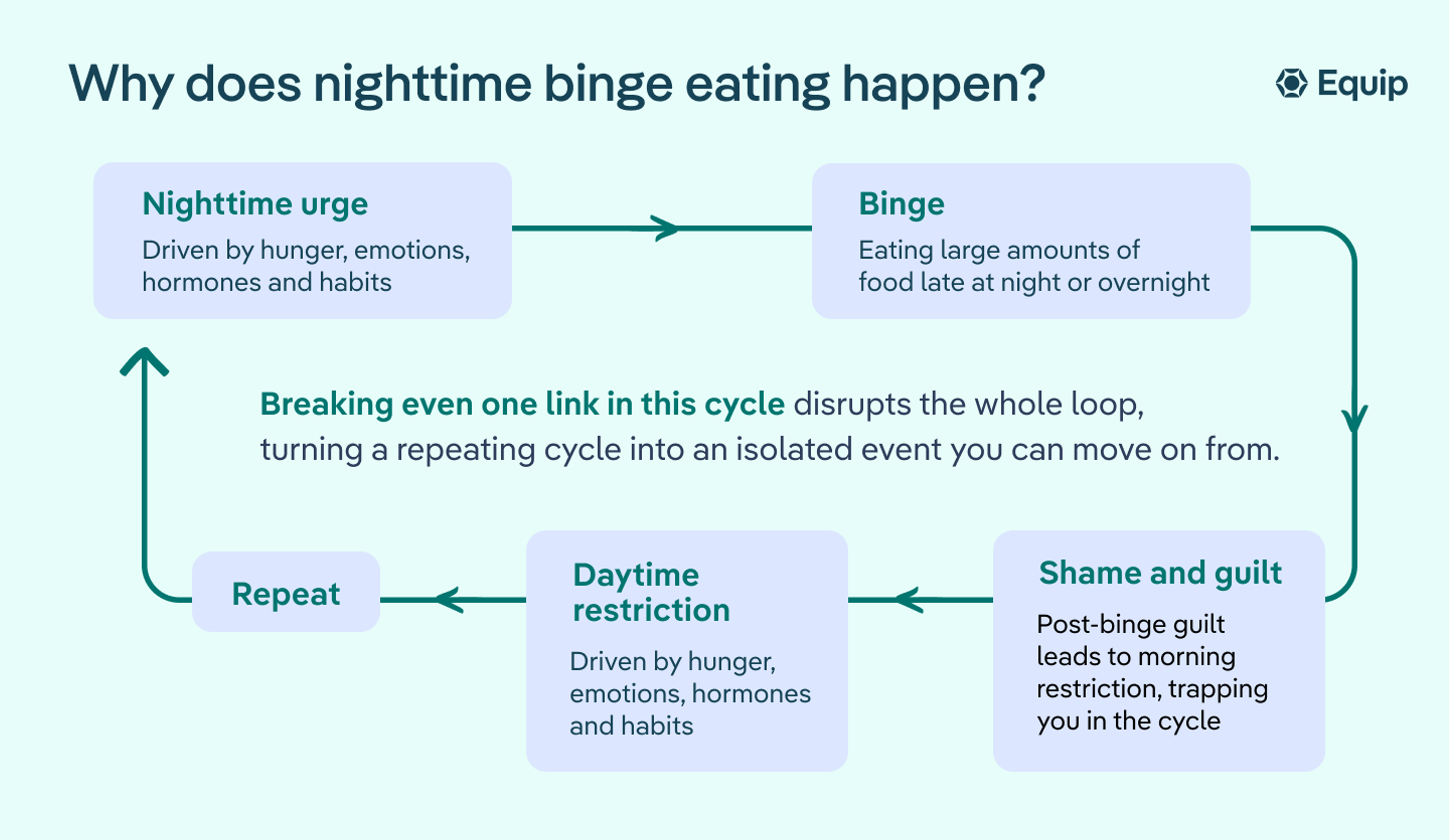
Energy deficits can place your body in survival mode by kicking off hormonal processes that send signals to your brain that you need food, stat. These hunger signals can become so powerful that they’re impossible to ignore, leading to binge episodes. This may be more common for you at night because of restriction during the day. Unfortunately, many people try to “compensate” for a nighttime binge by restricting the next day—falling into a harmful pattern known as the binge-restrict cycle.
“Waking up the morning after an episode often means having no appetite,” Dr. Simmons says. “If guilt and shame are present, a person might feel like they shouldn't eat breakfast because of what they ate the night before. What happens then is they restrict food until lunch or even later, which actually creates the perfect opportunity for another binge the following night due to a lack of daytime nutrition.”
Another factor is when foods get tagged morally as “good” or “bad.” “After bingeing on a food labeled as ‘bad,’ shame and guilt quickly reinforce that perceived ‘badness,’ making the patient feel even worse,” Dr. Simmons says. “This drives them to restrict their meals following this episode, which inevitably leads right back to another binge.”
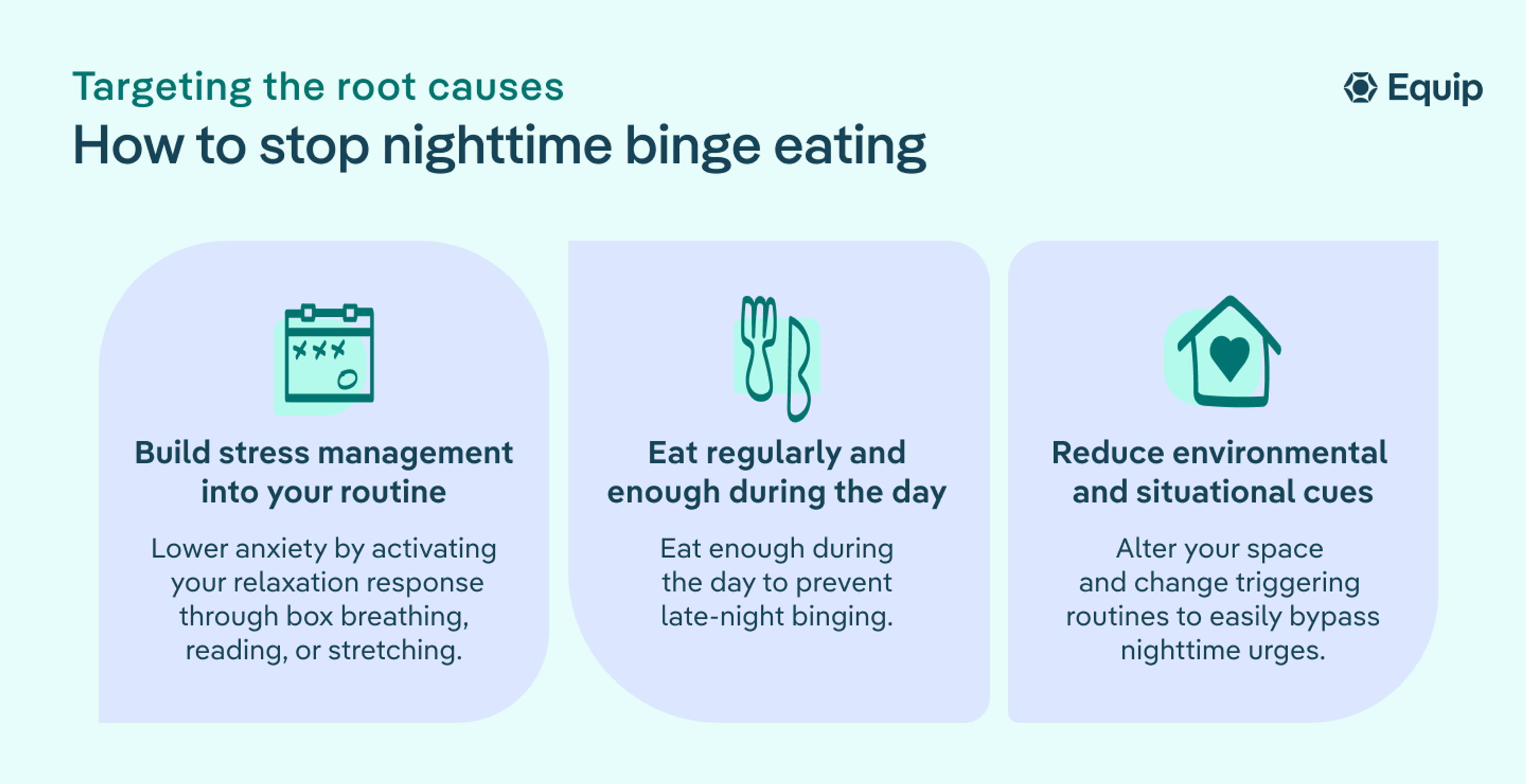
What you can do: Eat regularly and enough during the day
Aiming for three satisfying meals per day, as well as a couple of snacks if you get hungry between meals, can help reduce the likelihood of late-night hunger or nighttime cravings.
Stress and emotional eating
Stress or other emotions can also drive binge eating. For example, stress eating is emotional eating that we sometimes engage in when stressed, worried, scared, or anxious, according to research in the journal Proceedings of the Nutrition Society. It’s a normal process when it occurs on occasion.
“Food has always been a fundamental source of comfort for humans,” Dr. Simmons explains. She says that babies are a great example: They cry when hungry, but after they eat, they relax and inevitably drift off to sleep.
“Food literally alters our neurochemistry to make us feel good,” Dr. Simmons explains. “It makes complete sense that one of our first and easiest ways to find happiness and comfort comes from food. Where this can lead to issues, however, is when food becomes the primary mechanism we navigate toward during times of stress or high emotion.”
Repeated emotional eating at night, especially if you feel out of control around food (eating a lot in a short period) and significant distress, may actually be binge eating episodes. These episodes may be more likely to occur at night after a stressful or emotional day.
What you can do: Build stress management into your routine
If stress or difficult emotions trigger binge eating episodes, reducing these triggers can be helpful.
Stress and anxiety activate your fight-or-flight response, driven by your sympathetic nervous system. You can activate your parasympathetic nervous system (which drives your “calm” response) to get out of fight-or-flight mode. Breathwork is a great strategy in the moment. Try box breathing, for example: Inhale, hold, exhale, and hold, each for a count of four.
These two nervous system branches (sympathetic and parasympathetic) tend to work mostly in opposition to each other, almost like flipping a switch. Engaging in any activity that you find calming, such as knitting, reading, taking a bath, or stretching, can help.
However, sometimes with a history of trauma or ongoing anxiety, your fight-or-flight system gets chronically set to “on.” If this feels like the case for you, activating your calm response can be more challenging. You may need assistance from a licensed mental healthcare professional who can help you develop additional strategies.
Hormonal and circadian patterns
Hormones impact hunger and eating in complex ways, but we know that dysregulated patterns can lead to nighttime binge eating. Likewise, nighttime binge eating can lead to dysregulated hormonal patterns, creating a self-perpetuating cycle.
For example, leptin is a hormone produced in fat cells that tells your brain you’re full. However, with weight gain, your cells may produce excessive leptin, which can lead to leptin resistance, according to research published in European Eating Disorders Review. This means your brain fails to receive the fullness signal, increasing hunger and making binges more likely.
Leptin resistance is associated with various eating disorders, most commonly BED. But even if you (or a loved one) don’t meet the full criteria for a BED diagnosis, leptin resistance could be driving nighttime binge eating.
Another hormone that may play a role is cortisol. This stress hormone gets a bad rap, but when it’s regulated, it’s a good thing. It follows a pattern tied to your circadian rhythm, or sleep-wake cycle. The typical pattern is for cortisol to reach its highest point in the morning (helping you wake up) and to decrease as the day progresses. Chronic stress can dysregulate cortisol, however, and dysregulated cortisol is linked to emotional eating, binge eating, and BED, according to research published in the journal Appetite.
Cortisol dysregulation, along with the dysregulation of other hormones, can also disrupt your circadian rhythm. Higher cortisol at night is associated with delayed sleep, which may disrupt natural mealtimes, for example. This disruption can lead to eating after dinner, before bedtime, or even in the middle of the night.
Another recognized mental health condition and eating disorder is called night eating syndrome (NES). Criteria include eating more than 25% of your daily calories after dinner, according to research in the journal Current Obesity Reports. In the DSM-5, NES is listed under an umbrella term called otherwise specified feeding and eating disorder (OSFED).
What you can do: Prioritize a regular sleep schedule
If hormonal issues are driving your binge eating at night, they can be hard to address on your own. Working with a multidisciplinary care team can help. However, one thing you can do is set and stick to a regular sleep schedule as much as possible and ensure you’re getting seven to nine hours of sleep per night.
Habit and environmental cues
Nighttime binge eating can also become a habit that’s hard to break because of environmental cues. Attentional bias is the tendency to pay attention to specific stimuli in your environment while ignoring others. Research shows that people with BED have an attentional bias toward food cues, according to a review published in the journal Appetite.
Although you might be gone or busy during the daytime, the nighttime is generally a calmer, quieter time. Food cues (like even just walking into the kitchen), might be harder to ignore and drive evening binge eating.
Additionally, sometimes certain cues or habits trigger other habits. For example, if watching TV before bed triggers binge eating because the two usually go together, your brain can associate the two paired habits. If your brain finds them rewarding, it will motivate you to continue doing them.
What you can do: Reduce environmental and situational cues
As mentioned, sometimes, one habit triggers another. If this sounds familiar, you might be able to interrupt the cycle by forming different habits. For example, if scrolling on your phone before bed triggers nighttime binge eating, putting your phone in a different room while you prepare to sleep might help.
Changing ingrained habits can be difficult on your own. Again, working with a mental health professional can help you discover the strategies that work best for you.
What to do after a nighttime binge
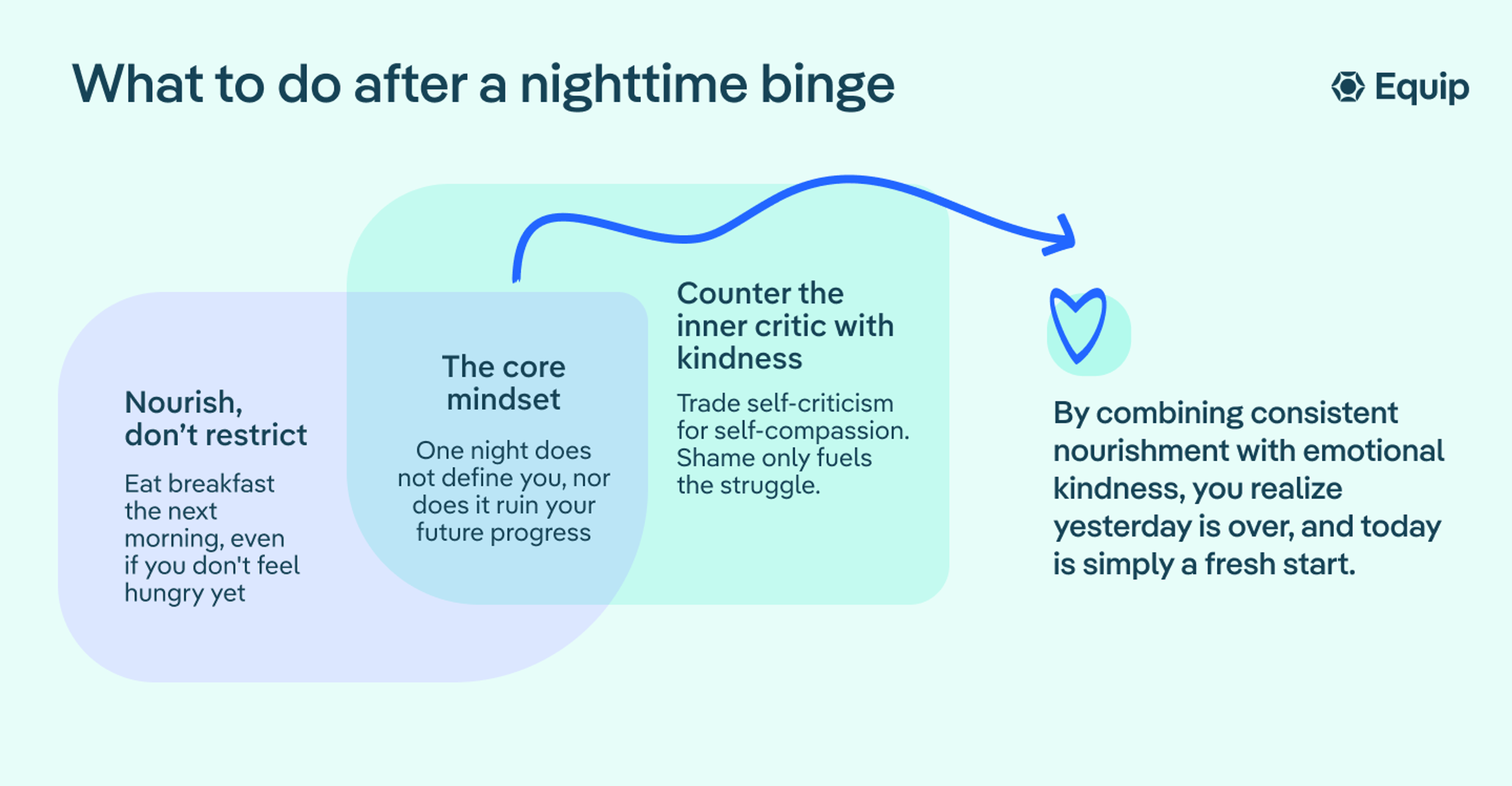
After a nighttime binge, one of the most important things you can do is be kind to yourself. That can start with interrupting any restriction.
“The absolute best advice I can give someone recovering from a night eating or binge eating episode the night before is to eat breakfast the next day, even if you are not hungry,” Dr. Simmons says.
Although easier said than done, absolving yourself of guilt and shame is also important. “Just because this happened last night doesn’t mean it has to continue happening,” Dr. Simmons says. “A single instance does not define you as a person, nor does it doom your future progress. We all deserve kindness and compassion, especially when we are struggling.”
When is nighttime binge eating an eating disorder?
Binge eating episodes, whether they occur at night or another time, are a disordered eating pattern. Binge eating is different from late-night snacking in that it feels uncontrollable and causes distress, such as feelings of shame or guilt. Binge eating episodes can also indicate that you or a loved one are dealing with an eating disorder.
You can take Equip’s free five-minute screener if you’re concerned that you may have an eating disorder, whether BED or another type.
Treatment for eating disorders usually involves a multidisciplinary approach, including therapy, nutritional guidance from a registered dietitian, eating disorder programs with peer support, and more.
A common misconception about eating disorder care is that it always involves inpatient or residential treatment, but that’s not the case. There are several levels of care for eating disorder treatment, including virtual options. What’s best for you or a loved one for binge eating treatment will depend on individual factors, such as symptoms and their severity, diagnosis, current health status, and more.
The bottom line
Nighttime binge eating episodes can signal a disordered eating pattern, especially if you’re feeling like you have no control around food and are dealing with significant shame or guilt regarding this.
“If you are experiencing any amount of distress around food,” Dr. Simmons says, “please know that you are not alone. It is always better to talk to a doctor, a loved one, or call a specialized treatment center like Equip. Our trained staff will listen to you without judgment and help advise you on the best next steps.”
As a final takeaway, she says, “Recovery is entirely possible! We see it every day here at Equip, and we can help provide you with the support and tools you need to work through whatever food difficulties you are facing.”
Speak to your medical provider or schedule a consultation with an Equip team member.
FAQ
Can eating more during the day actually reduce nighttime eating?
Yes, eating more during the day to meet your body’s nutritional requirements can reduce nighttime eating that typically occurs after dinner, before bed, or in the middle of the night. Restrictive diets during the day can lead to binge episodes or strong urges to eat, simply because your cells need nourishment to perform their functions, even at rest.
Should I skip breakfast after binge eating at night?
Skipping breakfast after binge eating at night can perpetuate the binge-restrict cycle, meaning that more restriction might lead to more binging. Eating breakfast the next day after a nighttime binge, along with lunch and dinner later, can actually help you interrupt the binge-restrict cycle. It’s also important to remember that your body needs food each day to function, regardless of what you ate yesterday.
Does nighttime binge eating go away on its own?
Nighttime binge eating, although not always related to an eating disorder, is a disordered eating pattern. Such patterns can be challenging to break without interventions. This is because complex underlying physiological and psychological factors trigger binge eating episodes. A multidisciplinary care team that specializes in disordered eating patterns can help you develop strategies to break the nighttime binge eating cycle.
Cassioli, Emanuele, et al. “Leptin Levels in Acute and Recovered Eating Disorders: An Arm‐Based Network Meta‐Analysis.” European Eating Disorders Review, vol. 33, no. 3, Dec. 2024, p. 525.
Chang, Rose Seoyoung, et al. “Stress-Induced Alterations in HPA-Axis Reactivity and Mesolimbic Reward Activation in Individuals with Emotional Eating.” Appetite, vol. 168, Sept. 2021, p. 105707.
Lavery, Megan E., and Deirdra Frum-Vassallo. “An Updated Review of Night Eating Syndrome: An Under-Represented Eating Disorder.” Current Obesity Reports, vol. 11, no. 4, Dec. 2022, pp. 395–404.
Nicolaides, Nicolas C., et al. “HPA Axis and Sleep.” Endotext, edited by Kenneth R. Feingold et al., MDText.com, Inc., 2000.
Reichenberger, Julia, et al. “Emotional Eating in Healthy Individuals and Patients with an Eating Disorder: Evidence from Psychometric, Experimental and Naturalistic Studies.” Proceedings of the Nutrition Society, vol. 79, no. 3, Aug. 2020, pp. 290–99.
Stojek, Monika, et al. “A Systematic Review of Attentional Biases in Disorders Involving Binge Eating.” Appetite, vol. 123, Apr. 2018, pp. 367–89.