Eating Disorder Therapy: What It Is, How It Works, and How to Find a Therapist


- Eating disorder therapy addresses the thoughts, emotions, and behaviors that keep an eating disorder going, usually alongside medical and nutritional care.
- Therapy is an essential part of eating disorder treatment, but it isn’t always the first step. Treatment generally starts with assessing your medical, nutritional, and psychiatric needs so your care team can decide what to address first.
- There’s no single “best” therapy for eating disorders. Approaches like enhanced cognitive behavioral therapy for eating disorders (CBT-E), family-based treatment, and others may be used depending on your diagnosis, age, symptoms, and medical needs.
- Eating disorder therapy can look different from general talk therapy. Sessions may include working directly on eating disorder behaviors, challenging rigid food- or body-related beliefs, practicing coping skills, and involving family members.
- Finding the right therapist matters. Look for someone with training and experience treating eating disorders who can also collaborate with the rest of your providers.

Eating disorder therapy is different from general talk therapy. It addresses the eating disorder directly while also making space for the experiences, emotions, and challenges wrapped up in it, according to Adriana Lindenfeld, MEd, a therapist at Equip.
So what does therapy for eating disorders actually look like? Here’s what to know about the different approaches, what happens in sessions, and how to find the right therapist.
What is eating disorder therapy?
Eating disorder therapy is specialized mental health care that helps people change the thoughts, behaviors, and patterns that contribute to an eating disorder, according to Advances in Psychiatry & Neurology. Unlike general talk therapy, it directly addresses eating disorder symptoms while also exploring things like emotions, relationships, body image, anxiety, and other factors that may be tied to the illness.
CBT-E
Eating disorder therapy can be more hands-on than you might expect, though what happens in sessions depends on the treatment approach.
Bek Urban thought eating disorder therapy would mean spending a lot of time talking about food and exercise. What she got was something much broader.
“Instead, my therapist worked with my dietitian to make sure those things were taken care of, which let us focus on other things in therapy: things like processing trauma, body image, fear of change, and practical day-to-day stuff about how life would be different in recovery,” says Urban, an Equip Research Intern.
In individual therapies like CBT-E, Lindenfeld says you might work with your therapist on:
- Identifying what triggers disordered behaviors like restriction, binge eating, purging, or food avoidance
- Challenging rigid food rules
- Working through body image concerns
- Exploring how anxiety, perfectionism, trauma, or low self-esteem may be connected to eating disorder symptoms
- Addressing relationship challenges or other stressors that may reinforce the eating disorder
- Practicing healthier ways to cope with difficult thoughts and emotions
Hands on resources for patients and families
FBT
In family-based treatment (FBT), sessions look different, particularly early on. Rather than working through these challenges directly with the young person, therapists primarily help caregivers support their child's recovery.
Importantly, therapy doesn’t involve telling someone their fears are irrational or convincing them to stop their behaviors. “We are trying to understand what function the eating disorder is serving and then help the person develop healthier ways of meeting those same emotional or psychological needs,” Lindenfeld says.
Eating disorder therapy is provided by licensed mental health professionals with specialized training in eating disorders. This may include psychologists, clinical social workers, and marriage and family therapists with the Certified Eating Disorder Specialist (CEDS) credential.
And because eating disorders affect both mental and physical health, therapy typically works alongside medical and nutritional care. “The goal isn’t simply to get someone to eat; it’s to restore adequate nutrition and medical stability so that the person is physically and psychologically able to participate meaningfully in treatment,” says Lindenfeld.
Why therapy usually isn't the first step in eating disorder treatment
Eating disorder treatment often starts with the basics: making sure someone is medically stable and restoring weight if needed. That’s because your nutritional and medical health can affect both what you need from therapy and how you can engage in therapeutic work.
“Eating disorders affect the brain and body simultaneously,” says Lindenfeld. “When someone is significantly malnourished, medically unstable, rapidly losing weight, purging frequently, or experiencing other medical complications, those issues need to be addressed alongside and sometimes before intensive psychological work. Malnutrition itself can also intensify anxiety, rigidity, obsessionality, depression, and difficulty thinking flexibly.”
Early on in treatment, there can be another barrier to therapy, too: anosognosia, or a lack of insight into having an illness or needing help.
“[Those with anosognosia] don’t believe they’re sick. This ambivalence can make it difficult to engage in one-on-one therapy and even more difficult to implement changes,” says Lainy Clark, MA, LPC, therapy lead at Equip. “Therapy [becomes] a bigger part of treatment when patients are weight-restored, and the anosognosia is no longer wreaking havoc.”
That’s not to say therapy is always put on hold until someone is medically stable or weight-restored. For adults, therapy typically begins alongside medical and nutritional care, though early sessions may focus heavily on supporting eating and interrupting eating disorder behaviors, per Neuroscience & BioBehavioral Reviews.
Family-based treatment (FBT) is the gold standard treatment approach for children, teens, and young adults with eating disorders. This type of therapy is mostly for the parents or caregivers, who will learn how to support adequate nutrition and interrupt eating disorder behaviors at home, according to research in Child Health Care.
What Equip treatment looked like for real patients


What happens in eating disorder therapy sessions?
Eating disorder therapy is more active and targeted than simply sitting down and talking about how you feel. Sessions often address eating disorder behaviors directly, while also helping you understand and change the thoughts, emotions, and patterns that keep them going.
What that looks like in practice depends partly on your age, diagnosis, and the treatment approach your therapist is using. For adults, Lindenfeld says that could mean:
- Early sessions: You’ll work with your therapist to understand your eating disorder patterns and begin making concrete changes, such as eating more regularly and monitoring eating disorder thoughts and behaviors.
- As treatment progresses: Sessions dig deeper into what’s keeping the eating disorder going. That might include rigid food rules, body image concerns, difficult emotions, low self-esteem, perfectionism, or relationship challenges.
- Later sessions: The focus shifts to maintaining your progress, preparing for setbacks, and making a plan to prevent relapse after treatment ends.
- Session length and frequency: This varies by therapy and individual needs. Some CBT-based treatments involve weekly, hour-long sessions over several months, per Current Obesity Reports. At Equip, the duration and length of your therapy sessions will adjust based on your needs, goals, and progress.
- Between sessions: Expect to put what you’re learning into practice. Depending on the approach, that might include monitoring eating patterns and related thoughts, completing exercises, or practicing new behaviors and coping skills.
FBT works differently. Rather than expecting a young person to manage the eating disorder on their own, therapy sessions are primarily for caregivers, who are in charge of renourishing their child and stopping disordered behaviors. Here’s what that looks like, according to Lindenfeld and research in Child Health Care:
- Early treatment: Sessions focus heavily on equipping caregivers to support nutrition and weight restoration, when needed. The young person is still part of treatment, but they aren’t expected to have the insight or motivation to drive their own recovery. They may not participate in therapy sessions, and that’s okay.
- As recovery progresses: Therapy helps the family gradually return responsibility around food to the young person, while also helping them build the skills and confidence to handle it.
- Later treatment: As the young person takes on more responsibility, sessions focus on building independence, getting back to age-appropriate activities and relationships, and helping the family prepare for challenges that may come up after treatment.
- Session length and frequency: FBT is typically delivered over six to 12 months, with more frequent sessions early in treatment.
- Between sessions: Much of the work happens at home. Caregivers put what they’re learning into practice by supporting meals, responding to eating disorder behaviors, and helping create an environment that supports recovery.
Whatever the format, the goal is collaboration, not judgment. “We want patients to understand that they are not their eating disorder,” says Lindenfeld. “By externalizing the illness, we can help patients separate their own identity and values from the disorder and work collaboratively to challenge its influence.”
Types of therapy used for eating disorders
There are several types of therapy for eating disorders, and no single approach is right for everyone. Which one your therapist recommends will depend on factors like your diagnosis, age, symptoms, and what seems to be keeping the eating disorder going.
And these approaches aren’t necessarily mutually exclusive. A therapist may draw from more than one depending on your needs, and the approach may change as treatment progresses.
Modality | Typically used for | What it focuses on | Evidence strength |
Enhanced cognitive behavioral therapy for eating disorders (CBT-E) | Primarily adults with anorexia, bulimia, binge eating disorder, and other eating disorders | Identifying and changing eating disorder behaviors and the thoughts and beliefs that reinforce them | Strong |
Family-based treatment (FBT) | Children and teens | Empowering parents or caregivers to support nutrition, interrupt eating disorder behaviors, and gradually return responsibility around food to the young person | Strong |
Dialectical behavior therapy (DBT) | People who struggle with intense emotions or use eating disorder behaviors to cope with them | Building skills for managing emotions, tolerating distress, staying present, and navigating relationships | Emerging for eating disorders |
Exposure and response prevention (ERP) | People with ARFID or another significant anxiety or fear around food, eating, weight, exercise, or related situations | Gradually facing feared foods or situations while practicing not responding with eating disorder behaviors | Emerging for eating disorders |
Temperament-based therapy with supports (TBT-S) | Primarily adults with anorexia, bulimia, and ARFID | Understanding temperament and brain-based traits that may contribute to eating disorder symptoms and finding more productive ways to work with them | Emerging |
Interpersonal psychotherapy (IPT) | Most established for bulimia and binge eating disorder | Addressing relationship and interpersonal difficulties that may contribute to or maintain eating disorder symptoms | Strong for some eating disorders |
Acceptance and commitment therapy (ACT) | May be used across eating disorder diagnoses, often alongside other approaches | Learning to respond differently to difficult thoughts and feelings while taking actions that align with your values | Emerging |
Which type of therapy is right for which eating disorder?
The best therapeutic approach depends on the person, not just the eating disorder they have. Providers consider your diagnosis, age, medical needs, co-occurring conditions (like anxiety, depression, or OCD), family dynamics, and preferences when deciding where to start.
“There isn’t a simple ‘one diagnosis = one therapy’ formula,” Lindenfeld says. “Two people with the same diagnosis can have very different maintaining factors, and therefore need different therapeutic strategies.”
Still, certain approaches are more commonly used for particular eating disorders and age groups:
- Anorexia nervosa: For children and teens, family-based treatment is a common approach. Adults, on the other hand, often receive anorexia therapy via approaches like CBT-E alongside nutritional and medical care.
- Bulimia nervosa: Family-based treatment can also be effective for children and teens with bulimia. For adults, CBT-E and other forms of eating disorder-focused CBT target binge eating, compensatory behaviors, and the patterns that keep them going.
- Binge eating disorder (BED): For adults, CBT and interpersonal psychotherapy for eating disorders are common evidence-based options, says Lindenfeld. FBT is usually the default for children and teens, though CBT-based approaches can also be used (with family involvement when appropriate), per the Child and Adolescent Psychiatric Clinics of North America.
- ARFID: CBT-AR and exposure-based approaches like ERP can help ARFID patients of all ages address the specific fears or other factors driving food avoidance or restriction, per Current Pediatric Reports. Children and teens may also benefit from FBT-ARFID, with caregivers taking an active role in treatment.
- OSFED: For both adults and young people, treatment generally follows the evidence-based approach for the eating disorder their symptoms most closely resemble, according to World Psychiatry.
How eating disorder therapists work with the rest of the care team
“Ideally, eating disorder treatment is multidisciplinary: a therapist, dietitian, medical provider, and, when appropriate, psychiatrist work together rather than treating the eating disorder in separate silos,” Lindenfeld says.
Depending on your needs, your care team may include:
- Therapist: Addresses the thoughts, emotions, and behaviors connected to the eating disorder and helps you build skills to support recovery.
- Dietitian: Helps you meet your nutritional needs, establish more consistent eating patterns, and work through challenges around food.
- Medical provider: Monitors your physical health and manages medical complications.
- Psychiatrist: Evaluates and treats co-occurring mental health conditions and may prescribe and manage medications when appropriate.
- Family or peer coach: Offers practical support and perspective based on lived experience with an eating disorder or supporting a loved one through recovery.
- Parents or caregivers: May take an active role in putting the treatment plan into practice at home.
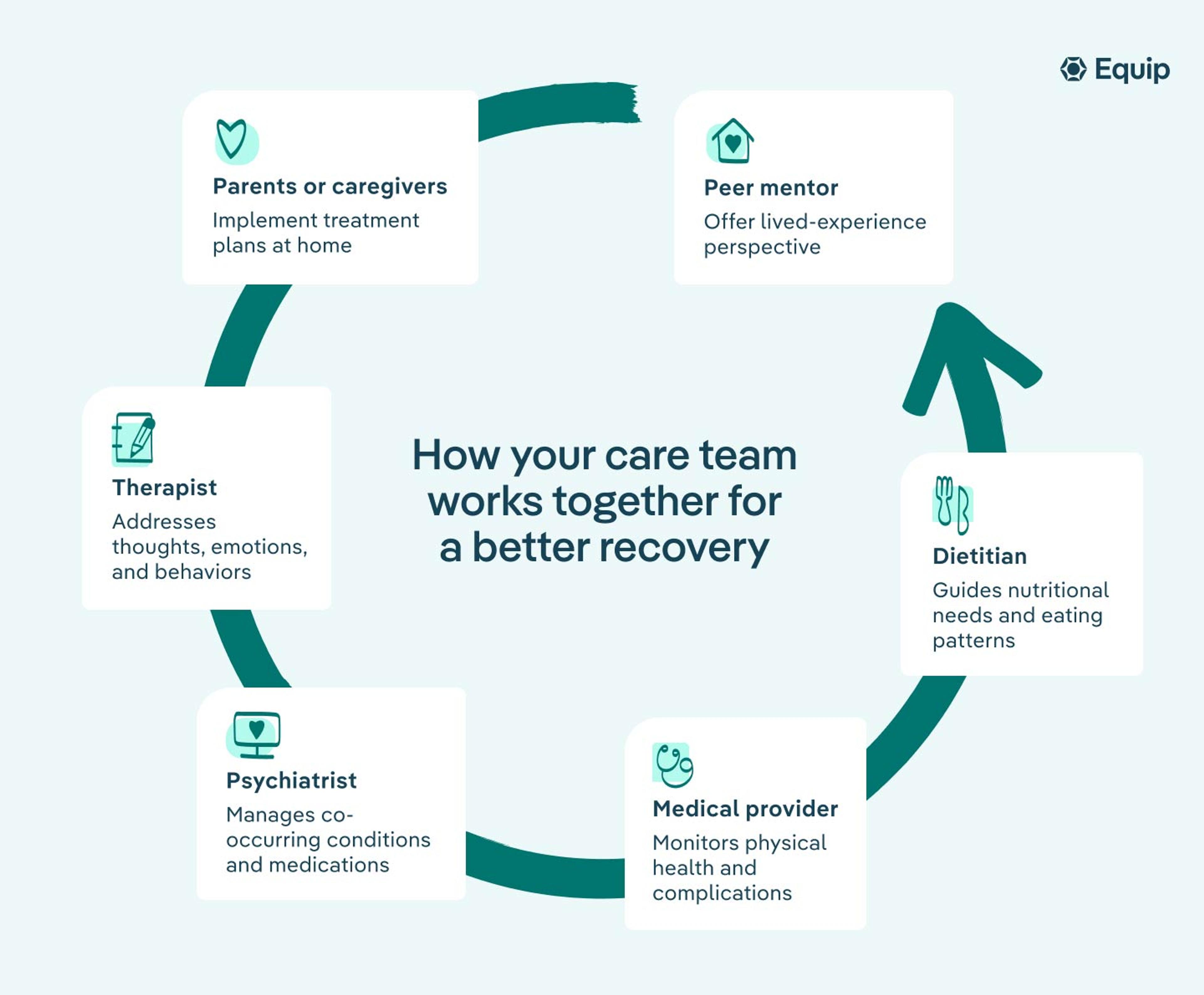
Working together allows your team to adjust treatment as your needs change. At Equip, every patient has a dedicated therapist, dietitian, medical provider, and coaches who collaborate closely so changes in one area of care can inform the others.
How long does eating disorder therapy take — and does it work?
Eating disorder therapy can take several months or longer, but there’s no universal timeline. Levels of care for eating disorders depend on factors like your diagnosis, symptoms, medical health, age, how long you’ve had an eating disorder, and how you respond to treatment, according to Lindenfeld.
Some evidence-based therapies do offer a rough framework. For example, CBT-E typically involves about 20 sessions over 20 weeks for adults who aren’t significantly underweight and about 40 sessions over 40 weeks for those who need to restore their weight, says Lindenfeld. FBT treatment for anorexia often takes place over roughly six to 12 months, per the Psychiatric Clinics of North America.
Research shows that these therapies can lead to meaningful improvement, but outcomes vary widely. In a review in Neuroscience & Biobehavioral Reviews, remission rates at the end of treatment ranged from about 40% to 60%.
A Journal of Eating Disorders study of FBT for teens with restrictive eating disorders also found promising results: About 75% of patients restored their weight, and nearly half both restored their weight and no longer had behavioral symptoms.
Recovery is gradual, and you’ll likely start to notice signs of progress long before treatment ends.. “Some people begin noticing changes relatively early, sometimes within the first several weeks, particularly when they start eating more consistently, interrupting behaviors, or experiencing a reduction in bingeing or purging,” Lindenfeld says.
But early progress doesn’t mean recovery is complete, or that it will be linear. Someone may stop bingeing or purging while still struggling with body image, for example, or restore weight while continuing to experience strong eating disorder thoughts.
“A difficult week or resurgence of symptoms doesn’t mean treatment has failed,” Lindenfeld says. “The goal is not perfection; it’s developing the ability to respond differently when the eating disorder inevitably gets loud again.”
If you’re not noticing progress—or therapy doesn’t feel like a good fit—talk with your treatment team. They can reassess what’s getting in the way and whether the approach, level of support, or treatment plan needs to change.
How to find an eating disorder therapist
Finding the right therapist starts with looking for someone who has experience treating eating disorders, not just general experience with mental health or nutrition. Keep an eye out for the CEDS credential, which signals a therapist who specializes in eating disorders.
You can start by asking your doctor or another member of your care team for a referral or searching an eating disorder provider directory. You can also search through your insurance company’s website to find in-network providers (or use our screener to see if Equip is in-network). Virtual eating disorder treatment is an effective option if you’d prefer not to commute to appointments or there aren’t specialists nearby.
When considering a therapist, ask questions like:
- What is your training?
- How much experience do you have treating eating disorders?
- Do you regularly treat my specific eating disorder or symptoms?
- Which types of eating disorder therapy do you use, and why?
- How do you work with dietitians, medical providers, and other members of a treatment team?
- How do you involve parents or caregivers when appropriate?
- Do you treat co-occurring conditions?
- How do you measure progress and decide when treatment needs to change?
Credentials matter, but so does feeling comfortable with your therapist. You should feel heard, respected, and safe asking questions—even when the work itself feels hard.

Of course, finding the right fit isn’t always simple. Cost and availability can limit your options, especially when you need specialized care. If a therapist you’re interested in doesn’t accept insurance coverage for eating disorder treatment, ask about out-of-network benefits, sliding-scale fees, or other ways to make care more affordable.
And if you’re still figuring out whether what you’re experiencing could be an eating disorder, that’s okay, too. This free eating disorder screener can help you better understand what’s going on and whether it may be time to reach out for support.
The bottom line
Eating disorder psychotherapy can be a powerful part of recovery, helping you change the behaviors and thought patterns that keep the eating disorder going. Alongside nutritional, medical, and family support, it can help you build healthier ways to cope and move forward.
There’s no single therapy or timeline that works for everyone. Recovery takes time, but the right care team can meet you where you are and adapt as your needs change.
FAQ
Can therapy alone treat an eating disorder?
Usually, eating disorder treatment involves more than therapy. Because eating disorders affect both physical and mental health, treatment may also include nutritional support, medical monitoring, and medication when appropriate. Children and teens may also need significant support from parents or caregivers.
What's the difference between CBT and CBT-E?
CBT, or cognitive behavioral therapy, helps people identify and change unhelpful patterns in their thoughts and behaviors, according to BioPsychoSocial Medicine. CBT-E, or enhanced cognitive behavioral therapy, is a version specifically developed to treat eating disorders and focuses on the patterns that keep eating disorder symptoms going.
What if my therapist doesn't specialize in eating disorders?
A therapist who doesn’t specialize in eating disorders may still be able to support other parts of your mental health, but eating disorder treatment typically requires specialized knowledge. Consider asking whether they have experience treating eating disorders and whether they can collaborate with an eating disorder dietitian, medical provider, or specialist.
- Aires, M. L. et al. “Interpersonal Psychotherapy (IPT) for Eating Disorders: A Literature Review.” European Psychiatry vol. 68,Suppl 1 S1055–S1056. 26 Aug. 2025, doi:10.1192/j.eurpsy.2025.2136
- Bentz, Mette et al. “An evaluation of family-based treatment for restrictive-type eating disorders, delivered as standard care in a public mental health service.” Journal of eating disorders vol. 9,1 141. 29 Oct. 2021, doi:10.1186/s40337-021-00498-2
- Bohon, Cara. “Binge Eating Disorder in Children and Adolescents.” Child and adolescent psychiatric clinics of North America vol. 28,4 (2019): 549-555. doi:10.1016/j.chc.2019.05.003
- Brigham, Kathryn S et al. “Evaluation and Treatment of Avoidant/Restrictive Food Intake Disorder (ARFID) in Adolescents.” Current pediatrics reports vol. 6,2 (2018): 107-113. doi:10.1007/s40124-018-0162-y
- Costandache, Gina I et al. “An overview of the treatment of eating disorders in adults and adolescents: pharmacology and psychotherapy.” Postepy psychiatrii neurologii vol. 32,1 (2023): 40-48. doi:10.5114/ppn.2023.127237
- Forsberg, Sarah et al. “Family-based treatment for pediatric eating disorders: Evidence and guidance for delivering integrated interdisciplinary care.” Children's health care : journal of the Association for the Care of Children's Health vol. 52,1 (2023): 7-22. doi:10.1080/02739615.2021.1984240
- Gorrell, Sasha et al. “Family-based Treatment of Eating Disorders: A Narrative Review.” The Psychiatric clinics of North America vol. 42,2 (2019): 193-204. doi:10.1016/j.psc.2019.01.004
- Grilo, Carlos M, and Adrienne Juarascio. “Binge-Eating Disorder Interventions: Review, Current Status, and Implications.” Current obesity reports vol. 12,3 (2023): 406-416. doi:10.1007/s13679-023-00517-0
- Knatz Peck, Stephanie et al. “Temperament-based treatment for young adults with eating disorders: acceptability and initial efficacy of an intensive, multi-family, parent-involved treatment.” Journal of eating disorders vol. 9,1 110. 8 Sep. 2021, doi:10.1186/s40337-021-00465-x
- Merwin, Rhonda M et al. “Acceptance and Commitment Therapy for Eating Disorders.” The Psychiatric clinics of North America vol. 48,3 (2025): 521-535. doi:10.1016/j.psc.2025.02.007
- Monteleone, Alessio Maria et al. “Treatment of eating disorders: A systematic meta-review of meta-analyses and network meta-analyses.” Neuroscience and biobehavioral reviews vol. 142 (2022): 104857. doi:10.1016/j.neubiorev.2022.104857
- Nakao, Mutsuhiro et al. “Cognitive-behavioral therapy for management of mental health and stress-related disorders: Recent advances in techniques and technologies.” BioPsychoSocial medicine vol. 15,1 16. 3 Oct. 2021, doi:10.1186/s13030-021-00219-w
- Reilly, Erin E et al. “Dialectical behavioral therapy for the treatment of adolescent eating disorders: a review of existing work and proposed future directions.” Eating disorders vol. 28,2 (2020): 122-141. doi:10.1080/10640266.2020.1743098
- Steinglass, Joanna E et al. “Confronting fear using exposure and response prevention for anorexia nervosa: A randomized controlled pilot study.” The International journal of eating disorders vol. 47,2 (2014): 174-80. doi:10.1002/eat.22214