My Loved One Has an Eating Disorder But Refuses Treatment. What Should I Do?


- Your loved one with an eating disorder may refuse treatment, not out of stubbornness, but because of complex brain changes that make recognition of the problem difficult.
- When someone has an eating disorder, disordered behaviors may also feel aligned with their values, so they may be resistant to change.
- Using nonjudgmental communication with “I” messages can open the lines of communication, but you may still notice resistance at first.
- Although challenging, your persistence is crucial: Those with eating disorders may not seek help on their own, and early intervention is best.

Helping someone with an eating disorder can be difficult, to say the least. You have to wade through the noise to find high-quality treatment, and even then, your loved one may resist your help.
While you’re focused on their best interests, the eating disorder may have caused cognitive changes that make your loved one see their behaviors as normal, or even positive. Getting them help as soon as possible, however, is important. Earlier intervention is associated with better outcomes and fewer complications. At the same time, the harder you push, the harder they may resist. But don’t despair and, above all, don’t give up.
If your loved one refuses eating disorder treatment, keep reading. First, we’ll explain why they might resist treatment. Then we’ll discuss various strategies to help encourage your loved one to seek the care they need. Whether you’re supporting a child, a teen, or an adult with an eating disorder, these tips will help you help them, even if that’s not initially what they want.
Understanding why someone might refuse treatment
Two words help explain why people with eating disorders may resist treatment: anosognosia and egosyntonia. Both terms are tongue-twisters, but their straightforward definitions shed light on why eating disorders are not a matter of choice or stubbornness. Instead, they are serious and complex mental illnesses.
Anosognosia | Egosyntonia | |
What it is | A medical condition in which someone is unaware of their mental or physical illness, often due to complex brain changes | When symptoms, behaviors, and thoughts feel aligned with personal values and identity |
What it sounds like | Refusing treatment and using phrases such as, “I am not sick,” “I don’t know why everyone is making a big deal out of this,” and “you’re trying to control me” | Championing or defending harmful behaviors with phrases like “I’m just being healthy,” “I’m disciplined,” and “this is my lifestyle” |
Anosognosia: when someone doesn’t know they are sick
Anosognosia is a medical condition in which someone is unaware of their mental or physical illness. The condition typically results from complex brain changes.
“Anosognosia is a common eating disorder symptom,” says Lainy Clark, MA, LPC, lead therapist at Equip. “It’s also referred to as a ‘lack of insight,’ and results in a person’s inability to recognize the need for help.”
“Without any intention to do so, many patients automatically go to minimizing symptoms and the need for intervention,” says Jenna Robinow, LMSW, another therapist at Equip.
She adds, “Part of anorexia, for example, is ambivalence toward its negative impact on a person’s health. Malnutrition gets in the way of clearly seeing the urgency of getting treatment. In that sense, it can be unfair to assume that someone in the throes of an eating disorder is going to be on board from the start.”
Someone with anosognosia isn’t trying to be difficult. Instead, the eating disorder can cause regions in their brain to actually change, impairing their ability to see themselves objectively. This can help explain why approaches like family-based treatment (FBT)—in which the person with the eating disorder doesn’t need to be aware of their condition in order to benefit from the treatment—are particularly effective.

Egosyntonia: alignment with the eating disorder
Eating disorders can sometimes be egosyntonic, which means they feel aligned with a person’s self-image, values, and feelings. While your loved one’s true values may be completely opposed to those of their illness, eating disorders are brain disorders, and brain distortions can make them feel aligned with the values of their disease. If egosyntonia is present, your loved one might know that they have an eating disorder, but not want to recover from it.
Given the stranglehold an eating disorder has on the mind, the alignment of eating disorder behaviors with personal values can be quite powerful.
Additionally, society tends to praise weight loss and thinness, and this praise can reinforce the idea that eating disorder behaviors are healthy and desirable.
How treatment resistance might show up
Resistance to eating disorder treatment can manifest in many ways. You may notice emotional, behavioral, physical, or psychological signs and symptoms, or some combination of several or all of these.
In some cases, your loved one may have outbursts, try pleading, or give the silent treatment in response to attempts to help them seek treatment. While these responses can be difficult to encounter and navigate, you’re not alone in facing them.
“The most common form of resistance is emotional dysregulation, which can result in pushback, outbursts of anger or rage, and crying,” Clark says. She adds that your loved one might also show an unwillingness to participate in treatment sessions or display aggression or increased hostility toward others.
Many patients may plead to get out of treatment by promising to attempt recovery on their own, says Tanya Hargrave-Klein, MS, RDN, lead eating disorder dietitian at Equip. Others may throw food, curse at their support network, or shut out concerned loved ones completely.
“This might include not returning text messages, not answering their phone, or not acknowledging support people in person,” she adds.
This type of opposition occurs quite often. “It’s expected for someone with an eating disorder to experience resistance to engaging in treatment,” she says. “It’s also very typical for them to want treatment one moment and then be opposed to it the next moment.”

How to talk to someone who doesn’t want help: a communication toolkit
Trying to talk to someone who doesn’t want help for their eating disorder can be a difficult and delicate endeavor. The most important things to prioritize in these conversations are compassion, patience, and nonjudgment. Here are some tips to communicate gently and effectively:
- Educate yourself. Lean in to resources like the Equip blog, F.E.A.S.T. and Project Heal to empower yourself with critical information and facts about what your loved one may be going through and how you can most effectively help them.
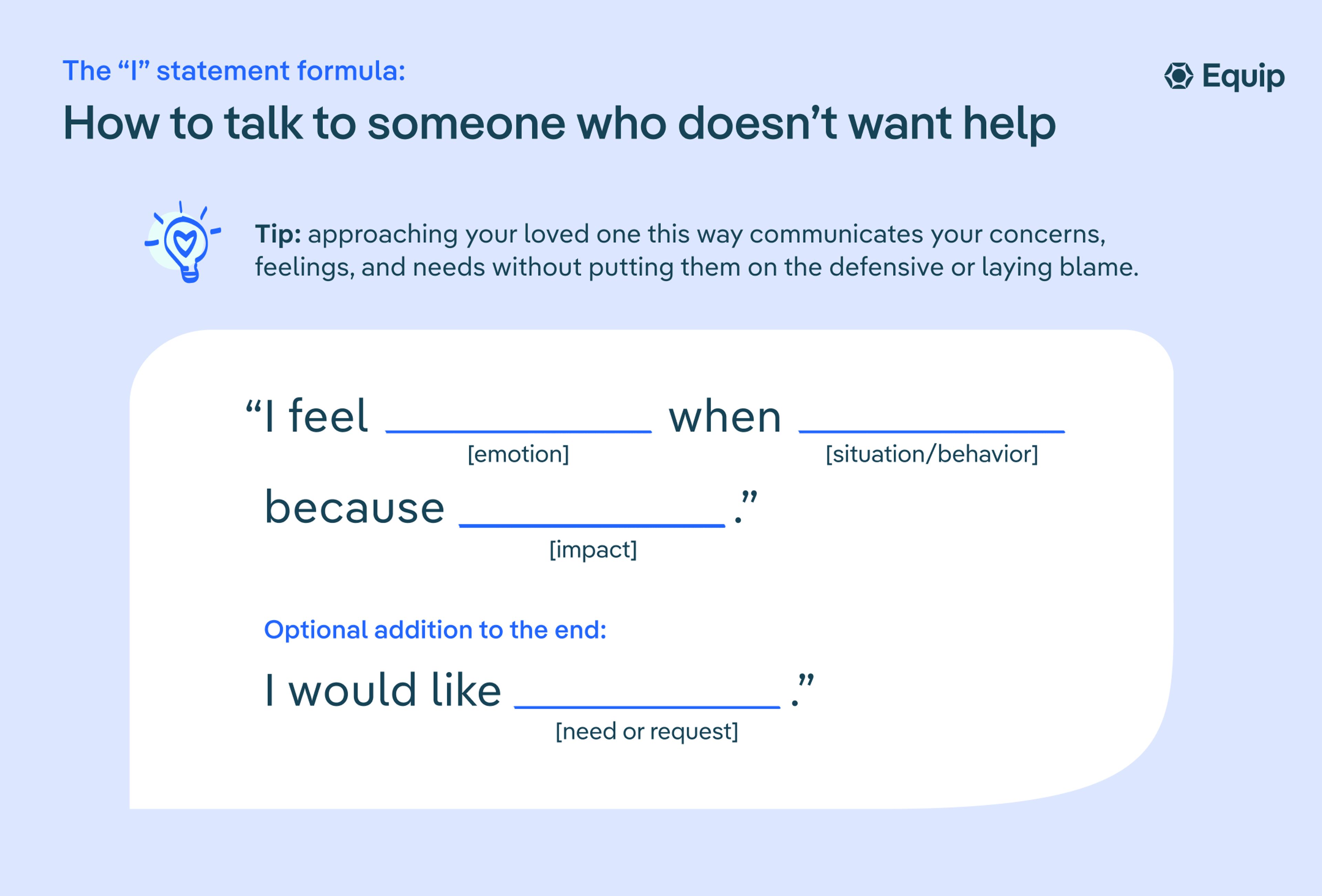
- Use kind, compassionate language. Approach your loved one with “I” messages, which can help you communicate your concerns, feelings, and needs without putting blame on the listener. Such statements typically follow this structure: “I feel (emotion) when (situation/behavior) because (impact)” and may also include “I would like (need or request).”
- Avoid confrontations or ultimatums. Rather than abruptly or unexpectedly confronting your loved one or using accusatory statements, express what you’ve noticed and why it concerns you.
- Gently offer treatment resources. Let your loved one know that help is available if they are willing. Offer your own support and guidance in making those connections, but don’t force or shame your loved one into taking advantage of your assistance.
- Model a healthy and enjoyable relationship with food to set an example as something to strive towards.
Myth vs. facts
Before approaching your loved one, it can be helpful to reframe your mindset and dispel any myths you may have heard about eating disorders. Knowing these facts may also help you communicate to your loved one that they deserve help:
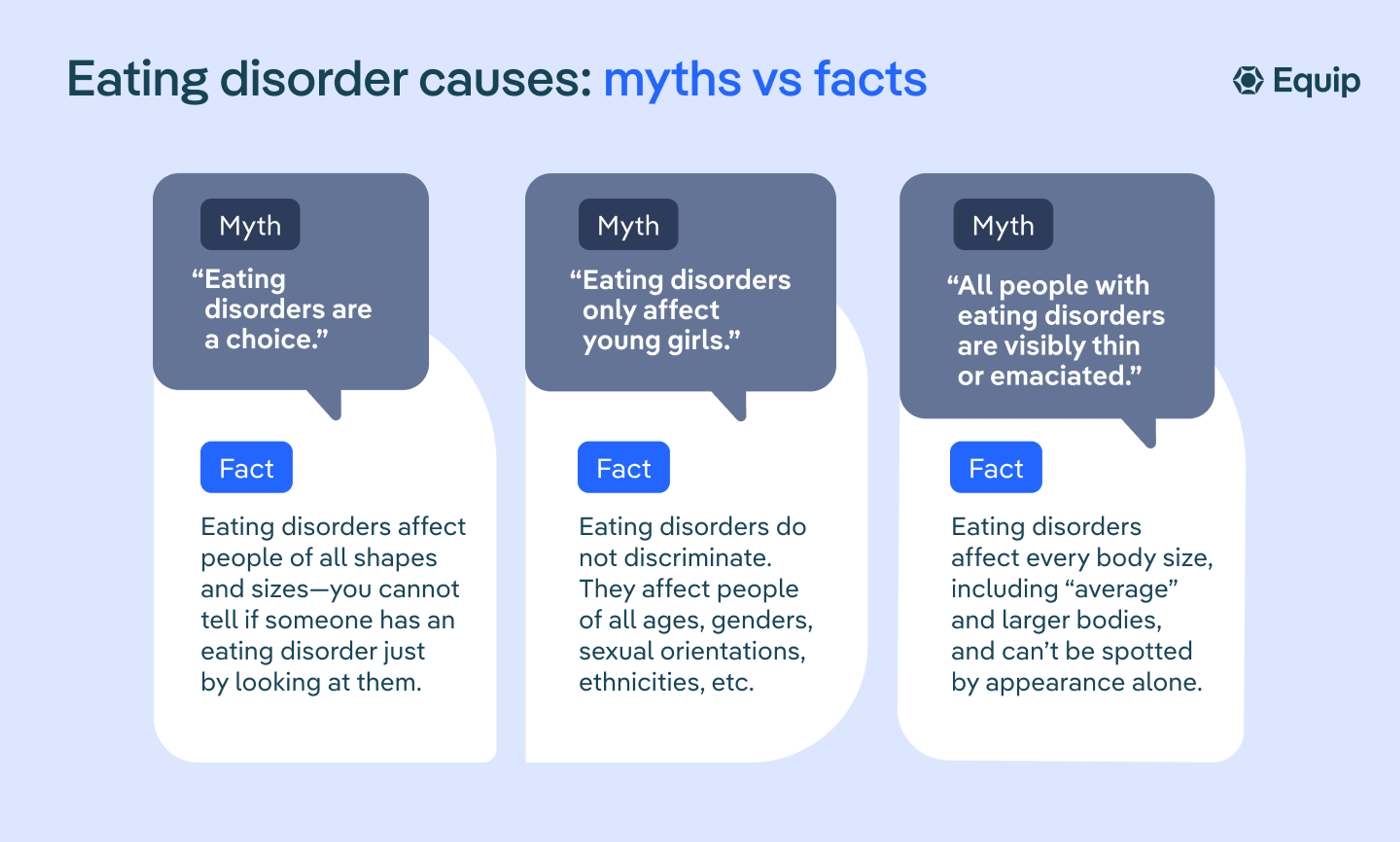
Myth: All people with eating disorders are visibly thin or emaciated.
Fact: Eating disorders can affect people of all shapes and sizes, including those in “average” and larger bodies. You cannot tell if someone has an eating disorder by looking at them.
Myth: Eating disorders are a choice.
Fact: Eating disorders are complex psychological illnesses influenced by a combination of genetics, environment, and psychosocial factors. There is no single cause of eating disorders, and they have nothing to do with choice, vanity, or attention-seeking.
Myth: Eating disorders only affect young girls.
Fact: Eating disorders do not discriminate. They affect people of all ages, genders, sexual orientations, ethnicities, etc.
Practical steps to encourage treatment
Understanding eating disorders is the first step in communicating to your loved one that they need help; having that conversation is next. So what do you do if someone you love refuses eating disorder treatment? You won’t find a one-size-fits-all strategy, but some tried-and-true tactics can help you gently encourage someone who is struggling.
Acknowledge their feelings and concerns
“It’s helpful to acknowledge what you are observing and validate your loved one’s feelings,” Hargrave-Klein says. “That might sound something like, ‘I can see that you don’t want to start treatment. That makes sense because it feels scary, and because you don’t know what to expect, and because it isn’t something your friends are having to do.’”
You can empathize with their experience while still encouraging eating disorder treatment. Express that you care about them and their feelings, and validate how hard it must be.
Use open and honest communication
Talking about eating disorders can be difficult, but treatment requires ongoing conversation. To open up the discussion, come prepared. Educate yourself about the various eating disorder treatment options, as well as the psychological components of eating disorders that can make treatment feel scary.
“Help your loved one fact-check or reframe some of their greatest fears about stepping into treatment,” Robinow advises. “Processing and getting curious about their resistance may diffuse some of their fears, which feel enormous in their head but may be broken down into more manageable hurdles that can be overcome with support.”
As your loved one talks, listen without judgment. This strategy increases the likelihood they’ll continue talking to you or even initiate a conversation with you on another day. Remember, this kind of talk isn’t a one-and-done discussion—you may need to have several conversations together, so don’t get discouraged if the first few c don’t go far, and keep the lines of communication open.
It can also be useful to share something your loved one always used to love before the eating disorder, but is no longer engaging in. This can help illuminate other values outside of the eating disorder, especially for people who are experiencing egosyntonia.
Problem-solve collaboratively
Work with your loved one to come to a solution rather than trying to force them toward treatment. Do so by expressing your concerns in a nonjudgmental way and allowing unconditional space for them to express their feelings. Then work together to find a plan you both feel better about.
“Don't assume you know how your loved one is feeling,” Robinow says. “Using ‘I’ statements, tell them what you are noticing in their behavior and allow them to tell you what their internal experience is like. This may support a more collaborative effort.”
It’s also important to note that if your loved one is a minor, they do not have to be fully on board with treatment for you to get them help. Often, young people begin treatment with resistance, and may even refuse to participate once care begins, but with an evidence-based approach like family-based treatment (FBT), treatment is still effective regardless of patient buy-in. Learn more about FBT and what it looks like at Equip.
When your loved one is an adult: navigating legal and medical crises
When you’re helping an adult loved one who refuses eating disorder treatment, you may need to consider a variety of unique legal obstacles.
According to Equip’s Director of Psychiatry, Maria C. La Via, MD, adults are able to consent to treatment for themselves and, conversely, are able to refuse treatment as well. “This includes refusing to see a primary care or other medical provider as well as a mental health provider for assessment and/or treatment,” she says. “Adults are able to refuse recommendations provided regarding treatment, which can often be frustrating for loved ones.”
Anyone navigating this situation may wonder what the legal options are for helping an adult who refuses treatment. Dr. La Via says she always recommends speaking with an attorney who works with adults who may not be making good decisions about treatment. “This may include issues around competency,” she says.
You can look at your state’s bar association website to find a local attorney who can help. The National Alliance on Mental Illness (NAMI) can also assist you with finding the right legal resources.
“There is also the option of pursuing involuntary treatment,” Dr. La Via says. “This goes by different names in each state, and it involves submitting paperwork through the court system to have an individual evaluated for an involuntary hold and decision about involuntary treatment.”
If an adult loved one is on the verge of, or is experiencing, a medical crisis as a result of their eating disorder, you have options. “Your first course of action would be to reach out to their primary care provider to express concern and to ask for recommendations,” she says.
She adds, “You can also encourage your loved one to make an appointment to see their PCP. While the loved one’s primary care office may not be able to share specifics on their particular situation, you can always share your concerns, even without a release of information from the identified patient.”
In the event of an urgent or emergent health crisis, encourage your loved one to go to either urgent care or the ER, and ideally accompany them to either. “If your loved one refuses to go voluntarily and you are still concerned, you should call 911 and explain the immediate concerns,” says Dr. La Via.
Dr. La Via emphasizes the importance of patience and empathy when supporting an adult loved one who is resistant to treatment. “Let them know that you understand how difficult it can be to pursue treatment and that you are there to support them in any way that you can,” she says.
“Ask or offer to speak with members of their treatment team or to help them find a treatment team if they don't have one,” she adds. “Get educated about eating disorders, read about risks and treatment options, reach out to providers to get information. Consider therapy for yourself to help you manage the distress of supporting a loved one who is struggling with an eating disorder.”
Ready to take the first step?
Understanding the importance of early intervention
No matter how reluctant your loved one may be about treatment, keep trying. Research shows that the sooner someone enters treatment, the less likely they are to struggle long-term with an eating disorder. Early intervention also increases the odds of a full recovery and encourages help-seeking behaviors.
Preventing caregiver burnout
Caregiver burnout is also a recognized concern that can lead to anxiety, depression, fatigue, and a decrease in quality of life and overall well-being. The following strategies and resources can help.
You cannot pour from an empty cup: support for the caregiver
In many cases, caregivers give everything they have to their loved ones, often at the expense of their own well-being and the well-being of the rest of their family. Caring for someone with an eating disorder who refuses treatment can be mentally, emotionally, and physically draining, and it’s absolutely okay and expected that you might feel difficult emotions like anger, exhaustion, and frustration.
While you may feel guilt or shame for needing a break, or feel helpless if your efforts are met with resistance, your well-being is just as critical as that of your loved one, and you deserve help and support too.
Equip understands the stress that many caregivers are under, which is why we provide care and resources for the entire family system. Family members receive their own support through caregiver coaches (people with lived experience supporting a loved one), support groups with others navigating similar experiences, and helpful content for overcoming recovery challenges (like supporting a loved one through meals).
Advocacy and support networks
You don’t have to go through this alone. Advocacy and eating disorder support groups can provide education and help you realize you’re not the only one facing resistance while helping someone with an eating disorder. Also, many people find it beneficial to hear what worked for others.
Here are some resources for ongoing support and education:
You can also sign up for the Equip newsletter to learn about support group opportunities and get information and resources on helping someone with an eating disorder.

The bottom line: have hope
When your loved one refuses eating disorder treatment, you may feel scared, frustrated, or unsure what to do next. But know that resistance is common, and it’s important not to give up. Your support is key to helping them recover.
Keep the conversation about treatment open. You can validate their experience and concerns while also educating them about the very real risks of eating disorders and the various treatment options available.
You can also help them find providers, make appointments for them, or give them rides to appointments to help reduce any friction or excuses for not getting help. No matter what, be persistent, because the sooner your loved one enters treatment, the better.
FAQ
What are common reasons why someone might refuse treatment for an eating disorder?
Someone might resist treatment for an eating disorder for a number of reasons. These may include that they don’t think they are ill, or they believe the eating disorder aligns with their self-image, values, and feelings, so they want to keep it. They might also have fears around entering treatment.
What should I say to someone who refuses eating disorder treatment?
You can start by maintaining open and nonjudgmental communication. Use an “I” message: “I feel (emotion) when (situation/behavior) because (impact),” and “I would like (need or request).”
Can someone recover from an eating disorder without professional help?
Although rare, recovering from an eating disorder without professional help is possible. The best chances of recovery occur with professional treatment from a knowledgeable care team. Additionally, the health risks are greater for someone trying to go it alone.
Are there effective treatments for eating disorders that don’t require patient buy-in?
The most effective treatment that doesn’t require patient buy-in is family-based treatment for eating disorders (FBT). In this modality, which is developed for children, teens, and young adults with eating disorders, a professional teaches the caregivers how to help their child regain weight (if necessary) and reduce their symptoms. This empowers parents to be active in their child’s recovery and take the reins initially to decide what their child eats and to stop disordered behaviors. In some cases, FBT-TAY, a related modality that focuses on transition-age youth, is more appropriate for teens and young adults.
Can I legally force my adult child into eating disorder treatment?
In most cases, you cannot legally force an adult child into eating disorder treatment, but there are exceptions. Depending on their mental and physical state and local laws, you may have the option to pursue involuntary treatment, which involves submitting paperwork through the court system to have an individual evaluated for an involuntary hold and to make the decision about involuntary treatment.
How should I handle mealtimes when they are refusing to eat what I've served?
Remain calm but firm when offering your loved one meals. Communicate that you are not intending to fight with them or make them angry or upset; you are doing what you know will help them fight their illness. Ensure that you have the support you need to navigate difficult mealtimes by seeking out a therapist with eating disorder knowledge and experience, and/or support groups.
What if my loved one agrees to treatment but then doesn't fully participate?
Ambivalence is a common component of eating disorder recovery. Because eating disorders can be egosyntonic, those affected may not want to recover. While this feeling is a symptom of the eating disorder itself, it feels real and legitimate to the person struggling. It’s important to acknowledge your loved one’s efforts but to let them know you’ve noticed their lack of participation and you worry it might undermine their recovery. If possible and allowed, consider communicating with their treatment team to find out additional ways you can offer your support and guidance.
Hands on resources for patients and families
References
- Acharya AB, Sánchez-Manso JC. Anosognosia. [Updated 2022 Jun 7]. In: StatPearls [Internet]. Treasure Island (FL): StatPearls Publishing; 2023 Jan-. https://www.ncbi.nlm.nih.gov/books/NBK513361
- Gregertsen, Eva C et al. “The Egosyntonic Nature of Anorexia: An Impediment to Recovery in Anorexia Nervosa Treatment.” Frontiers in psychology vol. 8 2273. 22 Dec. 2017. doi:10.3389/fpsyg.2017.02273
- Klein, David A et al. “Eating Disorders in Primary Care: Diagnosis and Management.” American Family Physician vol. 103,1 (2021): 22-32. https://www.aafp.org/pubs/afp/issues/2021/0101/p22.html
- Hyam, Lucy et al. ““Early intervention isn't an option, it's a necessity”: learning from implementation facilitators and challenges from the rapid scaling of an early intervention eating disorders programme in England.” Frontiers in Health Services vol. 3 (2023). doi:10.3389/frhs.2023.1253966
- Koreshe, Eyza et al. “Prevention and early intervention in eating disorders: findings from a rapid review.” Journal of Eating Disorders vol. 11, 38 (2023). doi:10.1186/s40337-023-00758-3