Anorexia Treatment: What Works, What to Expect, and How Recovery Begins


- Treatment for anorexia nervosa looks a little bit different for everyone, based on individual needs.
- Anorexia nervosa treatment might be inpatient, outpatient, or fall somewhere in between, and virtual options may be an appropriate choice
- The types of therapy involved include evidence-based methods, such as FBT and CBT-E. Nutritional support and medical monitoring also play key recovery roles.
- Treatment is available and recovery is possible with the help of a knowledgeable multidisciplinary care team.

If you’re looking into treatment options for anorexia nervosa (AN) for yourself or a loved one, the possibilities can get confusing. And taking the first step toward seeking treatment can feel scary, simply because you may not know what to expect—and change can be hard.
Let’s reflect on that second part for a moment. Neuroscience shows that malnutrition directly impacts the brain, increasing cognitive rigidity and making disordered thoughts and behaviors around food, exercise, and body image deeply entrenched. This is why professional treatment is so crucial: Disordered thoughts and behaviors around food, exercise, and body image become so ingrained that they’re hard to change without help from experts who understand the psychology and underlying causes of eating disorders.
Despite these challenges, change is necessary because anorexia nervosa is a serious mental health condition, as noted in the Diagnostic and Statistical Manual of Mental Disorders, Fifth Edition, Text Revision (DSM-5-TR).
A common misconception regarding eating disorder care is that you have to wait for serious health effects to show up before seeking help. You don't need to reach a medical crisis to deserve care—anorexia nervosa is a serious condition from the moment symptoms begin. It can take a heavy toll on mental health and well-being long before physical signs show up, and symptoms tend to worsen and become more entrenched the longer they go on. Plus, anorexia nervosa has the second highest mortality rate among all mental illnesses. However, the condition is treatable and recovery is possible. Help is available, and it can be tailored to your needs.
In this article, we explore anorexia treatment, anorexia therapies, the different levels of care, and how treatment differs for teens and for adults.
What does anorexia treatment involve?
Treatment for anorexia nervosa, or atypical anorexia (a presentation where a person meets all the criteria for anorexia but is not clinically considered "underweight"), involves a combination of approaches. Typically, this multifaceted treatment is delivered by a multidisciplinary care team that includes a therapist, dietitian, and medical provider. Treatment often includes evidence-based therapy approaches and nutritional rehabilitation, as well as medical monitoring, family or loved one involvement when appropriate, and weight restoration (which means returning the body to its natural, biological growth curve or set point).
Another factor to consider is what level of care you or your loved one needs. “Level of care” refers to the intensity of treatment a person will most benefit from. These levels of care exist on a spectrum ranging from inpatient hospitalization to outpatient options, including virtual care where it makes sense. The level of care you or a loved one needs will depend on individual factors, such as medical status, geographic location, level of outside support, and more. Equip is a fully virtual treatment model that integrates into your daily life and can adjust to match different levels of care depending on patient needs.
What happens before anorexia treatment begins?
Not everyone with anorexia nervosa requires the same type or level of care, and care should be customized to your (or your loved one’s) specific needs.
“Before treatment begins,” says Kelly Wakeland, LCSW, a therapist at Equip, “you’d want to have an evaluation by a trained eating disorder specialist or, at the very least, a screener from your primary care physician.”
She adds, “You may also be requested to get a medical exam and certain labs drawn to ensure if someone is medically stable enough for outpatient treatment or if their symptoms are so severe they warrant medical stabilization in a hospital setting.”
An evaluation might include:
- A physical exam, including orthostatic vitals (checking heart rate, blood pressure, and temperature while resting and standing) to assess cardiovascular health.
- Lab work (blood or urine samples) and medical testing, such as an electrocardiogram (ECG/EKG) to monitor heart function.
- A comprehensive review of eating disorder symptoms and behavior patterns.
- A review of co-occurring mental health conditions (such as depression, anxiety, OCD, trauma, self-harm, or suicidal ideation).
- An evaluation of the home environment and available family or social support.
- A review of personal and family medical history.
- A review of any prior eating disorder treatment or psychiatric interventions.
What levels of care are available for anorexia?
The levels of care for eating disorders exist on a spectrum from the least intensive to the most, and they depend on individualized needs. Plus, you or a loved one may start with one level and then “step up” or “down” in care as needed, since treatment doesn’t necessarily follow a straight line.
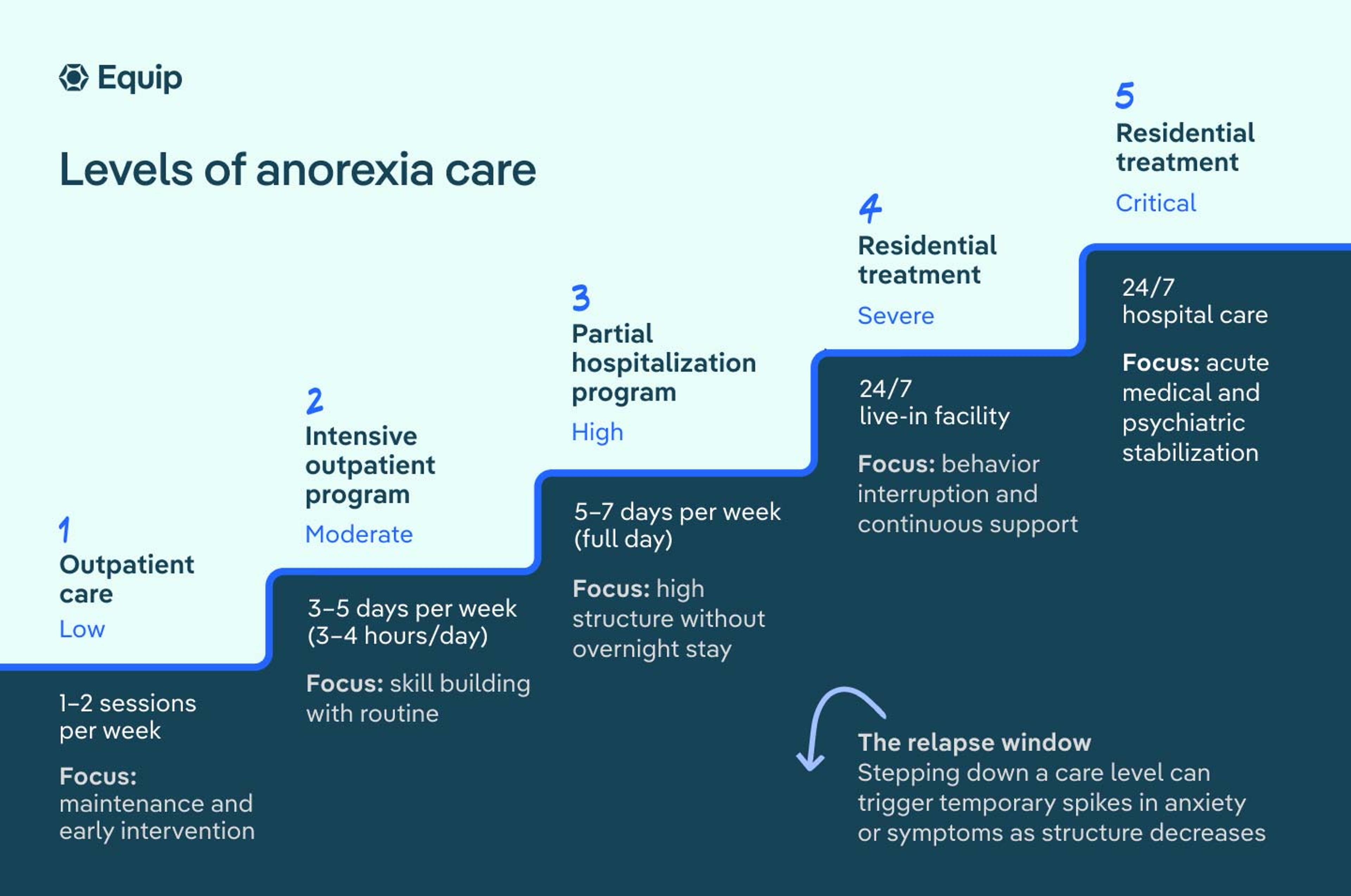
- Inpatient hospitalization is the highest level of care, occurring in a general or psychiatric hospital setting. It is designed for acute medical stabilization (e.g., addressing life-threatening heart rhythms, dangerously low blood pressure, or refeeding syndrome risk) or acute psychiatric crises.
- Residential treatment is a 24/7 live-in program for individuals who are medically stable but require 24-hour structure, meal supervision, and intense psychological support to interrupt eating disorder behaviors.
- Partial hospitalization programs (PHPs) offers a high level of structure without requiring overnight stays. Patients typically participate 5 to 7 days a week for several hours a day (including multiple supervised meals and group therapy) before returning home at night.
- Intensive outpatient programs (IOPs) are more intensive and structured forms of outpatient care with time commitments of typically 3–5 days per week, 3–4 hours per day (usually including one supervised meal). This allows patients to practice recovery skills while maintaining work, school, or home life.
- Outpatient treatment is the most common and flexible level of care, consisting of 1 to 2 weekly sessions with individual care team members (such as a therapist, dietitian, and physician). Outpatient care is appropriate for patients who are medically stable and are either catching symptoms early or continuing their progress after stepping down from higher levels of care.
The following table shows how the levels of care stack up, starting with the least structured and least time-intensive to the most structured.
Level of care | Time commitment | Typical duration | Virtual option | Living situation | Level of structure | Best for |
Outpatient Treatment | 1-3 hours per week | 6 months to 2+ years (as long as needed) | Yes | Living at home; attending weekly sessions | Minimal and flexible | Patients who are medically stable and catching symptoms early or continuing step-down care |
Intensive Outpatient Program (IOP) | 9–15 hours per week (about 3 hours/day, 3–5 days/week) | 2 to 4 months (8–16 weeks) | Yes | Living at home; attending multiple sessions during the week | Moderately structured | Medically stable patients who need structured support to reduce symptoms while maintaining daily life |
Partial Hospitalization Program (PHP) | 30–45 hours per week (about 5–8 hours per day, 5–6 days per week) | 3 to 8 weeks (1–2 months) | Yes | Living at home; attending a day program most days | Highly structured | Medically stable patients who need intensive daily structure and meal support, but don't require 24/7 care |
Residential Treatment | 24/7 care | A few weeks to a few months | No | Living on site at a treatment facility | Fully structured with ongoing supervision | Medically stable patients unable to stop severe eating disorder behaviors at home who require constant supervision |
Inpatient Hospitalization | 24/7 care | A few days to weeks or months | No | Living in a hospital setting | Fully structured with medical supervision | Patients requiring acute medical stabilization (e.g., severe heart complications, severe electrolyte imbalances, refeeding risk) or psychiatric crisis intervention |
As noted, in many cases, virtual care is an option. Virtual care is not a type of treatment, but rather a way of delivering anorexia treatment at home. It can equate to multiple different care levels, depending on the program.
“Virtual treatment can be an amazing option for anorexia nervosa if a patient is medically stable enough to not require 24/7 monitoring by a medical team,” Wakeland says. “Virtual treatment allows a patient to recover in their own home, avoiding the challenge of adjusting back to their environment after receiving treatment elsewhere.”
In-person monitoring at a doctor’s office may still be necessary at times, but with the overall adaptable nature of virtual care, you or your loved one might be able to continue school or work.
“The flexibility of virtual treatment often allows patients and families to retain some semblance of normalcy and can save considerable time and money compared to in-person treatment,” Wakeland adds.
What are the main treatment approaches to anorexia?
Treatment approaches for anorexia nervosa vary, depending on your (or a loved one’s) age and individual needs. But they tend to include evidence-based therapy, nutritional support, and medical monitoring. These options can sound a bit abstract, so let’s take a look at what they mean.
Evidence-based therapy
Evidence-based therapy for eating disorders refers to therapeutic approaches that have been proven to help people who are specifically dealing with an eating disorder. A number of different evidence-based modalities for anorexia nervosa exist, but the two with the largest body of research behind them are family-based treatment (FBT) and enhanced cognitive behavioral therapy (CBT-E).
- Family-based treatment (FBT): FBT is the gold standard for treating eating disorders in young people (children, adolescents, teens, and young adults). In this therapy approach, parents or caregivers take an active role in helping a loved one restore weight and normalize eating behaviors. It may be a part of outpatient, IOP, or PHP care. Sometimes FBT is part of residential programs for adolescents, through family sessions.
- Enhanced cognitive behavioral therapy (CBT-E): CBT is a part of many different types of therapy, though CBT-E is an enhanced form developed specifically to target eating disorders. It is a structured psychotherapy that focuses on identifying and changing unhelpful thoughts, beliefs, and behaviors that contribute to an eating disorder or disordered eating patterns. It is used as part of outpatient, IOP, PHP, and residential care. Sometimes it is even a part of inpatient stabilization.
Other modalities include dialectical behavior therapy (DBT), a type of therapy that incorporates mindfulness and emotional regulation skills; exposure and response prevention (ERP), which helps address eating-related fear and anxiety; and temperament-based therapy with support (TBT-S), in which individuals and their family members participate in group support for several days.
Nutrition support
Nutrition support is led by a registered dietitian on a multidisciplinary treatment team, but it’s more complex than just “eating more.”
“This often looks like identifying a patient’s caloric needs to support weight restoration, setting a target weight range for recovery, and providing psychoeducation and support to families who may have their own preconceived notions about food, dieting, and weight,” Wakeland says.
She adds, “Dietitians also review labs alongside medical providers in order to assess specific nutrient needs, inform frequency of weight checks, and help families generate ideas for creating meals that support their loved one’s recovery.”
Medical monitoring and stabilization
Medical monitoring helps assess how treatment is working based on regular physical and mental health assessments. This type of monitoring is partly for safety reasons, but also to help practitioners and patients assess how treatment is going and decide whether changes in care are necessary.
Again, eating disorder care doesn’t always follow a straight line. You or a loved one may need additional care at some points or less during others.
Who might be on an anorexia care team?
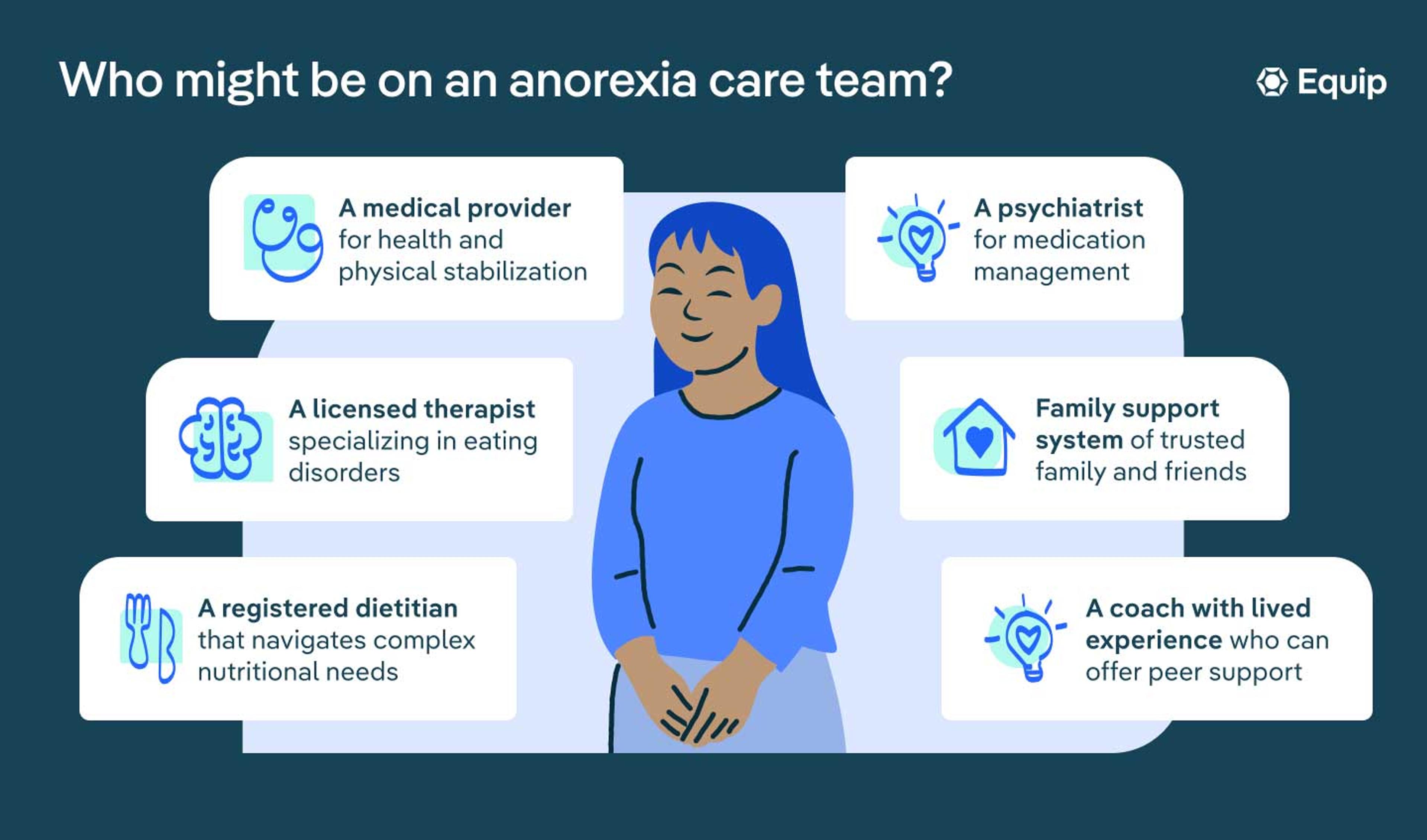
You might be wondering which types of medical professionals and other supports you might find as part of a multidisciplinary care team for treating anorexia nervosa. They may include some or all of the following people:
- A licensed mental health professional (such as a therapist) specializing in eating disorders
- A registered dietitian to help navigate complex nutritional needs
- A medical provider to monitor health status and stabilization
- A psychiatrist (if necessary) for medication management or treating multiple mental health conditions
- A coach with lived experience with anorexia nervosa who can offer peer support
- Family support system consisting of trusted family or other support members
How does anorexia treatment differ for children and teens?
Anorexia nervosa treatment differs between minors and adults. This is partially because children and teens with anorexia are still under the care of a parent or guardian and may need additional support. It’s also because these patient populations have different needs.
Anorexia treatment for teens and children
Loved-one involvement, especially for teens and children, helps support treatment and recovery, according to research in the journal European Eating Disorders Review. For this reason, FBT is often the best approach for young patients. Families usually need coaching on how to implement FBT at home and in daily life, including for meals, school, general routines, and more.
Anorexia treatment for adults
Adults with anorexia nervosa may have a complex history, including a longer span of living with the eating disorder, co-occurring mental health conditions, and preconceived notions about recovery. For these reasons, a multidisciplinary care team that is adept at collaboration is the most beneficial.
Treatment typically focuses on maintaining your autonomy, building a support system, and managing life’s everyday demands, especially those that may be triggering. CBT-E is a key therapeutic focus for adults, though other modalities might also play a role, according to research in the journal Clinical Therapeutics.
Despite the fact that adults often have a more complex history with anorexia nervosa, treatment and recovery is absolutely possible, no matter how long you’ve been struggling.
Is anorexia treatment covered by insurance?
Insurance coverage for anorexia nervosa treatment will vary by plan, provider, diagnosis, medical necessity, and the level of care required. Here’s a list of questions you can ask your provider/program and your insurance company:
- Is the program in-network with my insurance?
- What levels of care are covered?
- What documentation or evaluation is required?
- What out-of-pocket costs should I expect?
Equip is an in-network provider for most commercial insurance plans and a growing number of Medicaid plans. The admissions team can help you understand factors related to cost and coverage before you or a loved one starts treatment. You can also take Equip’s insurance screener to see if Equip is in-network with your health plan.
The bottom line
You might be wondering what recovery from anorexia nervosa looks like on the other side of initial treatment. It varies from person to person, but in general, it involves a restoration of health, improvements in overall well-being, and more.
“Recovery for someone with a diagnosis of anorexia nervosa, beyond the initial medical concern, typically includes returning to their body's natural growth trajectory or biological set point, the ability to eat normally and with age-appropriate independence without restricting the variety or volume of food, a healthy relationship with movement, and a neutral body image,” Wakeland says.
She adds, “Recovery can look different for everyone. It doesn’t mean never having an eating disorder thought again or being perfect. Eating disorder recovery is possible, and this diagnosis does not need to be a life sentence.”
FAQ
Can adults fully recover from anorexia?
Yes, adults can fully recover from anorexia nervosa. Adults sometimes have a longer history of living with the eating disorder, along with co-occurring mental health conditions, but help from a multidisciplinary care team can make recovery possible.
How do I know if someone needs inpatient treatment for anorexia?
The best way to learn whether you or a loved one needs inpatient treatment or a different level of care, such as outpatient (which can sometimes be virtual), is to undergo an initial assessment with a medical professional.
What type of therapy is most effective for anorexia?
The type of therapy that is most effective for treating anorexia nervosa will depend on factors unique to you or a loved one, including age, medical status, location, and more. CBT-E and FBT are evidence-based therapy methods for treating eating disorders, including anorexia nervosa. But they aren’t the only options.
Berkman, Elliot T. “The Neuroscience of Goals and Behavior Change.” Consulting Psychology Journal: Practice and Research, vol. 70, no. 1, Mar. 2018, pp. 28–44.
Dalle Grave, Riccardo, et al. “Treatment of Eating Disorders in Adults Versus Adolescents: Similarities and Differences.” Clinical Therapeutics, vol. 43, no. 1, Jan. 2021, pp. 70–84.
Treasure, Janet, et al. “The Value of Including Families in the Treatment of Anorexia Nervosa.” European Eating Disorders Review, vol. 29, no. 3, May 2021, pp. 393–401.