How to Stop Stress Eating: Practical Strategies for When Food Becomes a Coping Tool


- Most people stress eat from time to time, since certain foods and the activity of eating provide comfort via reward pathways in the brain.
- Stress eating in itself isn’t harmful, but stress eating that happens often, causes significant distress, or leads to feeling as if you have no control around food might indicate something more serious, including an eating disorder.
- If eating becomes a frequent way to cope with difficult feelings, some strategies can help you manage stress eating without restricting food.
- Help is available and recovery is possible if stress eating has changed into something more serious.

Stress eating is a common human experience. Maybe this sounds familiar: You’re nervous about a school or work project. You know you need to get started, but you find yourself in front of the pantry, rooting around for a snack. You’re not necessarily feeling hungry, but the crunch feels nice while you’re brainstorming.
Or maybe you’re at a social gathering, feeling slightly awkward without something for your fidgeting hands to do. You hit up the buffet, even though you ate a full meal before arriving.
These scenarios are normal and not a cause for concern. We all feel stressed out or nervous from time to time, and eating can provide comfort since it’s involved in brain reward systems.
However, it’s possible for stress eating to cross the line into something more concerning, and you may be wondering how to know when it has become an issue. We delve deeper into the science of emotional eating and how to stop stress eating. It isn’t a personal failure. It’s truly about biology. Let’s dig in.
Why stress eating happens
Stress eating is a type of emotional eating that we sometimes engage in when stressed, worried, scared, or anxious, according to research in the journal Proceedings of the Nutrition Society.
Stress eating can occur in the face of a major life event, such as a difficult breakup. Or it can occur as a way to cope with everyday stressors that life throws at you, whether related to work, school, family, the news cycle, or something else.
Research in the journal Nutrients indicates that emotional eating like this is not a matter of willpower. Instead, they write, “It is a neurobiological, psychological, and environmental phenomenon.” Indeed, our instinct to turn to certain tasty foods during times of stress is, at least, in part, driven by biology: according to research in the journal Advances in Pharmacological and Pharmaceutical Sciences, comfort foods increase levels of mood-related transmitters.
Physical hunger vs. emotional hunger: how to tell the difference in the moment
We have several different types of hunger, and understanding them helps you understand stress eating. We have physical hunger, which is when hormones signal to your brain that you should eat. And we have emotional hunger, which is eating because of stress, boredom, sadness, or even joy.
With physical hunger, the sensation typically builds slowly, and you might feel the telltale signs, such as having an empty or “gnawing” stomach or feeling low energy and reduced focus. With emotional hunger, the sensations come on suddenly as an urge to eat (usually something specific), but physical hunger signs are typically lacking.
You can also experience both types of hunger at once, according to Dani Castellano, RD, at Equip. “With food, it’s important to consider that you need to eat regularly and adequately,” she says. “You’re physically hungry and you’re stressed, and in this case, eating is a perfectly normal response.”
We also have other types of hunger—five in total—which Castellano breaks down in the table below.
5 types of hunger
Hunger/eating type | Definition | Sensations and examples |
Physical | Hunger brought on by your body’s biological need for food | Comes on slowly; may be felt as a “gnawing” stomach, lack of concentration, shakiness |
Emotional | Hunger brought on by feelings (stress, sadness, etc.) | Comes on suddenly; emotions can cause bodily sensations, including a “lump in throat”; physical hunger sensations may be lacking |
Social | Eating because of a social situation that has food | You might experience physical or emotional hunger in a social situation, or you might just be eating because others are |
Taste | Eating for the fun of it | Food is enjoyable, and you might be craving a specific texture, flavor, or temperature, such as a snow cone on a hot day or a salty broth when recovering from an illness |
Practical | Eating because it makes the most sense for your schedule | Even if you’re not hungry right at noon, you might eat because that’s your only lunch break |
Why dieting and restriction usually make stress eating worse
Dieting and restriction may drive stress eating, especially in the face of negative emotions, according to research published in Nutrition Reviews.
“One factor to consider, " Castellano says, “is that eating regularly and adequately helps to support meeting your body’s energy needs, stabilizing blood sugar, fueling your brain, etc.”
In the face of food restriction through dieting, she adds, “the body typically will ramp up cues for high-energy foods to make up for what it needs. Because of this, stress eating may increase or feel unavoidable as a coping mechanism in a high-stress situation—because the body simply needs food.”
Another consideration is that diet culture can lead to feelings of shame or guilt, which can also drive stress eating. “The types of food you eat when stressed may have value or judgment placed on them,” Castellano explains. If you eat a food that you or society labels as “bad,” negative feelings about what you ate can lead to additional stress, followed by guilt-driven restriction, which then leads to more stress eating, creating a harmful cycle.
Again, stress eating is not about a failure of willpower. “Food is more than fuel to many people,” Castellano says. “It’s normal to want to engage in something that is comforting.” And in the face of restriction, you may feel even more compelled to eat your favorite comfort foods.
How to stop stress eating: strategies that actually help
First, let’s just acknowledge that eating is something we all need to do to keep our bodies healthy. However, if stress eating itself is causing you distress, you might be looking for ways to reduce it.
The following strategies can help you manage stress eating, but they aren’t about restriction. They’re about learning coping strategies, ensuring you’re getting plenty of nutrients to support all that your body needs to do—and being kind to yourself.
Reduce the conditions that make stress eating more likely
Step one of reducing stress eating is to make sure your body has regular fuel. That might look like eating three regular meals and a couple of snacks throughout the day.
“Basically, if you want to work towards reducing stress eating, you have to make sure that you’re eating adequately and regularly at a baseline,” Castellano says.
If you’re physically hungry, you might have a hard time focusing on other skills you might use to cope with stress (another strategy for mitigating stress eating).
Additionally, getting adequate sleep on a regular schedule can help. Poor sleep ramps up stress and makes shaking off life’s mild irritations and frustrations even harder, according to research in the journal Emotion. And research in the journal Nutrients shows that poor sleep also increases physical hunger and cravings.
Pause and name what you’re feeling
When stress strikes, taking a beat to put a name to your specific feelings may help you regulate your emotions, according to an article in the Journal of Psychiatric Research. Emotional regulation is your ability to control your feelings, and it can aid with emotional reappraisal, or changing the way you think about specific feelings.
Cognitive behavioral therapy (CBT) can also help. CBT helps you identify your thought patterns and feelings that drive certain behaviors and reframe ones that are unhelpful or distorted.
For example, maybe before hanging out with friends, you think, I always say the wrong thing. You can identify this as “all-or-nothing thinking” and reframe the thought pattern as follows: Sure, everyone, including me, says the wrong thing sometimes. But also, I have good conversations.
Naming and reframing feelings (as necessary) helps you rewire your thought patterns over time. And as you reduce the thoughts that lead to certain harmful behaviors, those behaviors lessen as well.
Ready to take the first step?
Build a short list of non-food coping alternatives to stress
Chances are you have some other ways you like to cope with stress that don’t involve food. Having a list of them handy can help you remember that you have alternatives to stress eating. Again, this is not about skipping lunch or ignoring your hunger when you need a snack. It’s about calming your nervous system so that you can make a mindful choice in the moment.
Stress activates your fight-or-flight response, driven by your sympathetic nervous system. Anything that helps you activate your parasympathetic nervous system (which drives your “calm” response) will reduce sympathetic nervous system activity, bringing you into a calmer state.
You can use the following tips in various situations to stimulate your vagus nerve, which runs from your brainstem to your large intestine and helps regulate your parasympathetic nervous system.
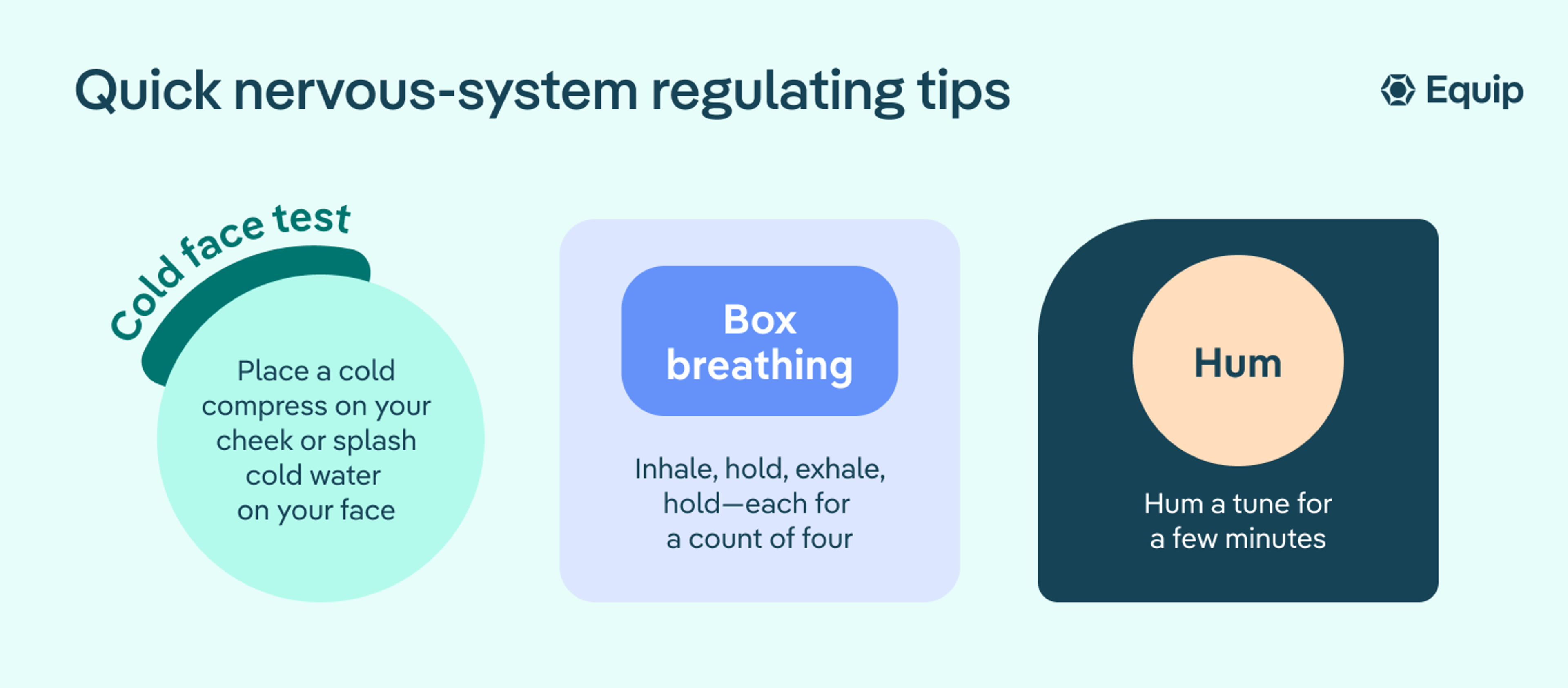
Quick nervous system-regulating tips:
- Cold face test: Place a cold compress on your cheek or splash cold water on your face.
- Box breathing: Inhale, hold, exhale, hold—each for a count of four.
- Hum: Hum a tune for a few minutes.
Practice self-compassion after a stress eating episode
If you do stress eat, be kind to yourself. Feelings of shame, guilt, or anxiety may crop up, but these feelings can also lead to a complex cycle that drives additional stress eating.
Self-compassion is a tool that can reduce negative feelings, according to research in the American Journal of Lifestyle Medicine. Breaking the cycle of negative self-talk can help you heal from emotional eating.
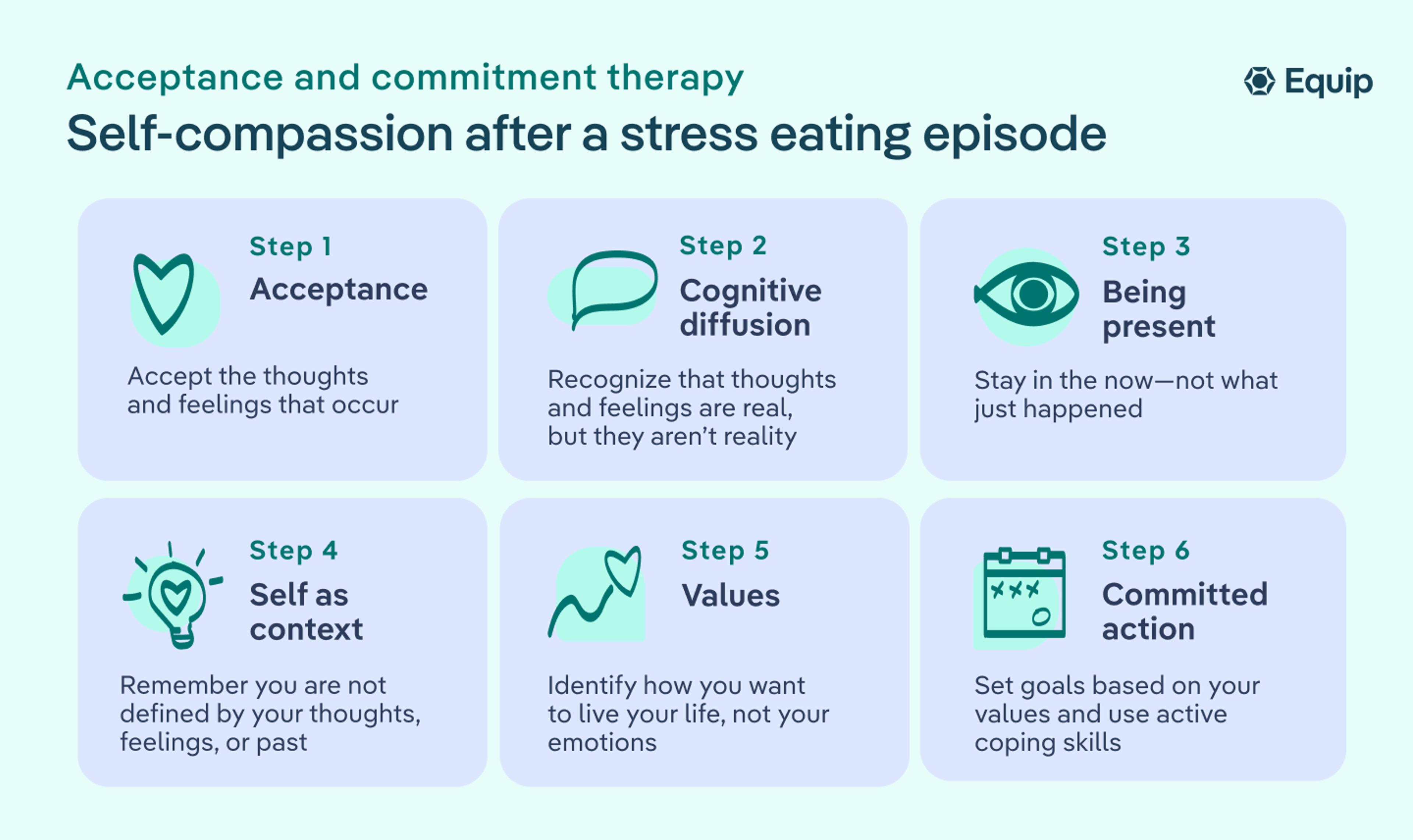
A therapeutic approach to self-compassion is acceptance and commitment therapy (ACT). It involves six steps:
- Acceptance: Accept the thoughts and feelings that occur.
- Cognitive diffusion: Recognize thoughts and feelings for what they are, but know they are not truths about you.
- Being present: Focus on the present moment (without judgment) rather than on what just happened.
- Self as context: Recognize that you are more than your thoughts, feelings, and past behaviors.
- Values: Identify what matters to you, or how you want to live your life, including not being controlled by your emotions.
- Committed action: Set actionable goals and take steps toward your values, such as by using some of the other techniques listed above to cope with stress.
When stress eating becomes something more serious
You might be wondering when stress eating morphs into something more serious, such as binge eating disorder (BED). BED is a recognized mental health condition, as noted in the Diagnostic and Statistical Manual of Mental Disorders 5th Edition (DSM-5).
BED is an eating disorder involving feeling as if you have no control around food and having recurrent binge episodes followed by intense distress. BED is not defined by body size, nor is it about a lack of willpower.
BED diagnostic criteria:
- You have recurrent binge eating episodes. Binge eating episodes are defined as eating in a discrete period of time (e.g., within any two-hour period) an amount of food that is definitely larger than most people would eat in a similar period of time under similar circumstances—and feeling a lack of control over eating during the episode.
- The episodes are associated with at least three of the following:
- Eating much more rapidly than normal
- Eating until feeling uncomfortably full
- Eating large amounts of food when not feeling physically hungry
- Eating alone because of feeling embarrassed by how much one is eating
- Feeling disgusted with oneself, depressed, or guilty after overeating
- You feel distress regarding binge eating.
- Binge eating occurs at least once a week, on average, for three months.
- Binge eating is not associated with compensatory behaviors, such as purging, fasting, or overexercising, and is not related to anorexia nervosa or bulimia nervosa.
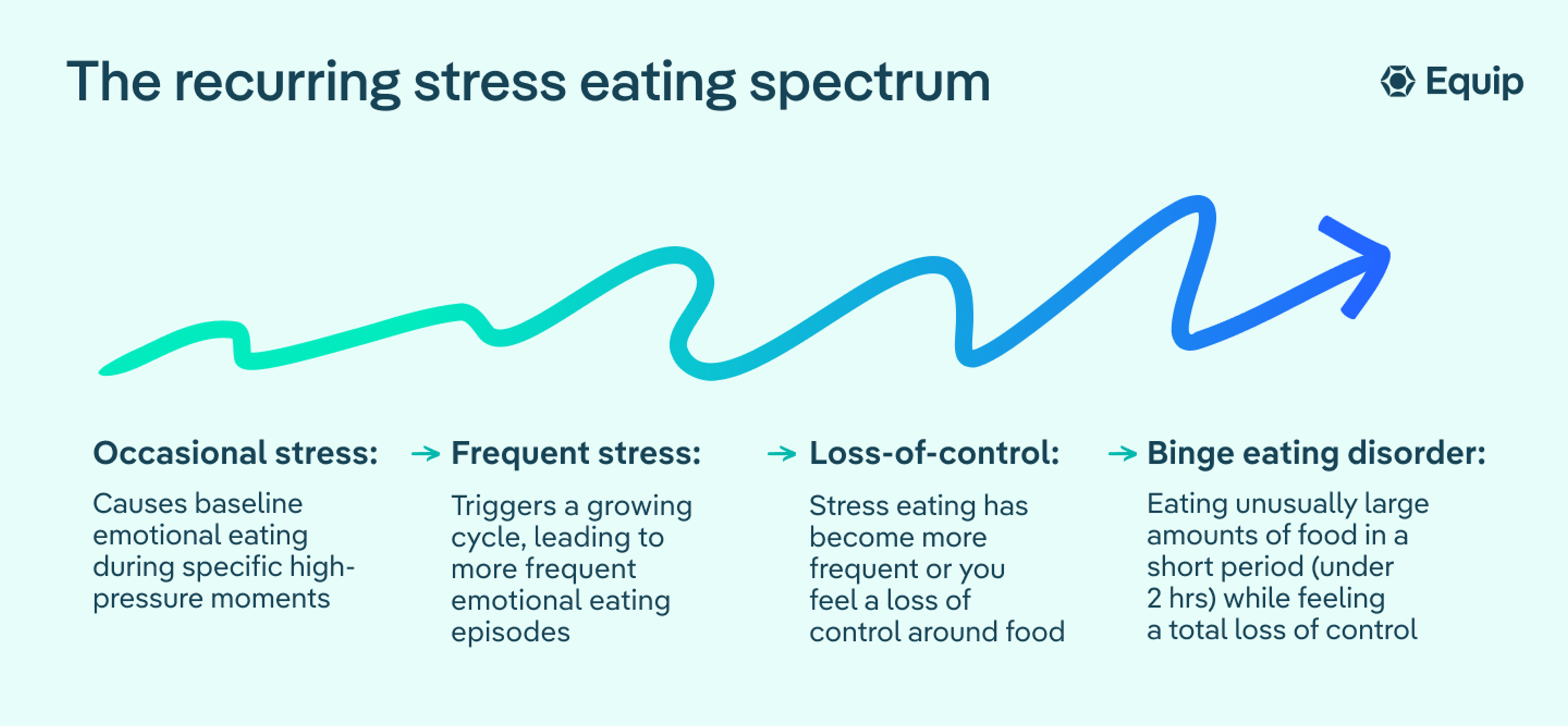
Think of stress eating and BED as existing on opposite ends of a spectrum, with many people falling somewhere in the middle. Castellano notes three factors that might indicate you’ve escalated from the occasional emotional eating nearly everyone does to a more concerning spot on the spectrum:
- Stress or emotional eating is causing you significant distress.
- Stress eating has become your only coping mechanism.
- Stress eating leads to loss-of-control eating or binge eating regularly
What professional support looks like and when to consider it
If you are concerned about yourself or a loved one, you might be wondering how stress eating is treated when it has become a frequent experience, or how BED is treated.
“At Equip,” Castellano says, “we use enhanced cognitive behavior therapy as the main treatment for our adult patients. Part of this includes using a self-monitoring tool, which allows someone to gain further insight into the patterns that are happening over time in regard to thoughts and context around eating.”
Another method is dialectical behavior therapy (DBT), a form of CBT. DBT helps encourage focusing on the present moment and learning to manage complex or challenging emotions without judgment.
The bottom line
Stress eating is common and normal when it occurs occasionally. Specific foods or just the act of eating can provide comfort by impacting the brain’s reward pathways and chemistry. However, frequent stress eating or feeling a loss of control around food might indicate something more serious. If stress eating has become a concern for you or a loved one, a consultation with a knowledgeable care team can help.
Equip offers individualized, evidence-based treatment and can coordinate with external clinicians as needed. Schedule a call here to get started.
FAQ
Why do I stress eat even when I’m not hungry?
Stress eating, even when you’re not physically hungry, happens because food and the activity of eating provide comfort. Stress eating is common as a way to cope with anxiety or complex emotions. Most people stress eat from time to time, but if stress eating has become more frequent or you feel a loss of control around food, talking to a knowledgeable healthcare provider can help.
Is stress eating an eating disorder?
Stress eating, when it occurs occasionally, is a normal experience and not considered an eating disorder. However, if stress eating is causing you significant distress, has become your main method of coping with difficult feelings, or makes you feel out of control around food, then your stress eating may be associated with something more complex. Binge eating disorder, for example, is a diagnosable eating disorder.
What should I do immediately after a stress eating episode?
After a stress eating episode, the most important thing you can do is to be kind to yourself. Acknowledge your feelings and what happened, but try to avoid negative self-talk, which can drive further stress eating.
How do I stop stress eating at night?
Stress eating at night sometimes occurs because of food restriction during the day. One way to reduce the likelihood of stress eating at night is to stick to regular meal times. Another strategy is to engage in calming activities as part of your bedtime routine and to acknowledge, without judgment, any negative feelings that crop up.
De Macedo, Isabel Cristina, et al. “The Influence of Palatable Diets in Reward System Activation: A Mini Review.” Advances in Pharmacological Sciences, vol. 2016, 2016, pp. 1–7.
Casari, Matheus Augusto, et al. “Does Restriction Lead to Binge Eating? A Scoping Review on Restrictive Diets in the Development and Maintenance of Binge Eating Disorder.” Nutrition Reviews, vol. 84, no. 1, Jan. 2026, pp. 189–206.
Cepni, Aliye B., et al. “Addressing Shame Through Self Compassion.” American Journal of Lifestyle Medicine, vol. 19, no. 2, Feb. 2025, pp. 194–97.
Minkel, Jared D., et al. “Sleep Deprivation and Stressors: Evidence for Elevated Negative Affect in Response to Mild Stressors When Sleep Deprived.” Emotion (Washington, D.C.), vol. 12, no. 5, Feb. 2012, p. 1015.
Morie, Kristen P., et al. “The Process of Emotion Identification: Considerations for Psychiatric Disorders.” Journal of Psychiatric Research, vol. 148, Apr. 2022, pp. 264–74.
Reichenberger, Julia, et al. “Emotional Eating in Healthy Individuals and Patients with an Eating Disorder: Evidence from Psychometric, Experimental and Naturalistic Studies.” Proceedings of the Nutrition Society, vol. 79, no. 3, Aug. 2020, pp. 290–99.
Richer, Robert, et al. “Vagus Activation by Cold Face Test Reduces Acute Psychosocial Stress Responses.” Scientific Reports, vol. 12, no. 1, Nov. 2022, p. 19270.
Trivedi, Gunjan, et al. “Humming (Simple Bhramari Pranayama) as a Stress Buster: A Holter-Based Study to Analyze Heart Rate Variability (HRV) Parameters During Bhramari, Physical Activity, Emotional Stress, and Sleep.” Cureus, vol. 15, no. 4, Apr. 2023, p. e37527.
Warren, Alison, and Leigh A. Frame. “Restoring a Healthy Relationship with Food by Decoupling Stress and Eating: A Translational Review of Nutrition and Mental Health.” Nutrients, vol. 17, no. 15, July 2025, p. 2466.
Yang, Chia-Lun, et al. “Increased Hunger, Food Cravings, Food Reward, and Portion Size Selection after Sleep Curtailment in Women Without Obesity.” Nutrients, vol. 11, no. 3, Mar. 2019, p. 663.