ARFID and Autism: Understanding the Overlap


- ARFID and autism are separate conditions, but they often overlap in areas such as sensory differences, anxiety, interoception differences, and a need for predictability.
- Not every autistic person has ARFID, and not everyone with ARFID is autistic. However, there is a higher prevalence of ARFID among people with autism.
- ARFID is often overlooked in autistic people because eating difficulties are sometimes assumed to be "just part of autism." But when eating starts affecting nutrition, health, or daily life, it may be more than "picky eating."
- The right support addresses the eating disorder while respecting a person's sensory needs, communication style, and autonomy.

Maybe you've spent years wondering why eating feels so much harder for you than it does for other people. Or perhaps you're worried because your autistic child's list of safe foods keeps getting shorter. As you search for answers, it may help to understand the relationship between ARFID and autism.
Autism and avoidant/restrictive food intake disorder (ARFID) are two distinct conditions, but they often overlap. Recognizing that connection can help explain why eating feels so hard—and remind you that these challenges are not your fault. People with ARFID aren’t just stubborn picky eaters, nor is it some kind of parenting failure. ARFID results from underlying factors beyond anyone's control.
In this article, we'll explore why ARFID and autism overlap, how to tell if food aversions are driven by more than autism alone, and what supportive, neurodiversity-affirming care can look like.
What is the connection between ARFID and autism?
ARFID is an eating disorder that involves avoiding or restricting food to the point that it affects nutrition, growth, health, or daily life, according to StatPearls. Unlike other eating disorders, ARFID isn't motivated by concerns about body weight or shape.
While ARFID and autism are separate conditions, an overlap between the two is fairly common.
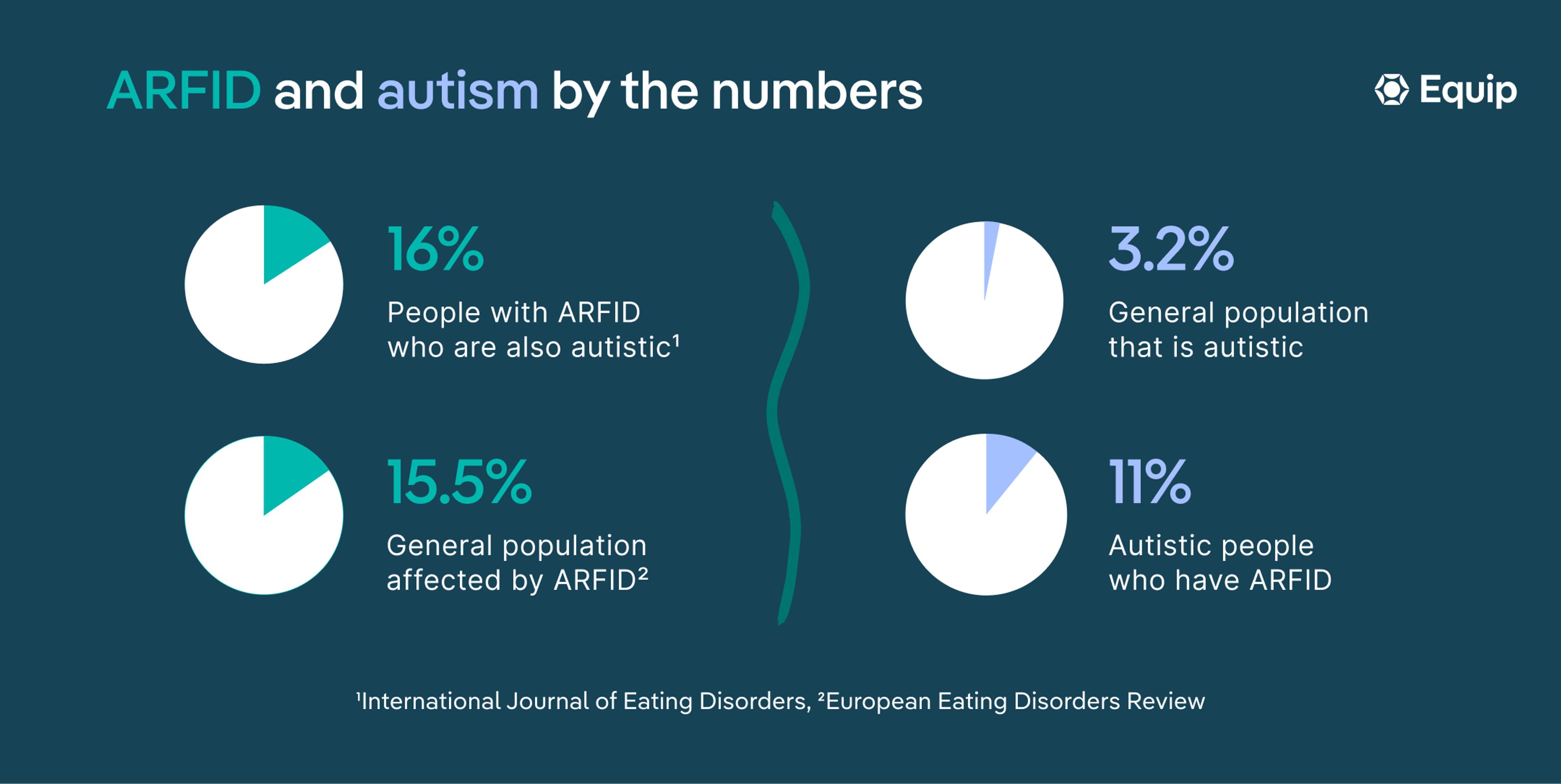
According to the International Journal of Eating Disorders, about 16% of people with ARFID are also autistic, compared with roughly 3.2% of the general population, per the National Institute of Mental Health. Likewise, about 11% of autistic people have ARFID. Estimates from the European Eating Disorders Review suggest ARFID affects between 0.5% and 15.5% of the general population, though prevalence varies widely across studies.
"Sensory sensitivity is a big connection here," says Lily Thrope, LCSW, founder of Thrope Therapy. "People with autism and other neurodivergence often struggle with sensory sensitivity related to color, texture, smell, and taste, which can relate to fear around certain sensory experiences of food."
Differences in awareness of internal body cues like hunger and fullness, anxiety, and a preference for predictability can also make eating more challenging for autistic people, per research in Current Opinion in Psychiatry.
Remember: Not every autistic person has ARFID, and not everyone with ARFID is autistic. Autism also doesn’t cause ARFID. However, experts believe the characteristics outlined above can make eating distressing or restrictive enough for some autistic people to develop the eating disorder.
Why do ARFID and autism often overlap?
There's no single reason why ARFID and autism often overlap. Instead, experts believe a combination of sensory differences, interoception (the ability to perceive internal signals, like hunger and fullness), anxiety, and a preference for predictability can contribute to autistic food aversions and make eating more stressful. Here’s the breakdown.
Sensory differences
For many autistic people, food is a full sensory experience, not just something that tastes good or bad. With autism, food textures, temperatures, smells, colors, appearances, or even sounds can make eating feel either totally comfortable or completely overwhelming, explains Thrope.
This goes beyond simply disliking certain foods. A slight change in texture, a different brand, or even food prepared in a new way can make a previously safe food feel impossible to eat. For example, someone may happily eat one brand of chicken nuggets but have a sensory food aversion to another brand's breading, smell, or texture.
Interoception and hunger cues
Another piece of the puzzle is interoception, which is the ability to notice what's happening inside your body. This includes recognizing signals like hunger, fullness, thirst, nausea, or discomfort.
Many autistic people experience interoceptive differences, making these signals harder to recognize or interpret, per the European Eating Disorders Review. They may not realize they're hungry until they're ravenous, or have difficulty telling when they're full. In some cases, people with autism forget to eat entirely.
Anxiety and fear around eating
According to Allison VanGordon, LMHC, a therapist at Equip, some people with ARFID struggle to eat because they associate food with fear rather than sensory discomfort alone.
They may avoid foods because they’re afraid of choking, vomiting, an allergic reaction, or stomach pain. These fears may begin after a distressing food-related experience or build gradually over time.
For autistic people, differences in interoception, emotional awareness, or tolerance for uncertainty can further intensify that fear, says VanGordon. If someone can tell that a food feels wrong but has trouble identifying why, avoiding it may feel like the safest option.
Predictability, routines, and safe foods
Many autistic people find comfort in routines, according to research in the Journal of Autism and Developmental Disorders. And food is no exception. Knowing exactly what a meal will look, smell, and taste like can reduce uncertainty and make eating feel more manageable.
This is one reason why many people with ARFID rely on "safe foods,” or foods they know they can eat without significant distress. These foods are often very specific: a particular brand, preparation method, or serving temperature may feel safe, while a seemingly minor change can make the food feel completely different.
Having preferred foods or routines isn't inherently a problem. It’s only concerning when the range of foods becomes so limited that it affects someone’s nutrition, health, growth, or everyday life.
How autism shows up alongside ARFID
ARFID can show up in different ways. Experts generally describe three main presentations, though many people experience a combination rather than fitting neatly into just one category. It's also common for these presentations to change over time. Someone might have both strong sensory sensitivities and a fear of choking, or a low appetite alongside a very limited range of safe foods, for example.
You can learn more in our guide to the different types of ARFID.
ARFID subtypes and autism overlap
ARFID presentation | What it means | How it may show up in autistic people |
Sensory sensitivity | Avoiding foods because of their taste, texture, smell, temperature, appearance, or other sensory qualities | A person may eat only foods with specific textures, brands, or preparation methods because other foods feel overwhelming or intolerable. |
Fear of aversive consequences | Restricting food because of fears about what might happen after eating, such as choking, vomiting, allergic reactions, or stomach pain | Anxiety around unpleasant physical sensations or difficulty interpreting body signals may make these fears feel especially intense. |
Lack of interest in eating | Eating very little because of a low appetite or difficulty recognizing hunger and fullness cues | Interoceptive differences may make it harder to notice hunger, remember to eat, or recognize when the body needs nourishment. |
Is it ARFID, autism, or both?
Many autistic people have strong food preferences without having ARFID.
The difference is that ARFID affects a person's health or daily life. If someone eats such a limited variety or amount of food that it leads to nutritional deficiencies, weight or growth concerns, or reliance on supplements, or makes school, work, relationships, or everyday activities harder, ARFID may also be part of the picture.
Why ARFID is often missed in autistic people
One reason ARFID can go unnoticed in autistic people is something called diagnostic overshadowing, per a study in Autism Research. In simple terms, this means eating difficulties are assumed to be "just part of autism," without digging deeper.
This overshadowing can also go both ways—meaning, autism could be missed in a person with ARFID. That’s why VanGordon says that when she's evaluating someone with ARFID, she looks beyond their eating habits to see whether similar patterns appear elsewhere in their life.
"If they have sensory sensitivities, do they also prefer certain textures of clothing? Are they overwhelmed or underwhelmed by their environment?" she says. "If the answer is yes, then I move forward with assessing [for traits of] autism."
Why identifying both matters
Recognizing ARFID doesn't change the fact that someone is autistic (or vice versa). It simply puts a name to eating challenges that should be treated, not brushed aside.
Understanding both conditions can also help guide personalized care plans. Someone with autism and ARFID deserves eating disorder–specific care tailored to their neurodivergence.
What does neurodiversity-affirming treatment for ARFID look like?
When ARFID and autism overlap in adults or children, treatment focuses on helping them meet their nutritional needs, reduce stress around eating, and build more flexibility with food—all while respecting their sensory needs, communication style, and autonomy.
A multidisciplinary team
ARFID is a complex eating disorder, which means treatment often involves more than one type of healthcare provider, per StatPearls. Depending on someone’s needs, their care team may include a therapist, registered dietitian, medical provider, and sometimes an occupational therapist, psychiatrist, or other specialist.
Each team member brings a different area of expertise. Their therapist can help address anxiety and food-related fears, their dietitian can support nutrition and meal planning, and their medical provider can monitor physical health and nutritional status.
Gradual food exposure
Trying new foods is often part of ARFID treatment. But food exposure doesn’t mean forcing someone to eat foods that feel frightening or intolerable—that can actually make things worse. Sustainable recovery begins by gradually building confidence with foods in a way that's collaborative, and respectful of their sensory and emotional needs, per research in Current Opinion in Psychiatry.
"Overall, if someone has ARFID (with or without also being autistic), you have to help find their why,” says VanGordon. “Just like any eating disorder, it has to make sense for them to engage and to want to do the scary thing of facing the food."
Sometimes, this looks like incorporating their interests into their food.
"If someone finds it helpful to relate [autism and ARFID], it can be meaningful to take something they enjoy and build exposures around it," says VanGordon. "If the person likes history, find a historical cookbook from the time period they enjoy. If they enjoy fantasy, find recipes to make based on their favorite storylines."
Family and caregiver support
For ARFID in children and teens, parents and caregivers play an essential part in treatment, according to a study in the Journal of the Canadian Academy of Child and Adolescent Psychiatry. Their ongoing support makes lasting recovery possible.
“Stay focused on validating, supporting, and understanding those with complex eating disorders like ARFID,” says Thrope. She also encourages families to honor safe foods, trust the treatment process, and avoid commenting on eating behaviors.
What to look for in a provider or program
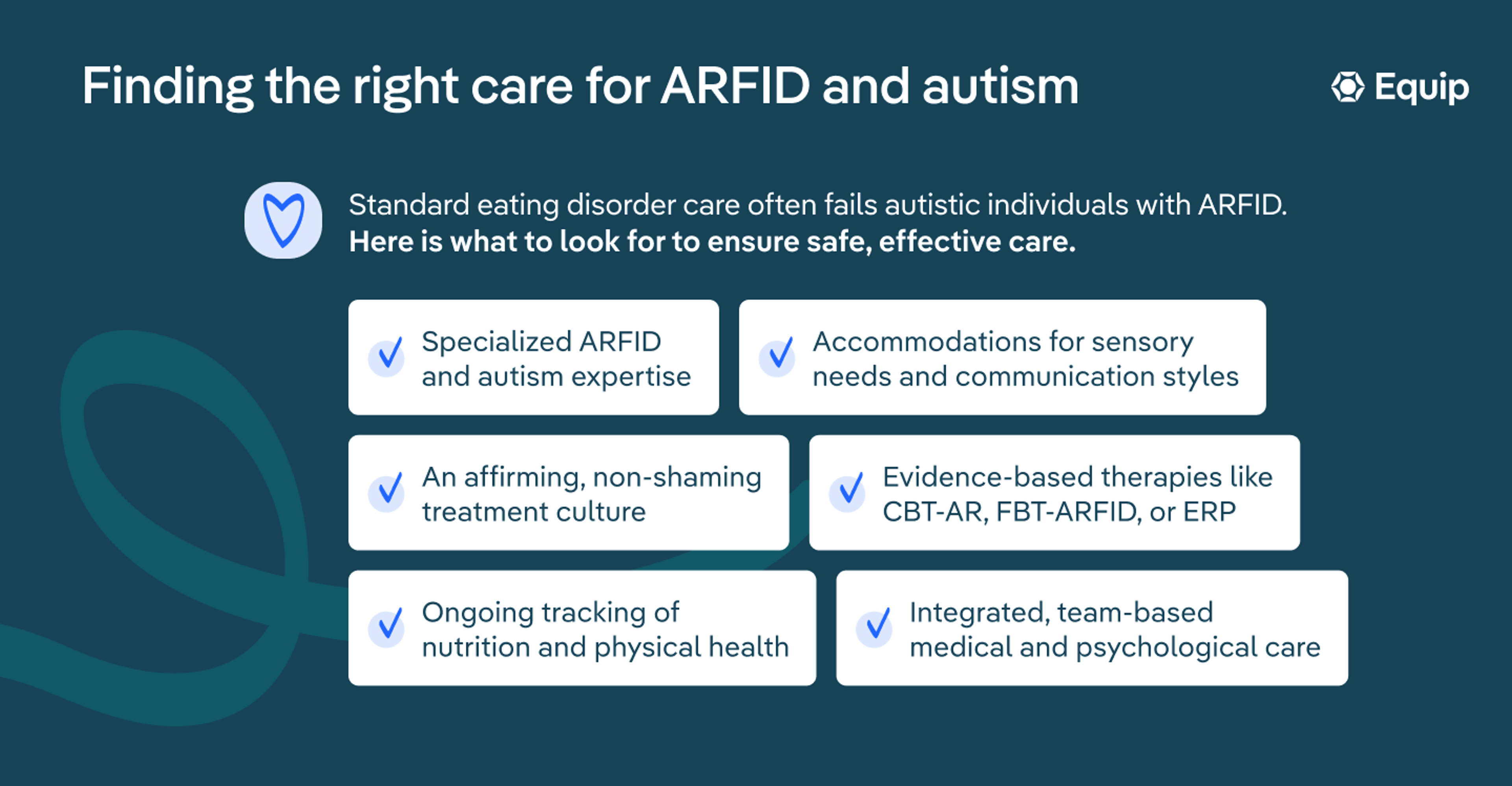
Not every eating disorder provider has experience treating autism, and not every autism provider is trained to address eating disorders. Additionally, not every eating disorder provider has specific expertise treating ARFID. When looking for the right fit, you should prioritize providers or programs that:
- Have experience treating ARFID
- Have experience supporting autistic and other neurodivergent patients
- Use a multidisciplinary team
- Adapt care to each person's sensory needs and communication style
- Take a collaborative, non-shaming approach
- Monitor nutrition, growth, and overall health throughout treatment
- Use evidence-based approaches, such as cognitive behavioral therapy for ARFID (CBT-AR), family-based treatment for ARFID (FBT-ARFID), or exposure and response prevention (ERP), per Pediatric Reviews and Nutrients
Equip’s multidisciplinary team provides evidence-based ARFID treatment that adapts to each patient's unique needs, including those who are autistic or otherwise neurodivergent. Equip also has the ability to work alongside ASD specialists when clinically indicated. Learn more about our ARFID treatment program and schedule a consultation here.
What to do if you think you or your loved one may have both ARFID and autism
If you think you or your loved one may have both ARFID and autism, the next step is to seek an evaluation from a pediatrician, primary care provider, therapist, or eating disorder specialist who understands both conditions. If this isn’t available, finding one specialist for each condition could be an alternative first step. The sooner you get answers, the sooner you can get the support you deserve.
While waiting for an appointment, it’s helpful to keep track of patterns, such as:
- Which foods feel safe or unsafe
- Whether eating causes anxiety, fear, or sensory distress
- Physical symptoms, such as weight loss, nutritional deficiencies, or slowed growth (in children)
- How eating challenges affect school, work, social activities, or family life
If you're ready for the next step, try our ARFID screener or learn more about Equip's ARFID treatment program. Equip is the largest ARFID treatment provider in the U.S. and has a proven track record of helping people, including children, recover gradually and safely from ARFID.
The bottom line
Autism can impact the way someone experiences food, but it doesn't mean significant eating challenges should be dismissed as "just part of autism." When an autistic person also has ARFID, recognizing both conditions helps explain why eating feels so difficult and shape a more cohesive—and effective—care plan.
Frequently asked questions (FAQs)
Does every autistic person have ARFID?
No. While autism and ARFID often occur together, not all autistic people have ARFID. Many autistic people have strong food preferences, rely on familiar foods, or avoid certain textures without those eating patterns affecting their nutrition, growth, health, or daily life.
How do I know if my autistic child's eating is severe enough to need treatment?
The lines between ARFID, autism, and picky eating are sometimes blurry. But if your child's eating is affecting their growth, nutrition, physical health, or everyday life, it's worth talking with a healthcare provider. You don't have to wait until they're eating only a handful of foods or become medically unstable to ask for help—early support can make a meaningful difference.
What should I tell a doctor if I think my child has both ARFID and autism?
Share specific examples of what you're noticing, such as which foods feel safe or unsafe, whether meals cause anxiety or distress, any weight or growth concerns, and how eating affects school, family life, or social activities. The more concrete information you can provide, the easier it is for a provider to understand the full picture.
Adams, Kiera Louise et al. “The role of interoception in the overlap between eating disorders and autism: Methodological considerations.” European eating disorders review : the journal of the Eating Disorders Association vol. 30,5 (2022): 501-509. doi:10.1002/erv.2905
Białek-Dratwa, Agnieszka et al. “ARFID-Strategies for Dietary Management in Children.” Nutrients vol. 14,9 1739. 22 Apr. 2022, doi:10.3390/nu14091739
Breiner, Courtney E et al. “Screening for Avoidant/Restrictive Food Intake Disorder Symptoms Among Autistic Adults: Measurement Invariance With a Comparison General Sample.” Autism research : official journal of the International Society for Autism Research vol. 18,7 (2025): 1381-1388. doi:10.1002/aur.70039
Burton, Claire et al. “Case Presentations Combining Family-Based Treatment with the Unified Protocols for Transdiagnostic Treatment of Emotional Disorders in Children and Adolescents for Comorbid Avoidant Restrictive Food Intake Disorder and Autism Spectrum Disorder.” Journal of the Canadian Academy of Child and Adolescent Psychiatry = Journal de l'Academie canadienne de psychiatrie de l'enfant et de l'adolescent vol. 30,4 (2021): 280-291.
Di Luzio, Michelangelo et al. “Understanding the Relationship Between Avoidant/Restrictive Food Intake Disorder and Obsessive-Compulsive Symptoms: A Systematic Review.” Nutrients vol. 18,5 874. 9 Mar. 2026, doi:10.3390/nu18050874
Keski-Rahkonen, Anna, and Anu Ruusunen. “Avoidant-restrictive food intake disorder and autism: epidemiology, etiology, complications, treatment, and outcome.” Current opinion in psychiatry vol. 36,6 (2023): 438-442. doi:10.1097/YCO.0000000000000896
MacLennan, K et al. “In Our Own Words: The Complex Sensory Experiences of Autistic Adults.” Journal of autism and developmental disorders vol. 52,7 (2022): 3061-3075. doi:10.1007/s10803-021-05186-3
National Institute of Mental Health. “Autism Spectrum Disorder (ASD).” National Institute of Mental Health, Apr. 2023, https://www.nimh.nih.gov/health/statistics/autism-spectrum-disorder-asd. Accessed 27 July 2026.
Ramirez, Zerimar, and Sasidhar Gunturu. “Avoidant Restrictive Food Intake Disorder.” PubMed, StatPearls Publishing, 2024, www.ncbi.nlm.nih.gov/books/NBK603710/.
Sader, Michelle et al. “The Co-Occurrence of Autism and Avoidant/Restrictive Food Intake Disorder (ARFID): A Prevalence-Based Meta-Analysis.” The International journal of eating disorders vol. 58,3 (2025): 473-488. doi:10.1002/eat.24369
Sanchez-Cerezo, Javier et al. “What do we know about the epidemiology of avoidant/restrictive food intake disorder in children and adolescents? A systematic review of the literature.” European eating disorders review : the journal of the Eating Disorders Association vol. 31,2 (2023): 226-246. doi:10.1002/erv.2964
Saure, Emma, and Anna Keski-Rahkonen. “Neurodiversity-affirming eating disorder care: insights into addressing co-occurring autism and eating disorders.” Current opinion in psychiatry vol. 38,6 (2025): 445-451. doi:10.1097/YCO.0000000000001042
Seetharaman, Sujatha, and Errol L Fields. “Avoidant/Restrictive Food Intake Disorder.” Pediatrics in review vol. 41,12 (2020): 613-622. doi:10.1542/pir.2019-0133