Lanugo and Anorexia: Understanding a Serious Warning Sign


- Lanugo is a fine, downy hair that protects the fetus during pregnancy and disappears around the time of birth. It can reappear in people experiencing significant malnutrition.
- The eating disorder anorexia nervosa can cause the reappearance of lanugo (as a survival mechanism) and affect other forms of hair on the body.
- Equip has a proven track record of helping people recover gradually and safely from anorexia nervosa and other eating disorders. Recovery resolves lanugo.

Everyone has some body hair, and it looks different from person to person. Body hair can be light or dark, thick and coarse or fine and soft. This hair plays an important role in keeping your body safe and comfortable. It helps protect your skin from injury such as a scrape, from friction with other body parts (think armpits), and from the sun’s ultraviolet (UV) radiation. Certain types of hair, like eyelashes and nose hairs, also filter out dust, germs, and more. Additionally, body hair helps keep you warm and cool as needed. Hair also plays a role in physical sensations, since follicles are connected to nerves that tell your brain when something is touching your skin.
In other words, having body hair in general is completely normal—and, in fact, a good thing! But if you’ve noticed a new growth of fine downy hair on yourself or a loved one, you may be wondering what it is. It could be lanugo.
Lanugo hair is a different type of body hair, and its presence is a symptom of malnutrition. Lanugo can show up as a symptom of anorexia nervosa, an eating disorder characterized by severely restricting food intake. Severe nutrition restriction can mean that you or a loved one aren’t getting enough nutrients to meet the body’s needs. When this happens, lanugo develops as a survival mechanism, specifically to keep you warm.
If you notice the presence of lanugo, it can be scary or even affect your self-confidence. The good news is that by addressing malnutrition through tailored eating disorder treatment lanugo can go away.
In this article, we explore lanugo in anorexia nervosa—including what it is, what causes it, when it goes away, and more.
What is lanugo?
Not all body hair is the same. So let’s explore the three types to help get at the differences between lanugo and other body hair.
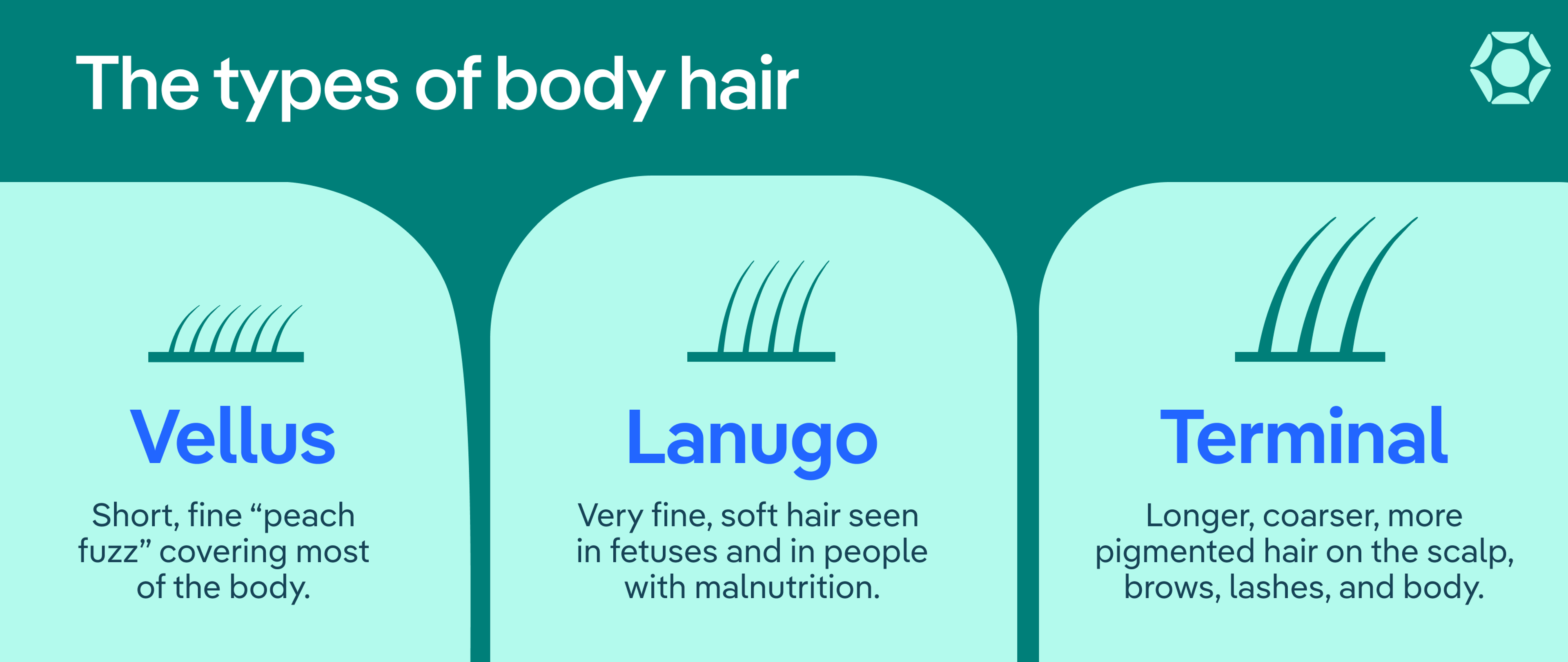
Type of body hair:
- Vellus: This type of hair is often called “peach fuzz” and appears on most parts of the body. It’s typically short and fine and lightly pigmented.
- Terminal: This type of hair shows up on the scalp, eyebrows, eyelashes, face, pubic region, and armpits. It is longer, coarser, and more pigmented than vellus hair.
- Lanugo: This fine, soft hair develops in the womb, usually starting about three months into fetal development. But it can also appear in people during times of severe malnutrition.
Ready to take the first step?
Now that we've defined the different types of body hair, let's take a closer look at the characteristics and function of lanugo.
Lanugo in the womb:
- Helps regulate temperature.
- Holds in place the vernix caseosa, a waxy substance that contributes to innate immunity, the immune system defenses you are born with.
- Helps protect a developing fetus from damaging substances in amniotic fluid, a surrounding liquid that provides cushioning and more.
“Lanugo is typically shed just before birth,” says Barbara Kessel, DO, CEDS, Supervising Child and Adolescent Psychiatrist at Equip. However, sometimes it is present on a newborn before eventually going away.
When lanugo shows up in an adult, however, it is usually considered a red flag. “Lanugo can recur in patients with severe anorexia nervosa and is a sign of severe malnutrition,” Dr. Kessel says. “It is differentiated from ‘peach fuzz,’ or vellus hair, because vellus hair is typically more pigmented and shorter than the less-pigmented, fur-like, lanugo,” she adds.
Lanugo vs. "peach fuzz"
Characteristics | Lanugo | Vellus hair (“peach fuzz”) |
Timing and development | Develops in the womb; goes away before or just after birth; may return in instances of malnutrition | Develops during childhood; may be replaced by terminal hair in certain bodily areas during adulthood |
Thickness | Soft and fine, fur-like | Soft and fine |
Length | Longer than peach fuzz | Short |
Location | Appears all over on a fetus; may appear anywhere on the body during states of malnutrition | Can appear on most body parts |
Function | Protects the fetus in the womb; it is a survival mechanism when it develops in people | Protects skin and regulates body temperature |
Pigmentation | May lack color or range from blond to dark brown | Ranges from blond to dark brown |
Why does anorexia cause lanugo hair to grow?
“[Lanugo] occurs because of loss of the body’s insulating layer of fat and is the body’s attempt at helping regulate temperature, similar to how it functions in a fetus,” Dr. Kessel explains.
Your body needs fat stores to provide insulation and keep you warm. If you or a loved one has anorexia nervosa, which is characterized by severe food restriction, malnutrition can deplete the body’s fat stores.
Food is what powers your body, and you need a certain amount of calories from food just to support everyday bodily functions, like keeping your heart pumping, your lungs breathing, your immune system working, your brain operating, and more. In addition to these baseline needs, you also require calories to support movement and physical effort, whether that’s standing in line at the pharmacy, walking your dog, lifting a package off your front porch, or working out.
If you don’t take in enough nutrients from protein, fats, and carbohydrates and get adequate levels of vitamins and nutrients, your body has to start burning the stored energy in your body fat. This can deplete fat storage, including what’s needed for insulation.
When your body’s insulation is inadequate, hormones signal to the hypothalamus in your brain that you’re experiencing a bodily threat, like starvation or chronic cold, and it responds with some survival mechanisms.
The hypothalamus does the following to try to protect you:
- Disrupts thyroid-stimulating signals
- Shuts down reproductive processes
- increases cortisol (the “stress” hormone)
These changes to thyroid, reproductive, and stress hormones then lead to changes in body hair. They promote vellus hair follicles to produce lanugo hair, which is longer and softer.“Lanugo will appear as new hair growth on surfaces of the body such as the face, back, and arms,” Dr. Kessel says. In short, any anorexia hair growth or anorexia body hair is lanugo, which is a survival mechanism your body uses to keep you warm.
When does lanugo go away?
If you or a loved one is experiencing malnutrition and lanugo, you might understandably be worried. But the good news is that when malnutrition goes away, so does lanugo.
Eating disorders are complex and don’t resolve overnight, but recovery is possible with help from knowledgeable providers. “[Lanugo] should shed with weight restoration and replenishing the energy and fat stores in the body,” Dr. Kessel says.
How is lanugo addressed during anorexia treatment?
The first step of anorexia nervosa treatment generally involves renourishing the patient, normalizing eating habits, and gaining weight if necessary. Lanugo isn’t addressed directly—but through this process, the body realizes it’s no longer in a survival state, and lanugo goes away.

What other hair changes can happen in anorexia?
“In addition to lanugo,” Dr. Kessel explains, “individuals with anorexia nervosa or atypical anorexia nervosa might experience other kinds of changes to their hair.”
Additional hair changes in anorexia:
- Receding hairline
- Thinning scalp hair
- Brittle hair
- Hair falling out in clumps
Again, addressing malnutrition and food restriction helps resolve these concerns.
The bottom line
When lanugo appears on you or a loved one, the fine downy hair can understandably cause worry or impact your self-confidence. But know that this hair is a warning sign from the body, and when you address the underlying problem, it will go away.
Lanugo is a soft hair that protects a fetus in the womb. We all have it before we are born. But in adults and adolescents, lanugo can be a sign of the eating disorder anorexia nervosa.
Anorexia nervosa is characterized by severe food restriction, which can lead to malnutrition, or not getting enough food to support your body’s functions. Lanugo develops during malnutrition as a form of survival, specifically to keep your body warm.
Recovery from anorexia nervosa is possible, and recovery tends to resolve physical symptoms such as lanugo or other body and scalp hair concerns.
Ready to take the first step?
FAQ
What is lanugo in anorexia nervosa?
Lanugo is a fine, downy hair that protects a fetus during development. It usually goes away just before or soon after birth. However, lanugo can return if you develop anorexia nervosa, an eating disorder characterized by severe food restriction. Food restriction can lead to not getting enough nutrients to support everyday functioning, including keeping you warm.
Why does malnutrition cause lanugo?
Lanugo is a survival mechanism to help regulate body temperature during times of malnutrition. Malnutrition depletes your insulating layer of fat. When you don’t have enough fat storage to keep you warm, the hypothalamus goes into survival mode. Hormonal changes as part of this survival mode encourage lanugo to grow to help keep you warm.
Does lanugo go away after anorexia nervosa recovery?
Yes, lanugo goes away with anorexia nervosa treatment—typically when weight is restored to a level that supports your bodily needs, including temperature regulation.
What does anorexia nervosa do to hair?
The eating disorder anorexia nervosa can lead to changes with your body hair. It may cause the growth of lanugo—long, fine hairs that can grow all over the body to keep you warm. Additionally, anorexia nervosa can lead to thinning or receding scalp hair, which may also become brittle from a lack of nutrients.
What does lanugo hair look like?
Lanugo hair is fine and soft. Some people describe it as “fur-like.” It tends to be lighter than your usual vellus hair, the hair that normally appears all over most of the body and is often called “peach fuzz.” Lanugo is also generally longer than vellus hair.
Amorim, Tânia, et al. “Neuroendocrine Adaptations to Starvation.” Psychoneuroendocrinology, vol. 157, Nov. 2023, p. 106365. ScienceDirect, https://doi.org/10.1016/j.psyneuen.2023.106365.
Cohen, Paul, and Bruce M. Spiegelman. “Cell Biology of Fat Storage.” Molecular Biology of the Cell, vol. 27, no. 16, Aug. 2016, pp. 2523–27. PubMed, https://doi.org/10.1091/mbc.E15-10-0749.
Misra, Madhusmita, and Anne Klibanski. “Endocrine Consequences of Anorexia Nervosa.” The Lancet. Diabetes & Endocrinology, vol. 2, no. 7, Apr. 2014, p. 581. pmc.ncbi.nlm.nih.gov, https://doi.org/10.1016/S2213-8587(13)70180-3.
Osilla, Eva V., et al. “Calories.” StatPearls, StatPearls Publishing, 2025. PubMed, http://www.ncbi.nlm.nih.gov/books/NBK499909/.
Verhave, Brendon L., et al. “Embryology, Lanugo.” StatPearls, StatPearls Publishing, 2025. PubMed, http://www.ncbi.nlm.nih.gov/books/NBK526092/.
Yesudian, Patrick. “Human Hair – An Evolutionary Relic?” International Journal of Trichology, vol. 3, no. 2, Dec. 2011, p. 69. pmc.ncbi.nlm.nih.gov, https://doi.org/10.4103/0974-7753.90799.