“Why Do I Never Feel Full?” A Judgment-Free Look at the Potential Causes


- If you rarely feel full or satisfied after eating, that’s not a sign that you lack willpower. Fullness is signaled by a complex conversation between your brain and body, and those signals can become disrupted.
- Many things can affect fullness, including how much food you’re getting, stress, sleep, certain health conditions or medications, neurodivergence, and a history of dieting or restriction.
- If your hunger and fullness cues feel unreliable, addressing the root cause can help. With the right support and nourishment, feelings of fullness can become clearer and more consistent.

You finish a meal, but somehow, you still don’t feel satisfied. If you often find yourself wondering why you never feel full, know that the answer has much more to do with how your brain and body communicate than with willpower.
“Fullness is more than just your stomach literally being ‘full.’ It involves communication between your digestive system and your brain,” says Nicole Ivelevitch, LCSW, owner and founder of Temperance Psychotherapy.
That communication happens through your gut, brain, hormones, and your ability to notice and interpret signals from inside your body, she says. A lot can get in the way of those signals, including stress, sleep, eating patterns, medications, health conditions, neurodivergence, and a history of dieting.
Below, we’ll unpack why you may never feel full, what your body may be trying to tell you, and how you can start reconnecting with your hunger and fullness cues.
Why do I never feel full after eating?
If you never feel full after eating, it may be because something is making your body’s fullness signals harder to send, notice, or interpret. And in some cases, your body may simply still need more food.
Feeling full involves a lot more than food taking up space in your stomach. As you eat, your stomach, gut, hormones, and brain are constantly communicating about how much energy and nourishment you’re getting, according to Ivelevitch. Then your brain has to pick up on and make sense of those messages, a process called interoception.
It also helps to know that feeling full and feeling satisfied after eating aren’t quite the same thing, per a research article in Appetite. Fullness refers to the physical sensations that build as you eat, while satisfaction is that sense of, “Yep, that hit the spot.”
In other words, you can feel physically full without feeling satisfied, which is one reason having food in your stomach doesn’t always mean you’re done wanting to eat.
There are plenty of other reasons fullness signals can get muddled. Here are some of the most common:
Possible reason | What’s happening in the body | What can help | Type of cause |
Biology and hormones | Sleep, stress, hormones, and other bodily processes can change how strongly you feel hunger and fullness | Addressing the underlying issue, with help from a healthcare provider when needed | Body and health factors |
Not eating enough | Your body may keep asking for food because it hasn’t gotten enough energy or a satisfying mix of nutrients | Eating enough and nourishing yourself consistently | Food and eating habits |
Eating quickly or while distracted | It takes time for fullness to build in your body and brain, so rapid eating may not register | Slowing down and paying more attention to eating when you can | Food and eating habits |
Dieting or restriction | Frequently ignoring or overriding your body’s cues can make them harder to recognize over time | Eating regularly and gradually rebuilding trust in your body’s cues | History of dieting |
A health condition or medication | Certain conditions and medications can change appetite and hunger or fullness signals | Talking with a healthcare provider about persistent or sudden changes | Body and health factors |
How your body and health can affect fullness
Your hunger and fullness cues are shaped by a whole network of signals in your body. That means plenty of things happening behind the scenes can change how hungry or full you feel, including:
- Fullness and hunger hormones: Hormones help your brain keep tabs on your body’s energy needs, per a paper in Frontiers in Nutrition. Ghrelin, for example, stimulates your appetite, while leptin suppresses it. When these hunger hormones shift—which can happen with things like changes in sleep, stress, eating patterns, and certain health conditions—it can change how strongly you experience hunger and fullness.
- Blood sugar: Your blood sugar naturally rises and falls throughout the day, including after you eat. When it drops, your body may respond with hunger as it looks for more energy, per a study in JMIR Formative Research. Certain conditions that affect blood sugar (like diabetes) can also cause increased hunger.
- Sleep: A stretch of poor sleep can do more than leave you tired, according to Tanya Hargrave-Klein, MS, RDN, LD, lead eating disorder dietitian at Equip. Not getting enough sleep can affect hormones and brain pathways involved in appetite, which can lead to low satiety or hunger even after eating, per research in Nutrients.
- Stress and emotions: “Conditions like sadness or grief disrupt key neurotransmitters—including serotonin and dopamine—that signal satiety to the brain, which can interfere with the body's natural ability to recognize when it's comfortably full,” says Hargrave-Klein. This can go in both directions: For some people, stress dulls hunger. For others, it may make hunger and fullness cues feel less predictable or harder to read.
- Health conditions and medications: “Conditions like gastroparesis or slow stomach emptying [can affect fullness],” says Hargrave-Klein. “Constipation and ulcers can also cause feelings of fullness after eating very little.” Medications like stimulants, some antidepressants, and certain diabetes medications can also change your appetite or affect how you experience hunger and fullness, per PubMed.
How your food and eating habits can affect fullness
What and how you eat can affect how satisfied you feel afterward. Factors that can play a role include:
- Not eating enough overall: If you’re not eating enough or your body isn’t consistently getting the energy it needs, it may keep asking for more, says Ivelevitch.
- What’s in your meals: Different nutrients contribute to fullness and satisfaction in different ways. For instance, foods rich in protein and fiber take longer to break down, which can contribute to longer-lasting fullness. On the other hand, your body digests foods high in refined carbohydrates (like juice or sweets) more quickly. That’s not to say every meal needs to be nutritionally “perfect;” instead, focus on getting enough variety and nourishment overall, which generally means aiming for all three macronutrients in any meal or snack.
- Eating quickly or while distracted: “Fast eating often outpaces the brain's capacity to register fullness,” says Hargrave-Klein. “Screen time and multi-tasking obscure vital hunger cues, leaving many to eat beyond comfortable fullness before their body registers it has had enough.”
- Eating on autopilot: Eating mindfully can help give you enough space to hear what your body is telling you, according to Hargrave-Klein. When you can, try checking in with things like taste, enjoyment, comfort, hunger, and satisfaction as you eat to give yourself more opportunities to notice your body’s cues.
Your eating habits can be shaped by more than physical hunger and fullness, too. Food can be tied to emotions, comfort, pleasure, and routines, so you may feel physically full but still want to eat, or be physically hungry and want comfort or pleasure from food at the same time.
Neither physical nor emotional hunger is bad, but recognizing the difference can help you understand what you need:
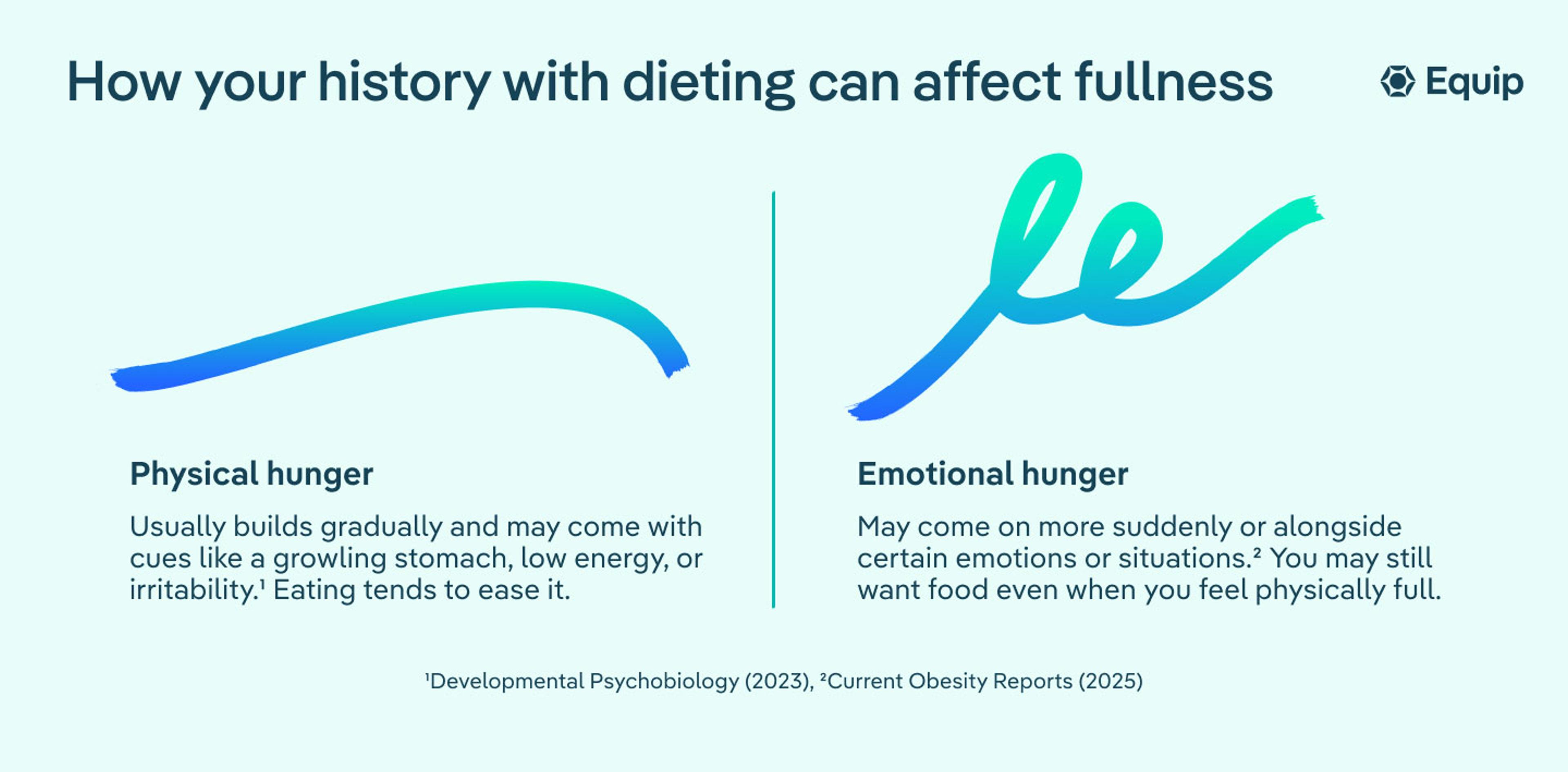
- Physical hunger: Usually builds gradually and may come with cues like a growling stomach, low energy, or irritability, per a 2023 study in Developmental Psychobiology. Eating tends to ease it.
- Emotional hunger: May come on more suddenly or alongside certain emotions or situations, according to Current Obesity Reports. You may still want food even when you feel physically full.
How your history with dieting can affect fullness
If you’ve spent years dieting or restricting what you eat, your hunger and fullness cues may be harder to recognize or trust. That’s because your body may have adapted to not having those signals consistently heard or met.
“Dieting essentially teaches people to eat according to external rules (such as calorie counts or designated meal times) rather than listening to their interoceptive cues,” says Ivelevitch. “Chronic dieting can make hunger and fullness cues less predictable and harder to interpret.”
Restriction can also kick off a biological response that makes fullness especially difficult to detect. When your body isn’t getting enough food, hunger can become much more intense, Ivelevitch explains. That can lead to eating past comfortable fullness, followed by guilt or an urge to restrict again—and thus the binge-restrict cycle continues.
Dieting can also affect satisfaction. Rigid food rules may lead you to choose what you think you “should” eat rather than what actually sounds satisfying, per research in the International Journal of Environmental Research and Public Health. That may leave you feeling physically full, but still wanting something more.
When not feeling full is a sign of something more
Not feeling full from time to time isn’t necessarily cause for concern. But if you’re always hungry even after eating—especially alongside distress around food, feeling out of control while eating, restriction, or bingeing and purging—it may be worth talking to a professional, says Ivelevitch.
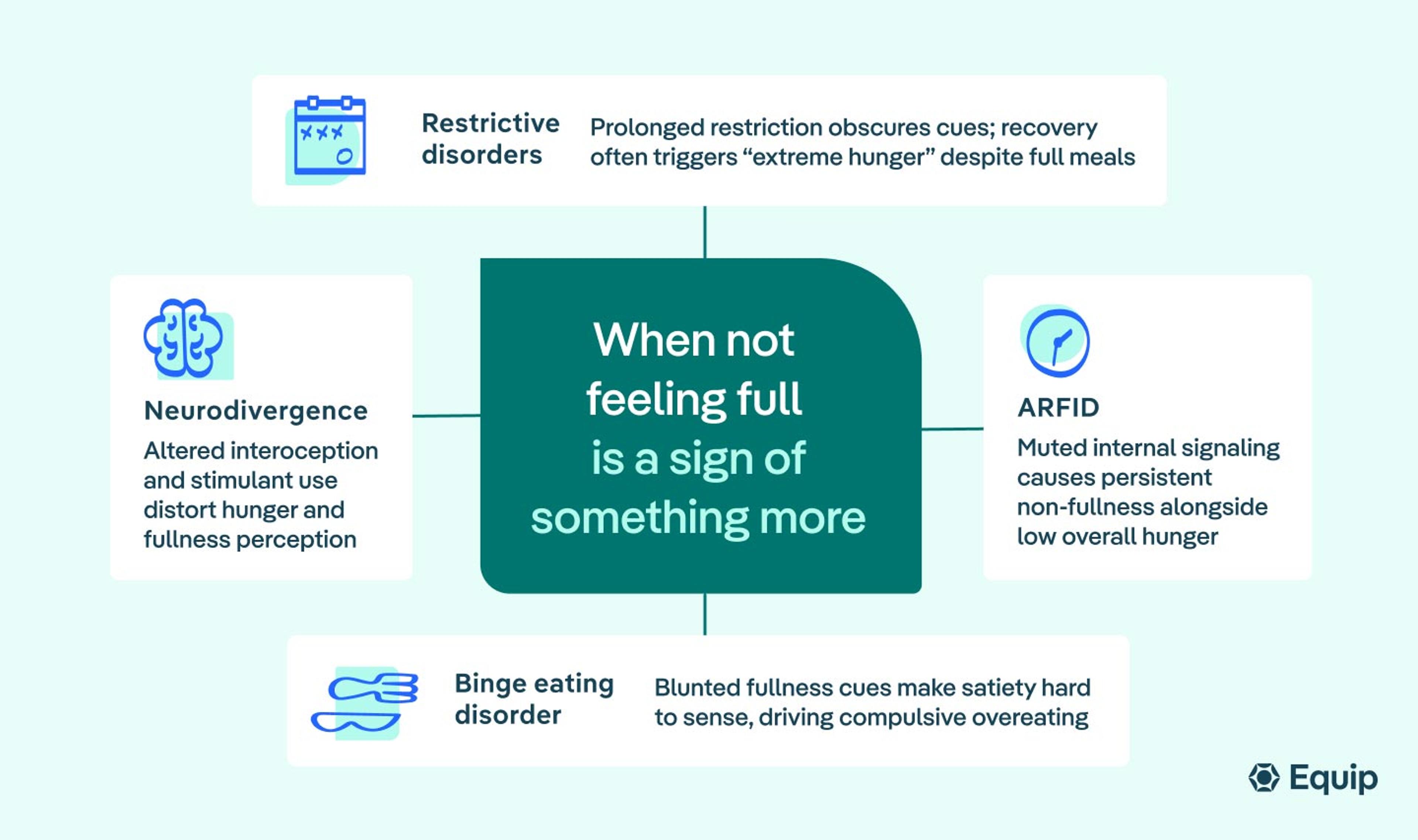
According to Hargrave-Klein and Ivelevitch, consistently not feeling full can sometimes be a sign of:
- Binge eating disorder: During a binge, you may eat beyond physical fullness while feeling unable to stop. While your stomach may technically be full, disrupted hunger and fullness cues can make that fullness difficult to recognize or respond to, leading to compulsive overeating. Other signs of binge eating disorder include feeling out of control or shame.
- Restriction or anorexia: Restriction can make hunger and fullness cues harder to recognize in either direction. In anorexia recovery, you may also experience extreme hunger as your body responds to getting more consistent nourishment. That can mean feeling hungry soon after eating or still wanting food even when you’re physically full.
- Low appetite and lack-of-interest ARFID: Some people with avoidant/restrictive food intake disorder (ARFID) have trouble noticing internal hunger and fullness cues, per research in Pediatric Reviews. For instance, you may feel like you’re never full, but not hungry.
- Neurodivergence: Some neurodivergent people, including those with ADHD, experience internal body signals differently, per a review in Frontiers in Psychiatry. This can make hunger and fullness harder to notice or interpret, which is why ADHD and eating disorders can occur together. Stimulant medications used for ADHD can also affect appetite.
None of these experiences automatically means you have an eating disorder. But if eating feels out of control, causes distress, or takes up a lot of your mental space, you deserve support—and you don’t have to wait until things feel “serious enough” to reach out.
Wondering whether your relationship with food warrants a closer look? Equip’s clinically validated, 2-minute eating disorder screener is a simple place to start.
What you can do to reconnect with fullness
If your fullness cues feel faint or confusing, the first step is figuring out what may be interfering with them. Factors like poor sleep, stress, hormonal changes, health conditions, and medications can all affect hunger and fullness, so identifying the root cause and addressing it may help your cues become clearer.
If you’ve ruled out other causes, you can start rebuilding your connection with fullness through two main practices.
First, start with consistent nourishment. Hargrave-Klein recommends eating regularly throughout the day to support your natural hunger and fullness cues (also known as intuitive eating). If you can’t reliably tell when you’re hungry, mechanical eating (eating on a regular schedule rather than waiting for hunger) can provide helpful structure while your cues are still coming back.
Second, bring more awareness to eating. Ivelevitch recommends approaching meals with curiosity and noticing things like hunger, comfort, energy, mood, enjoyment, and satisfaction before, during, and after eating. This gives you more opportunities to notice and understand what your body is telling you.
And remember, you don’t have to untangle this by yourself. If your fullness changes suddenly or persistently, talk with a healthcare provider to rule out a medical cause. And if eating feels out of control or comes with distress, restriction, bingeing, or purging, an eating disorder professional can help you understand what’s going on and reconnect with your cues.
If any of this feels familiar and you’re not sure whether it’s an everyday issue or something more, Equip’s free, private eating disorder screener can be a low-pressure place to start.
The bottom line
If you never feel full, the cause likely has more to do with how your brain and body communicate than with willpower or self-control. Fullness depends on a complex set of physiological signals, and factors like sleep, stress, health conditions, eating patterns, and a history of restriction can affect how clearly you feel them.
The good news is that these signals can often become clearer with consistent nourishment, time, and the right support. Whether the cause is physical, related to your eating patterns, or something you’re still figuring out, you deserve help understanding what your body is telling you.
Frequently asked questions (FAQs)
Is never feeling full a sign of an eating disorder?
Not necessarily, but consistently not feeling full after eating can sometimes be part of an eating disorder or disordered eating. Restriction, bingeing, and repeatedly overriding your body’s cues can all make hunger and fullness harder to recognize. If not feeling full comes with distress around food, feeling out of control while eating, or significant restriction, consider talking with an eating disorder professional.
Why do I feel like I’m never full but not hungry?
You can have trouble recognizing fullness without feeling clearly hungry, especially if your internal body cues are faint or difficult to interpret. Hunger and fullness both rely partly on interoception—your ability to notice and make sense of signals from inside your body—so you may find that neither cue feels particularly obvious.
Why do I never feel full with ADHD?
ADHD can make hunger cues harder to notice or interpret for some people. Differences in interoception, distraction, and hyperfocus may make it easier to miss physical signals, while stimulant medications can also affect appetite.
Braden, Abby et al. “Emotional Eating and Obesity: An Update and New Insights.” Current obesity reports vol. 14,1 70. 29 Sep. 2025, doi:10.1007/s13679-025-00661-9
Cheon, B K et al. “Avoiding hunger or attaining fullness? Implicit goals of satiety guide portion selection and food intake patterns.” Appetite vol. 138 (2019): 10-16. doi:10.1016/j.appet.2019.03.003
Gomes, Sofia et al. “Sleep Patterns, Eating Behavior and the Risk of Noncommunicable Diseases.” Nutrients vol. 15,11 2462. 25 May. 2023, doi:10.3390/nu15112462
Kaisari, Panagiota et al. “Associations Between Core Symptoms of Attention Deficit Hyperactivity Disorder and Both Binge and Restrictive Eating.” Frontiers in psychiatry vol. 9 103. 29 Mar. 2018, doi:10.3389/fpsyt.2018.00103
Lim, Byunggul et al. “The Effect of Hunger on the Likelihood of Glucose Excursions in Adults with Overweight or Obesity: Continuous Glucose Monitoring and Ecological Momentary Assessment Observational Study.” JMIR formative research vol. 10 e85897. 10 Jun. 2026, doi:10.2196/85897
Péneau, Sandrine et al. “Validation of the Flexible and Rigid Cognitive Restraint Scales in a General French Population.” International journal of environmental research and public health vol. 19,19 12519. 30 Sep. 2022, doi:10.3390/ijerph191912519
Seetharaman, Sujatha, and Errol L Fields. “Avoidant/Restrictive Food Intake Disorder.” Pediatrics in review vol. 41,12 (2020): 613-622. doi:10.1542/pir.2019-0133
Stevenson, Richard J et al. “The development of interoceptive hunger signals.” Developmental psychobiology vol. 65,2 (2023): e22374. doi:10.1002/dev.22374
Sun, Xurui et al. “Neural and hormonal mechanisms of appetite regulation during eating.” Frontiers in nutrition vol. 12 1484827. 24 Mar. 2025, doi:10.3389/fnut.2025.1484827
Verhaegen, Ann A., and Luc F. Van Gaal. “Drugs That Affect Body Weight, Body Fat Distribution, and Metabolism.” PubMed, MDText.com, Inc., 11 Feb. 2019, https://www.ncbi.nlm.nih.gov/books/NBK537590/.