Male Anorexia: What It Looks Like and Why It’s Often Missed

- Anorexia doesn’t have a gender. Boys and men can and do develop anorexia, though it may look different than the stereotype most people expect.
- In males, anorexia often centers on leanness, muscularity, performance, or control, and may include rigid eating and compulsive exercise that can appear “healthy” on the surface.
- Eating disorders in boys and men are frequently missed because of stigma, praise for extreme discipline, and diagnostic tools that weren’t designed with males in mind.
- The medical risks of anorexia are serious for everyone, regardless of gender or body size, and can be present even without extreme weight loss.
- Eating disorder treatment for men works, and recovery is possible with the right support.
For decades, eating disorders have been framed as something that mainly affects girls and women. That belief shows up everywhere: in media, healthcare, and everyday conversations.
It’s also wrong.
Years ago, a friend of mine was known for being “gym-obsessed.” He tracked everything he ate, never missed a workout, and talked about getting leaner often. Most people saw discipline. Some even admired it. What they didn’t see—and what none of us had language for at the time—was that he was quietly struggling with anorexia.
Though we often associate the illness with girls and women, boys and men develop anorexia, too. They struggle with food, body image, and control. They face the same medical risks. Yet many go years without being recognized or diagnosed because what they’re experiencing doesn’t match the narrow stereotype of what anorexia is “supposed” to look like.
Let’s be clear upfront: Anorexia doesn’t have a gender. Here, we’ll dive into how it can show up in boys and men, why it’s often missed, and what treatment and recovery can look like. If you’re worried about yourself or someone you love, you’re not alone, and help is available.
What is male anorexia?
Anorexia nervosa is a serious eating disorder that involves ongoing restriction of food, intense fear of weight gain or body changes, and behaviors that interfere with getting enough nutrition. It also involves rigid rules around eating, a strong need for control, and distress when those rules are disrupted.
“Male anorexia” isn’t a separate diagnosis. It’s a descriptive term sometimes used to describe anorexia nervosa in boys and men—and the fact that it’s even used draws attention to how often anorexia nervosa in men is overlooked.
“Eating disorders are still often assumed to be a ‘female issue,’ which contributes to under recognition in boys and men,” explains Rachel Levine, LMFT, LSWA, CEAP, a therapist at Equip. In fact, as many as 30% of people with eating disorders are male, yet many boys and men are never diagnosed or treated.
In reality, anorexia can affect people of all genders, body sizes, ages, and backgrounds. You don’t have to look emaciated or fall below a specific weight to have anorexia. Many people with anorexia live in bodies that appear average or larger, (a condition called atypical anorexia), and it carries many of the same medical risks.
Regardless of how anorexia shows up, it’s still a treatable mental health condition—and boys and men deserve recognition, care, and support.
How anorexia can show up differently in boys and men
Stereotype | Reality |
Anorexia is always about wanting to be very thin. | In boys and men, anorexia often involves wanting to be lean, very low body fat, or more muscular. |
Anorexia only involves not eating. | Many boys and men both restrict food and exercise excessively. |
People with anorexia avoid exercise. | Many feel driven to work out and become distressed if they miss a workout. |
You have to look underweight to have anorexia. | Boys and men with anorexia may look fit, muscular, or average-sized. People in larger bodies could also be experiencing anorexia. |
Extreme discipline means someone is healthy. | Extreme control around food and exercise can signal an eating disorder. |
Eating disorders in men don’t always look like a drive for thinness. “In boys and men, concerns often center on lean muscularity or low body fat rather than weight loss,” says Levine.
According to Levine, these patterns can resemble dedication to fitness or performance, including:
- Strict food rules
- Cutting out entire food groups
- Focusing on protein, supplements, or macros
- Compulsive exercise
- Distress about missing workouts
- Training despite injury or exhaustion
And because these behaviors align with cultural ideas about discipline and masculinity, they’re often reinforced rather than questioned, she adds.
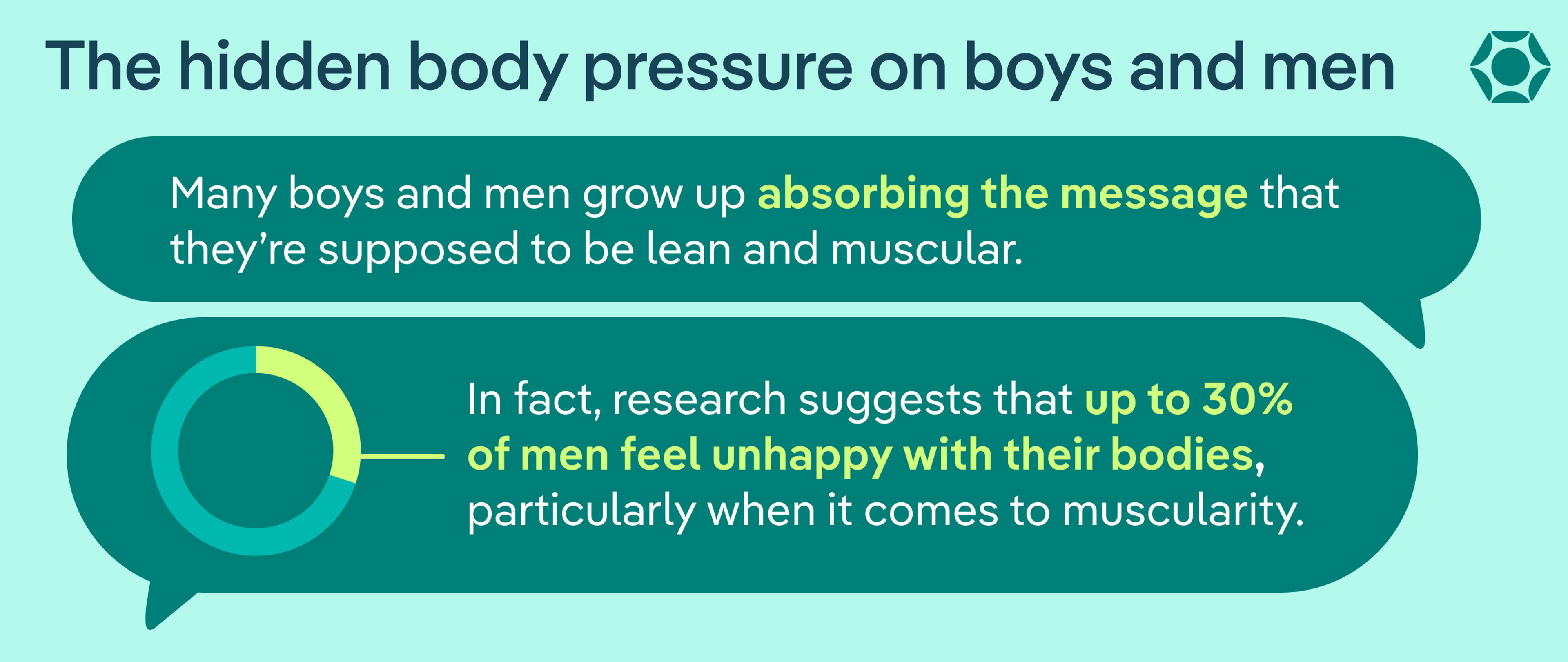
Many boys and men grow up absorbing the message that they’re supposed to be lean and muscular. In fact, research suggests that up to 30% of men feel unhappy with their bodies, particularly when it comes to muscularity.
That’s why, for some, anorexia can overlap with muscle dysmorphia (sometimes called bigorexia). This is a pattern where someone feels “not muscular enough” or “not lean enough” and uses extreme eating or exercise behaviors to try to change their body.
But just because male anorexia can look different on the outside doesn’t mean it’s any less serious. Whether someone is chasing thinness, leanness, or muscularity, anorexia carries the same underlying risks.
Signs of anorexia in boys and men
“Male anorexia is often concealed behind a 2-hour-a-day gym routine or a rigid 3,000-calorie-a-day meal plan.” – Kaila Hattis, MA, LMFT
Anorexia doesn’t look the same in everyone. Some boys and men may appear visibly underweight, while others may not. Some may talk openly about food or body concerns, while others keep their struggles private. What matters most is patterns—especially when thoughts, behaviors, or physical changes start to revolve around food, body shape, or control.
If you’re noticing several of the signs below in yourself or someone else, it may be a signal that it’s time to reach out for help.
Behavioral signs
These are changes in eating, exercise, or daily routines that may signal a problem. In practice, this can look like:
- Skipping meals, eating very small portions, or following increasingly rigid food rules
- Cutting out food groups (like carbs or fats) without a medical reason
- Obsessively counting calories, macros, or tracking food
- Compulsive or rigid exercise, distress when unable to work out, or exercising despite injury or illness
- Using exercise as a way to “make up for” eating
- Avoiding eating in front of others or frequently making excuses to skip meals
- Spending excessive time planning, preparing, or thinking about food
- Using supplements, laxatives, diet pills, or steroids to try to control weight, shape, or muscle mass
- Withdrawing from social situations that involve food
Psychological signs
Not all signs are visible. Some signs of anorexia in males show up in thoughts and feelings, like:
- Intense fear of gaining weight or changing body shape
- Preoccupation with leanness, muscularity, or body fat
- Feeling “never good enough” physically, even with significant weight loss or muscle gain
- Irritability, anxiety, or distress around food or meals
- Perfectionism, rigid thinking, or a strong need for control
- Shame or secrecy about eating habits or exercise
- Difficulty recognizing the seriousness of symptoms or believing help is deserved
Physical signs
Physical changes can also develop as the body becomes undernourished or overworked, such as:
- Noticeable weight loss or failure to gain expected weight during growth
- Fatigue, dizziness, or feeling cold often
- Slowed heart rate or low blood pressure
- Gastrointestinal issues
- Hair thinning or hair loss
- Hormonal changes
- Frequent injuries, stress fractures, or slow healing
Health risks of anorexia in boys and men
Anorexia is a serious medical condition for anyone, regardless of gender. When the body isn’t getting enough fuel—or is being pushed through excessive exercise—multiple systems are affected.
This can happen even when someone doesn’t look “extremely thin” or when weight loss seems subtle, says Levine. In other words, someone can be in real medical danger even if it isn’t obvious.
Health effects of anorexia in boys and men may include:
- Slowed heart rate, low blood pressure, or irregular heart rhythms
- Hormonal changes, such as low testosterone or reduced sex drive
- Bone loss and a higher risk of stress fractures
- Electrolyte imbalances that affect the heart and muscles (can be dangerous and there is a risk of refeeding syndrome, so must be managed under clinical supervision)
- Fatigue, weakness, and brain fog
- Digestive issues like constipation or bloating
- Higher risk of anxiety, depression, substance use, and suicidal thoughts
Some warning signs are easy to misread. A very low resting heart rate, for example, may be chalked up to being “in great shape,” even when it reflects a medical issue, according to Kaila Hattis, MA, LMFT, a therapist and owner of Pacific Coast Therapy. And because boys and men are often diagnosed later, their bodies may endure these stresses for longer, which further increases risk.
Why anorexia in boys and men is often missed
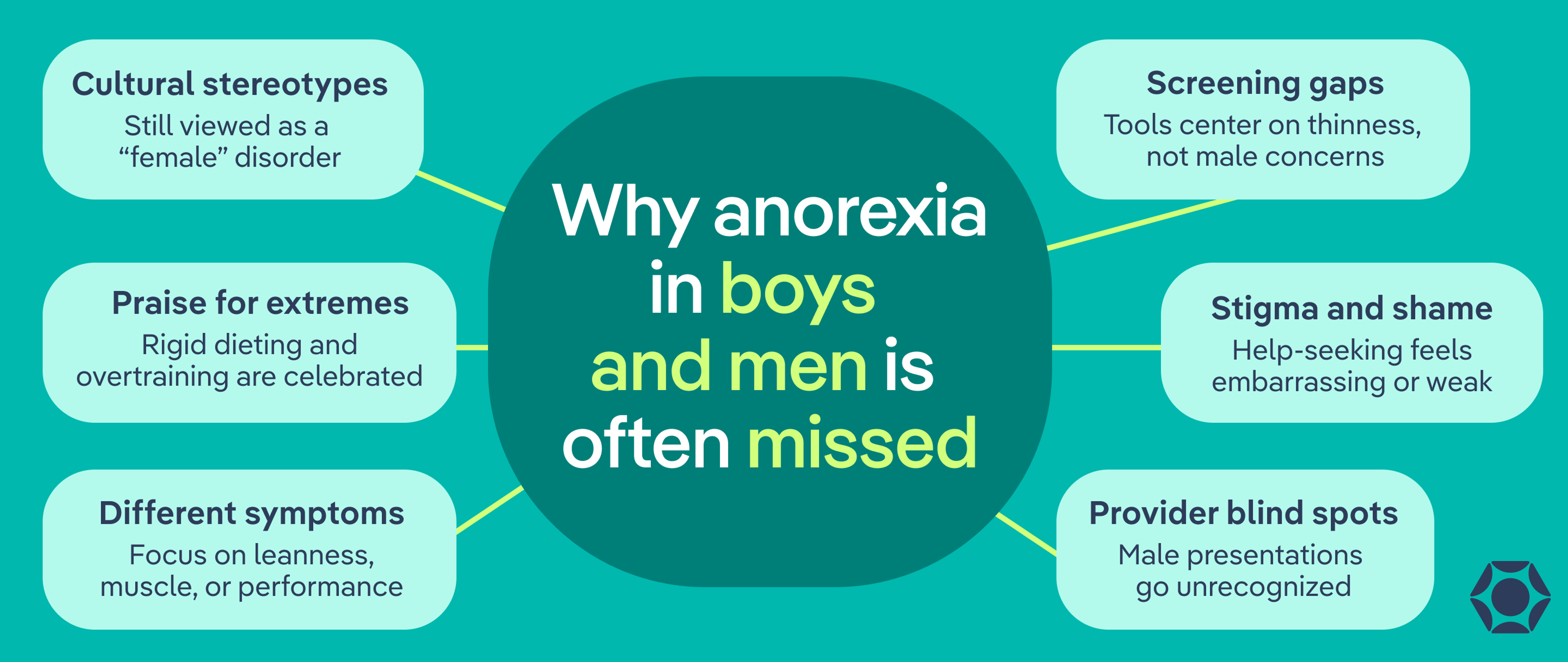
- Cultural stereotypes: Eating disorders are still seen as a “female issue.”
- Praise for extreme behaviors: Weight loss, rigid eating, and intense exercise are often celebrated in fitness culture.
- Different symptom patterns: Focus on leanness, muscle, or performance instead of thinness.
- Screening gaps: Many assessments are built around thinness-focused concerns.
- Stigma and shame: Boys and men may feel embarrassed or weak asking for help.
- Provider blind spots: Clinicians may not recognize male-specific presentations.
Many boys and men with anorexia go unnoticed because our culture, our healthcare systems, and even our diagnostic tools weren’t built with male experiences in mind.
Instead, eating disorders are still widely seen as a “female issue,” says Levine. That belief shapes who gets screened, who feels comfortable speaking up, and, ultimately, who gets diagnosed.
According to Levine and Hattis, several overlapping factors contribute to this:
- Cultural stereotypes: The idea that eating disorders mainly affect girls and women makes it harder for boys and men to recognize their own symptoms (and harder for others to see them, too).
- Stigma and shame: Many boys and men grow up with messages that they should be tough, self-reliant, and unemotional. Struggling with food or body image can feel embarrassing or “unmanly,” which keeps people silent.
- Praise for extreme behaviors: Weight loss, rigid eating, and intense exercise are often framed as signs of discipline or dedication, especially for males. This praise can hide serious risk.
- Gaps in screening and assessment: Traditional screening questions tend to focus on fear of weight gain or desire for thinness, which may miss muscularity- or performance-focused concerns. Amenorrhea (lack of menstruation) also used to be—and sometimes still is—used as criteria for an anorexia nervosa diagnosis.
- Provider dismissal or lack of awareness: Some clinicians simply don’t know what anorexia can look like in boys and men, leading to missed or delayed diagnoses.
What contributes to anorexia in boys and men
There isn’t one single cause of anorexia. Like all eating disorders, it develops from a mix of biological, psychological, and sociocultural factors that interact over time.
According to Hattis and Levine, some common contributing factors for boys and men include:
- Genetics: Having a family history of eating disorders, anxiety, depression, or other mental health conditions can increase risk.
- Cultural pressure around masculinity and bodies: Many boys and men absorb messages that they should be lean, muscular, disciplined, and in control. These ideals are reinforced by media, fitness culture, and social norms.
- Dieting or sport-related restriction: Weight-cutting sports, bodybuilding, or performance-focused training environments can normalize extreme eating and exercise behaviors that can slide into eating disorders in athletes.
- Stressful transitions or major life changes: Puberty, injuries, relationship changes, academic pressure, career stress, or other big shifts can increase vulnerability.
- Using control as a coping strategy: Restricting food or overexercising can become a way to manage anxiety, numb difficult emotions, or feel a sense of control.
How anorexia is diagnosed and treated
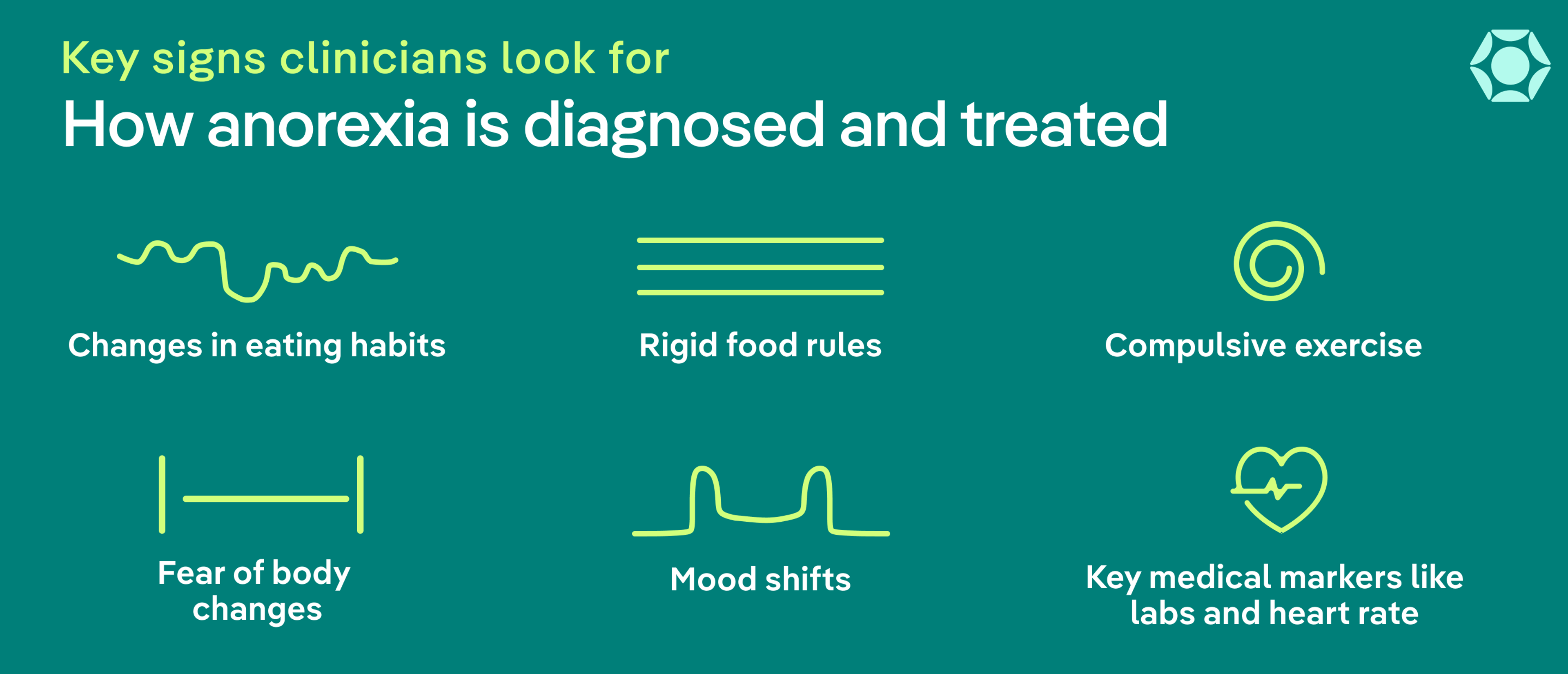
Anorexia is diagnosed based on patterns in eating, exercise, and thoughts (a good place to start is this quick screener). Clinicians also take into account the impact those patterns have on someone’s physical and emotional health—including their bloodwork results, any weight loss, and other physical symptoms. It’s important to note that while weight loss can be a factor, anorexia affects people of all body sizes. Clinicians look at things like:
- Changes in eating habits
- Rigid food rules
- Compulsive exercise
- Fear of body changes
- Mood shifts
- Medical markers such as heart rate, blood pressure, labs, and growth or weight history
For boys and men, it’s especially important that providers ask about muscularity goals, supplement use, and exercise patterns, not just fear of gaining weight. When those questions aren’t asked, many people are left wondering whether what they’re experiencing “counts.”
That uncertainty often turns into the belief that they don’t look “sick enough” to deserve help. This belief is incredibly common, and it’s one of the biggest barriers to care. But you don’t have to meet a stereotype to deserve support.
Once you have a diagnosis, treatment focuses on two things at the same time: restoring physical health and addressing the thoughts and coping patterns that keep the disorder going.
That usually includes:
- Medical monitoring to make sure the body is safe
- Nutrition support to help the body get the fuel it needs
- Therapy to build healthier coping skills and address anxiety, perfectionism, or control
- Family or caregiver involvement when helpful
- Ongoing support to strengthen recovery and prevent relapse
Research shows that when boys and men receive evidence-based treatment, they respond just as well as females. The takeaway: Anorexia in any gender is treatable, and recovery is possible.
Barriers boys and men often face when seeking help
“Emotional socialization teaches many boys and men to minimize vulnerability and suppress distress, which may delay recognition of internal struggles and promote disordered behaviors.” — Rachel Levine, LMFT, LSWA, CEAP
Even when something feels off, reaching out can be hard. According to Levine, many boys and men run into obstacles such as:
- Feeling like they won’t belong in treatment spaces
- Telling themselves it’s “not that bad”
- Struggling to put emotions into words
- Lack of provider expertise regarding male anorexia
- Being dismissed in the past
These barriers are real. But they don’t mean help isn’t available. Inclusive, knowledgeable care exists, and asking for support is not a sign of weakness. “Genuine strength is displayed through vulnerability,” says Hattis.
Anorexia in LGBTQIA+ boys and men
LGBTQIA+ boys and men experience higher rates of eating disorders, including anorexia. This isn’t because of their sexual or gender identity—it’s because many face higher levels of stigma, discrimination, and pressure about their bodies.
In some LGBTQIA+ spaces, there can be strong and sometimes conflicting ideals about appearance, such as pressure to be lean, muscular, toned, or a specific “look” tied to belonging or desirability. For someone who already feels vulnerable, controlling food or exercise can start to feel like a way to cope, gain a sense of control, or try to feel safer in their body.
For transgender and nonbinary people, eating disorder symptoms can also intersect with gender dysphoria: For example, using restriction or weight manipulation in an attempt to change how the body looks or is perceived. These experiences are real and deserve the same level of care as any other presentation of anorexia.
Because of these added stressors, affirming and inclusive care matters. Everyone deserves eating disorder treatment that honors who they are—feeling respected, understood, and safe in treatment can make a meaningful difference.
Supporting a boy or man with anorexia
Watching someone you care about struggle with anorexia can feel frightening, confusing, and exhausting. You may not know what to say, when to step in, or how to help without making things worse.
But you don’t have to have the perfect words to make a meaningful difference. Here are some ways to support a loved one who may be struggling:
- Trust your gut: If something feels off, it’s worth paying attention. You don’t need proof or a diagnosis to express concern.
- Look beyond weight or appearance: Changes in eating, exercise, mood, or isolation can matter more than how someone looks.
- Lead with care, not confrontation: Use “I” statements (for example, “I’ve noticed you seem really stressed around food, and I’m worried about you.”) rather than accusations.
- Encourage professional help: Offer to help find a provider, schedule an appointment, or attend a consultation together.
- Reduce isolation: Many boys and men feel alone or like they don’t belong in eating disorder spaces. Connecting them with others who have lived experience—such as Equip’s male-specific support groups or peer mentors—can be powerful.
- Advocate when concerns are dismissed: It’s okay to speak up, ask more questions, or look for another provider if you don’t feel your loved one is being taken seriously.
- Take care of yourself: Consider talking with a therapist, joining a caregiver support group, or leaning on trusted people in your life so you’re not carrying this alone.
Recovery is possible for boys and men
“Despite the barriers, when boys and men do receive evidence-based care, treatment response is similar to females, underscoring the importance of early recognition and inclusive practice.” — Rachel Levine, LMFT, LSWA, CEAP
Recovery from anorexia is real, and it happens for boys and men. With evidence-based treatment, people can stabilize medically, restore regular eating, reduce compulsive exercise, and loosen the rigid thoughts that keep the disorder in place, according to Levine.
Getting support earlier can improve outcomes, but it’s never too late to start. Many people seek help after months or years of struggling and still see meaningful improvements in their health, relationships, and quality of life.
Recovery doesn’t mean losing your identity, strength, or goals. It means having enough energy to think clearly, train or move in healthier ways (if and when appropriate), show up for school, work, and relationships, and handle stress without relying on food or exercise as the only coping tools.
The bottom line
Even though eating disorders are still seen as a “female problem,” anorexia doesn’t have a gender. Boys and men can and do develop this illness, even when it doesn’t look the way most people expect.
Anorexia in boys and men is often missed because symptoms may center on leanness, muscularity, performance, or compulsive exercise. Different presentation doesn’t mean different severity. The risks are real, regardless of body size or appearance.
Boys and men deserve to be taken seriously. They deserve access to informed, inclusive care. And they deserve to know that recovery is possible. So if you’re worried about yourself or someone you love, you don’t have to wait for things to get worse. Help is available, and recovery is within reach.
Frequently asked questions (FAQs)
Can you have anorexia without wanting to be thin?
Yes. Many boys and men with eating disorders are not trying to be thin. Instead, their concerns may focus on being lean, having very low body fat, looking more muscular, or improving performance. The underlying pattern—restriction, rigid control, and fear of body changes—is what defines anorexia, not a desire for thinness.
Is excessive exercise a sign of anorexia in men?
It can be. Many men with anorexia feel driven to exercise in a rigid or compulsive way, become anxious if they miss workouts, or use exercise to compensate for eating. When exercise starts to feel out of control or interferes with health, relationships, or daily life, it may be part of an eating disorder.
What should I do if I’m worried about someone’s eating or exercise?
Start by sharing your concern in a calm, supportive way. Focus on specific behaviors you’ve noticed rather than appearance. Encourage a medical and mental health evaluation, and offer to help find providers or attend an appointment. Advocate for your loved one if they feel dismissed: It’s okay to ask questions, try a new doctor, and request an eating disorder screening or referral to a specialist.
Arslan, Müge et al. “The Effect of Bigorexia Nervosa on Eating Attitudes and Physical Activity: A Study on University Students.” International journal of clinical practice vol. 2022 6325860. 24 Aug. 2022, doi:10.1155/2022/6325860
Bell, Kathryn et al. “Eating Disorder Symptoms and Proneness in Gay Men, Lesbian Women, and Transgender and Non-conforming Adults: Comparative Levels and a Proposed Mediational Model.” Frontiers in psychology vol. 9 2692. 8 Jan. 2019, doi:10.3389/fpsyg.2018.02692
Bunnell, Douglas. “Eating Disorders in Men and Boys.” National Eating Disorders Association, 8 Mar. 2024, www.nationaleatingdisorders.org/eating-disorders-in-men-and-boys/.
Clemente-Suárez, Vicente Javier et al. “The Impact of Anorexia Nervosa and the Basis for Non-Pharmacological Interventions.” Nutrients vol. 15,11 2594. 1 Jun. 2023, doi:10.3390/nu15112594
Cusack, Claire E et al. “Eating disorders among queer and trans individuals: Implications for conceptualization, assessment, and treatment.” Bulletin of the Menninger Clinic vol. 88,2 (2024): 128-147. doi:10.1521/bumc.2024.88.2.128
Frostad, Stein, and Mette Bentz. “Anorexia nervosa: Outpatient treatment and medical management.” World journal of psychiatry vol. 12,4 558-579. 19 Apr. 2022, doi:10.5498/wjp.v12.i4.558
Gorrell, Sasha et al. “Gender-based clinical differences in evidence-based treatment for adolescent anorexia nervosa: analysis of aggregated randomized controlled trials.” Eating and weight disorders : EWD vol. 27,3 (2022): 1123-1130. doi:10.1007/s40519-021-01257-7
Gorrell, Sasha, and Stuart B Murray. “Eating Disorders in Males.” Child and adolescent psychiatric clinics of North America vol. 28,4 (2019): 641-651. doi:10.1016/j.chc.2019.05.012
Mills, Regan et al. “Early intervention for eating disorders.” Current opinion in psychiatry vol. 37,6 (2024): 397-403. doi:10.1097/YCO.0000000000000963
Moore, Christine A, and Brooke R Bokor. “Anorexia Nervosa.” National Library of Medicine, StatPearls Publishing, 2023, www.ncbi.nlm.nih.gov/books/NBK459148/.
Quittkat, Hannah L et al. “Body Dissatisfaction, Importance of Appearance, and Body Appreciation in Men and Women Over the Lifespan.” Frontiers in psychiatry vol. 10 864. 17 Dec. 2019, doi:10.3389/fpsyt.2019.00864