Laxative Abuse and Eating Disorders: Understanding the Signs and the Path to Recovery


- Laxative misuse involves the regular and frequent or excessive use of laxatives.
- It is a disordered behavior that people with eating disorders may engage in because of the misconception that a bowel movement leads to weight loss or because of the “empty” feeling it produces.
- Calories are digested in the small intestine, long before waste reaches the rectum for defecation, so laxative misuse does not lead to weight loss.
- Laxative misuse can lead to short- and long-term health complications.
- You don’t need an eating disorder diagnosis to seek help for laxative misuse, and recovery is possible.

Many people need a laxative now and then to ease a bout of constipation. In these cases, a laxative is harmless and can relieve discomfort. But if you find yourself or a loved one constantly using laxatives, it can have negative health impacts and may signal a larger issue, such as an eating disorder.
People often search the term “laxative abuse” to understand more about what might be going on. Medical studies also sometimes use this term. For these reasons, we’ve used the phrase here and in our headline. However, the word “abuse” is loaded with stigma, adding shame to an already tough topic. Equip clinicians prefer using “laxative misuse,” and that’s what you’ll find throughout the rest of this article.
Embarrassment about misusing laxatives is common. We don’t want to pile on additional negative feelings. Instead, we want to raise awareness and encourage seeking help, because the issue is often beyond yours or a loved one’s control.
Laxative misuse is linked to compulsion, an uncontrollable urge to do something, and compulsivity is driven by brain biology, not a lack of willpower. Both compulsivity and laxative misuse are also linked to eating disorders.
However, laxative misuse doesn’t require an eating disorder diagnosis to be taken seriously. On its own, it’s recognized as a serious behavior that can harm health. Help for laxative misuse is available, regardless of whether you or a loved one has an eating disorder diagnosis.
In this article, we explore the link between laxative misuse and eating disorders, the potential health risks, and what treatment might look like.

What is laxative abuse?
Laxative misuse is the regular or excessive use of laxatives to produce a bowel movement.
The behavior can be a sign of an eating disorder, but people may also misuse laxatives for other reasons. For instance, people with chronic constipation might overuse laxatives to find relief. Athletes trying to cut weight for a competition also might engage in the practice. And finally, some people may misuse laxatives to create the illusion of an illness by inducing diarrhea. Most commonly, however, the issue is related to disordered eating behaviors.
“I describe laxative misuse to my patients as the repeated use of laxative medication to try to lose weight, change or control body size, or alleviate guilt after binging episodes,” says Hannah Stadler, LMFT, a therapist at Equip. “This can look like using excessive quantities of laxatives and/or using them regularly and frequently for those reasons.”
Why laxatives do not work for weight loss
Laxatives do not cause true weight loss. By the time feces reach your colon and rectum, your small intestine has already absorbed calories from foods and drinks.
Rather than containing calories, feces are made up of about 75% water and 25% solid matter. The solid matter contains fiber (which your body can’t digest), cholesterol, bacteria, dead cells and cellular material, bile, and other waste products.
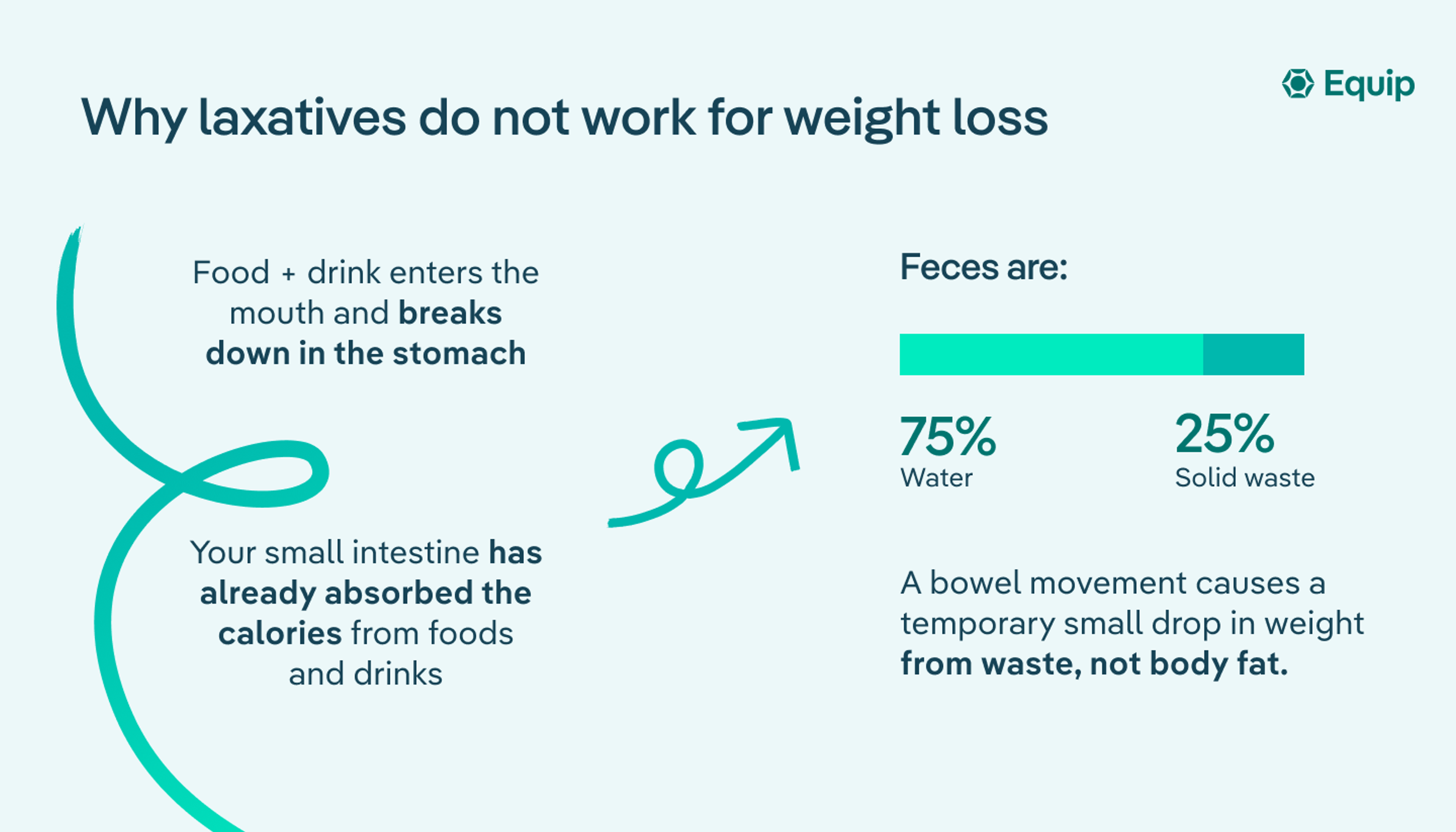
A bowel movement might produce a small drop in weight, since feces do weigh a small amount. This drop is not from the loss of stored body fat, however, and the weight lost will return with the next meal or beverage.
How laxative misuse connects to eating disorders
Laxative misuse is a common behavior tied to eating disorders. Eating disorders sometimes feature what’s called “compensatory behaviors,” which are behaviors meant to “make up for” or “get rid of” food eaten.
Compensatory behaviors in eating disorders include:
- Chewing and spitting out food
- Fasting
- Diuretic misuse
- Enema or colonic misuse
- Oral laxative misuse
- Overexercising
- Self-induced vomiting
- Skipping meals
“Laxative use can be common in patients with anorexia nervosa and bulimia nervosa as an effort to try to lose weight and/or purge via laxatives to induce more frequent bowel movements that could lead to weight loss,” Stadler says. Again, any weight lost through laxative misuse is not a true weight loss.
“This behavior signals a potential eating disorder because the individual is displaying actions connected to a goal of rapid weight loss, controlling body size, trying to expel or purge food they are eating,” Stadler says. “It can frequently be used in combination with other eating disorder behaviors such as purging via vomiting, restricting intake, and compulsive exercise.”
What are signs of laxative misuse?
You might be concerned about your own laxative use and wondering if you’re misusing these products. Or you might be concerned about a loved one’s recent behaviors. Here are signs to watch for in yourself or in a loved one.
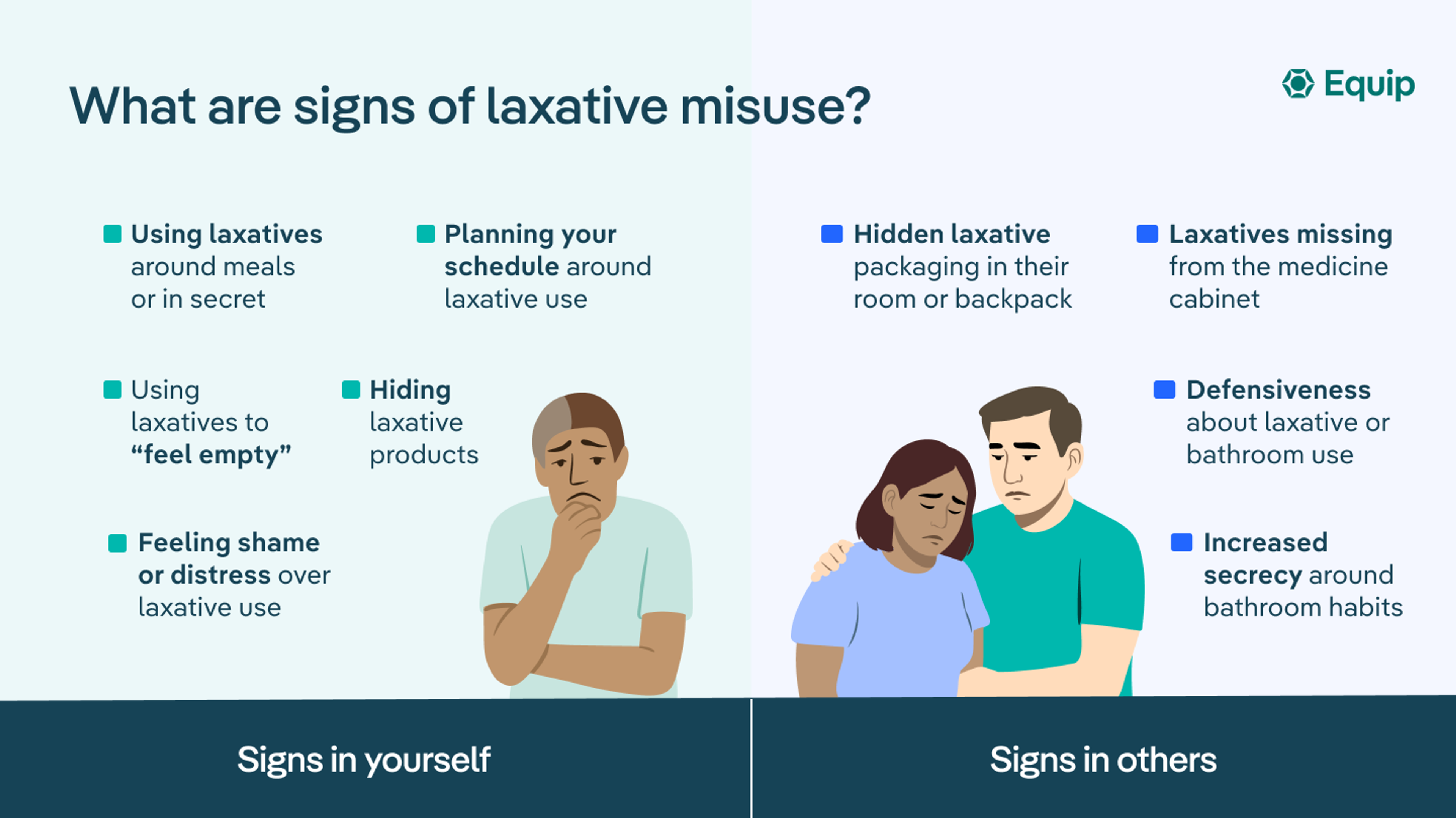
Signs in yourself
- Using laxatives before or after meals or snacks
- Hiding laxative products and using them in secret
- Feeling shame around using laxatives
- Using laxatives to “feel empty”
- Planning your schedule around when you can use laxatives
- Feeling distress when you are unable to use a laxative
Signs in someone you love
- You find hidden laxative supplies or packaging in their room or backpack.
- Laxatives have gone missing from your family’s medicine cabinet.
- You’ve noticed a new secrecy around your loved one’s bathroom use.
- Your loved one becomes defensive when asked about laxative or bathroom use.
Whether you’re worried about yourself or a loved one, you can also take Equip’s free five-minute eating disorder screener to assess whether you should be concerned.
What are the health risks of laxative misuse?
Laxative misuse can have several negative effects on health, both in the short and long term.
“Potential complications of laxative misuse include severe physical harm, such as intensified dehydration, damage to the digestive tract, electrolyte imbalances, physical dependency on the medication, and a false sense of weight loss,” Stadler says. “These physical complications can lead to more severe issues such as paralysis, irregular heartbeat, rectal prolapse, and even sudden cardiac arrest if left untreated, thus making addressing the behavior in a timely manner so crucial.”
Short-term effects
- Abdominal cramping or pain
- Bloating
- Dehydration
- Diarrhea
- Dizziness
- Electrolyte imbalance
- Fecal incontinence
- Frequent bowel movements
- Nausea and vomiting
- Urgency
- Weakness
Long-term risk and dependence
- Bone loss or damage
- Chronic dehydration
- Chronic constipation
- Colonic nerve and muscle damage
- Disruption to gut microbiome
- Heart arrhythmias (abnormal heart rhythms)
- Heart failure
- Kidney damage
- Kidney stones
- Muscle weakness or paralysis
- Persistent electrolyte imbalances
- Reduced bowel function (“lazy colon”) or laxative dependence
- Sudden cardiac arrest (heart stops beating)
Laxative misuse health risks at a glance
Risk | What happens | Why it matters |
Dehydration | You eliminate fluids with every bowel movement | Dehydration places strain on organs and impedes blood circulation |
Electrolyte imbalance | Loss of water in feces also causes mineral loss, and several minerals are electrolytes; additionally, some electrolytes contain minerals, such as magnesium | Electrolytes are minerals that help maintain fluid balance and are involved in muscle, heart and brain function; an electrolyte imbalance places a strain on tissues and organs |
Digestive dependence | Overuse of stimulant laxatives can lead your colon to become dependent on them | Laxative overuse can lead to “lazy colon,” in which the muscles and nerves of the large intestine stop functioning properly without laxatives |
Long-term organ strain | Dehydration and electrolyte imbalances impair kidney and heart function | Over time, strain on the kidneys or heart can lead to serious damage and even failure |
What does recovering from laxative misuse look like?
Recovering from laxative misuse involves a multidisciplinary approach that addresses the underlying reasons for engaging in the behavior.
In the introduction of this article, we noted that laxative misuse can be a compulsive behavior, according to research published in the Journal of Psychiatric Research.
Compulsive behaviors stem from complex interactions among the brain's decision-making, habit-forming, and sensory-signaling systems, as well as dysregulation of various neurotransmitters (chemical messengers), according to research published in Neuropsychology Review.
For these reasons, stopping can be challenging. Stopping is not a matter of willpower; instead, it’s about retraining the brain, and that’s where a knowledgeable care team comes in.
“Recovery from laxative misuse can involve patient psychoeducation from a trained professional to target a patient’s psychological dependency on laxatives,” Stadler says.
Why stopping safely takes support
A sudden cessation of laxatives after using them for a long time can cause physical complications. That’s why it’s important to stop the behavior with the help of a doctor or eating disorder-informed professional rather than trying to navigate the situation on your own.
The use of stimulant laxatives can lead to dependence. This can mean that the muscles and nerves of your digestive tract that are involved in the movement of waste stop working as effectively, or at all.
When you stop using laxatives after a period of misuse, these muscles and nerves don’t immediately return to their normal functioning. This can lead to uncomfortable rebound constipation, bloating, and other symptoms, and you may need to retrain your bowels under the guidance of a medical professional.
What treatment involves
The treatment you or a loved one needs for laxative misuse will vary depending on unique circumstances. The best approach is to work with a multidisciplinary care team that can offer medical, nutrition, and therapy support to help stop laxative misuse safely and address the underlying factors contributing to the behavior.
An eating disorder-informed therapist can employ evidence-based approaches to treating laxative misuse, such as cognitive behavioral therapy for eating disorders (CBT-E) and exposure and response prevention (ERP).
Equip offers multidisciplinary, judgment-free care for eating disorders and disordered eating patterns, like laxative misuse. Even if you do not have an eating disorder diagnosis, Equip can help. You do not have to wait for symptoms to become “serious enough,” and early intervention usually leads to better outcomes.
The bottom line
Laxative misuse for weight loss is a common compensatory behavior that’s linked to eating disorders. Although more frequent bowel movements may give the illusion of weight loss, the loss is due to water weight, not actual fat loss.
Laxative misuse may seem like a harmless behavior, but it can lead to serious health complications including dehydration, electrolyte imbalances, organ strain, and dependence on laxatives.
Since laxative misuse can become a compulsion, stopping is less about willpower and more about complex processes in the brain. But help is available and recovery from laxative abuse and eating disorders is possible.
FAQ
What’s the difference between occasional laxative use and laxative misuse?
Occasional laxative use involves using a laxative once in a while to treat constipation, such as while traveling or after surgery. People also sometimes use non-stimulant laxatives as directed by their doctor to treat ongoing constipation as a symptom of an underlying condition or a side effect of a medication. Laxative misuse is different. It involves ongoing or excessive use of laxatives without a medical reason or doctor’s recommendation.
How often is too often to take laxatives?
This will depend on the type of laxative in question. Stimulant laxatives should only be used sparingly for a few days or as directed by your doctor. Osmotic laxatives should only be used for a week or less, unless your doctor directs you to take this type regularly. Bulk-forming laxatives are considered fiber supplements and can safely be used regularly as long as you are drinking enough fluids.
Can a colonoscopy detect laxative misuse?
In some cases, laxative misuse can be detected with a colonoscopy. This is because some stimulant laxatives can leave a dark pigment on the colon lining over time, a condition called melanosis coli.
MacNeil, Brad A., et al. “Examining the Associations between Laxative Use, Substance Use, Depressive Symptoms, and Obsessions and Compulsions in Adults with an Eating Disorder.” Journal of Psychiatric Research, vol. 182, Feb. 2025, pp. 142–48.
Luigjes, Judy, et al. “Defining Compulsive Behavior.” Neuropsychology Review, vol. 29, no. 1, Apr. 2019, p. 4.
Mawer, Scott, and Ali F. Alhawaj. “Physiology, Defecation.” StatPearls, StatPearls Publishing, 2026.
Roerig, James L., et al. “Laxative Abuse.” Drugs, vol. 70, no. 12, Aug. 2010, pp. 1487–503.
Van Den Heuvel, Odile A., et al. “Brain Circuitry of Compulsivity.” European Neuropsychopharmacology, vol. 26, no. 5, May 2016, pp. 810–27.