What Is Food Noise? Causes, Signs & How to Quiet It


- Food noise refers to obsessive, repeated thoughts about food that occur even when you’re not hungry.
- Food noise doesn't always mean you have an eating disorder, but it's a common symptom of one.
- Physical hunger usually eases after eating, while food noise often persists even when you meet your body's nutritional needs.
- Consistently eating enough, challenging rigid food rules, and rebuilding trust in your body's hunger cues can help quiet food noise.
- If thoughts about food are taking over your day or causing distress, it's worth talking with an eating disorder-informed provider.

While everyone thinks about food here and there, food noise refers to persistent thoughts about food that feel difficult to ignore. It isn't an eating disorder itself, but it can be a symptom of one—particularly when those thoughts are constant, distressing, or interfere with daily life.
Although the experience isn't new, the phrase "food noise" is. It exploded into the mainstream after Oprah Winfrey's TV special “Shame, Blame and the Weight Loss Revolution,” in which several people—including Winfrey herself—described how GLP-1 medications reduced the constant mental chatter around food.
Since then, the term has appeared in advertisements and other conversations about weight loss medications. But food noise is much more nuanced than those messages might suggest, and it's especially complex for people with eating disorders.
"My food noise was always on," says Equip Lead Recovery Coach Makailah (Mak) Dowell. "It never turned off, even after meals and snacks. My food noise served as a bully to ensure I aligned with my eating disorder, not with myself."
For Dowell, restricting food only made the problem worse. "For some folks, when they step away from the food, the food noise becomes quieter," she says. "For me, it would only turn up more."
Below, learn the true definition of food noise, how to spot it, and how to get support when the noise becomes too loud.
What is food noise?
Food noise refers to persistent thoughts about food that feel unwanted or distressing, or cause social, mental, or physical problems, according to Nutrition & Diabetes.
“[It’s] the persistent and unwanted thoughts, feelings, and beliefs about food and eating that take up excessive mental, physical, and emotional space,” agrees Tanya Hargrave-Klein, MS, RDN, LD, lead eating disorder dietitian at Equip. “This may include obsessive thoughts about food rules.”
One common example is the belief that you shouldn't eat between meals, a rule that Hargrave-Klein says can create a cycle of self-judgment.
"This becomes part of food noise when a person 'shoulds' themself about never breaking this rule," she says. "Then it becomes difficult to not have obsessive thoughts about eating snacks: 'What would I have?' 'What would it taste like?' 'When would I have it?'"
Many of Hargrave-Klein's patients describe this internal dialogue as a tape playing on repeat. "[This] crowds out space for other thoughts, making them unable to be truly present in the moment and fully engage in other activities," she says.
For Dowell, food noise was a constant loop of thoughts like "you don't deserve this meal," "that's too much food," and "that food is too scary right now."
"I would describe it as the isolated events where the eating disorder, anxiety, or stress of a meal/snack/food is loud," Dowell says. "These thoughts would continually show up in my mind to the point where I would step outside of my values and into my eating disorder."
What causes food noise?
Food noise doesn't have a single cause. It is often triggered by factors like physical hunger and undereating, chronic dieting or food restriction, stress, and differences in the way the brain processes hunger and fullness cues. Often, more than one of these factors is at play.
And while food noise can interfere with quality of life and signal an underlying problem, it's important to remember that thinking about food isn't inherently a bad thing.
“People have thoughts about food throughout the day,” Hargrave-Klein says. “We think about which foods are in our pantry, what foods taste good, and which foods would satisfy our hunger. These recurring thoughts help us plan ahead so that we can nourish adequately. It’s when these thoughts become more persistent that they can be problematic.”
One of the biggest drivers of food noise is restriction, according to Alyssa O’Connell, RDN, registered dietitian at Equip.
“When the body or mind senses a lack of adequate nourishment or freedom around food, it hyper-focuses on it as a survival mechanism, generating persistent thoughts about eating,” she explains.
One classic study from 1944 illustrates just how powerful the role of restriction can be. In the Minnesota Starvation Experiment, researchers placed 36 healthy young men on a calorie-restricted diet that caused them to lose about 25% of their body weight. As the study went on, many participants developed obsessive thoughts about food, irritability, unusual eating behaviors, anxiety, and depression.
“If someone gets too hungry or restricts their intake of food, this may trigger food noise and lead to out-of-control eating when they finally give themself permission to eat,” adds Hargrave-Klein. This can result in the binge-restrict cycle: Restriction leads to intense hunger and overeating, which triggers guilt and another attempt to restrict, which then leads to hunger, food noise, and more overeating.
Stress can also turn up the volume on food noise, per research in Nutrients. For some people, difficult emotions like anxiety, uncertainty, or shame make food thoughts more persistent even when they're not physically hungry.
Dowell says that in her case, the thoughts weren't simply about eating. They were rooted in guilt, shame, and the belief that certain foods made her "good" or "bad."
"My food noise would deem me worthy or not every single day," she says. "It controlled me."
Food noise can also look different for neurodivergent people.
What Equip treatment looked like for real patients


For example, some people with ADHD have differences in interoception (the ability to recognize internal body signals like hunger and fullness). This can make it harder to distinguish physical hunger from other sensations, according to research in Biological Psychology. As a result, some may have a harder time recognizing when they're truly hungry or full, which can make thoughts about food feel more frequent or difficult to interpret.
Others may find that impulsivity, hyperfocus, or sensory sensitivities influence how often they think about food. These experiences don't necessarily mean someone has both ADHD and an eating disorder, but they can overlap.
Food noise vs. hunger: how to tell the difference
It's common to assume that food noise means you're hungry all the time. But in reality, hunger and food noise are two different things, says Cay Schubert, LICSW, a social worker and therapist at Fields That We Know Psychotherapy.
Physical hunger is your body's way of signaling that it needs nourishment, per Endotext. Food noise, meanwhile, is often fueled by restriction, dieting, rigid food rules, stress, or disordered eating, says Schubert.
So how can you tell which one you're experiencing?
“Physical hunger typically presents with bodily cues. This can be a rumble in the stomach, low energy, or lightheadedness that can fade when one eats,” says O’Connell. “Food noise, on the other hand, tends to present as a repetitive, intrusive, or anxious thought about food, even when not physically hungry.”
Physical hunger | Food noise |
A physical signal that your body needs nourishment | Persistent mental chatter about food |
Usually builds gradually over several hours | Can feel intrusive, repetitive, or difficult to turn off |
Often comes with physical sensations like a growling stomach, low energy, or irritability | Often involves food rules, guilt, anxiety, or obsessive thoughts about eating |
Usually becomes quieter after eating enough | May continue or become louder after eating, especially during periods of restriction |
Helps you recognize when your body needs food | Can make it harder to recognize and trust your body's hunger cues |
Is food noise a sign of an eating disorder?
Food noise isn't an eating disorder itself, but it is a common symptom of many eating disorders, per Nutrition & Diabetes. While everyone experiences thoughts about food from time to time, persistent, distressing food noise—especially when it's paired with restriction or rigid food rules—can be an early sign that something deeper is going on.
The Minnesota Starvation Experiment offers one explanation why, by showing what happens when you don’t eat enough: after months of calorie restriction, the participants (who did not have eating disorders) developed obsessive thoughts about food. Those changes resemble the thought patterns Hargrave-Klein says she regularly sees in people with eating disorders.
“Some report not being able to stop thinking about what food looks like, smells like, or tastes like,” she says. “Others report overwhelming urges to view photos of food, scroll Pinterest for recipes, or report an inability to stop thinking about their next meal or snack.”
While everyone's experience with food noise is different, Hargrave-Klein says one pattern stands out: "While individual experiences with food noise vary from person to person, it's rare that food noise is not present with an eating disorder."
When to be worried about food noise
Persistent food noise can sometimes be a symptom of an underlying issue that needs to be addressed, like an eating disorder, chronic food restriction or dieting, or prolonged stress. While thoughts about food are a normal part of life, they shouldn't crowd out everything else or leave you feeling distressed, says Hargrave-Klein.
Here are some signs food noise is cause for concern:
- Thoughts about food negatively affect your performance at school, work, or daily responsibilities
- You find yourself thinking about food when trying to engage in activities that used to make you happy
- You plan your meals and snacks far in advance, and repeatedly think about what you’re going to eat (even after you’ve already decided)
- You ruminate about food you’ve eaten
- You spend an abnormal amount of time consuming food-related content
- Thoughts about food feel more important than all or most other thoughts
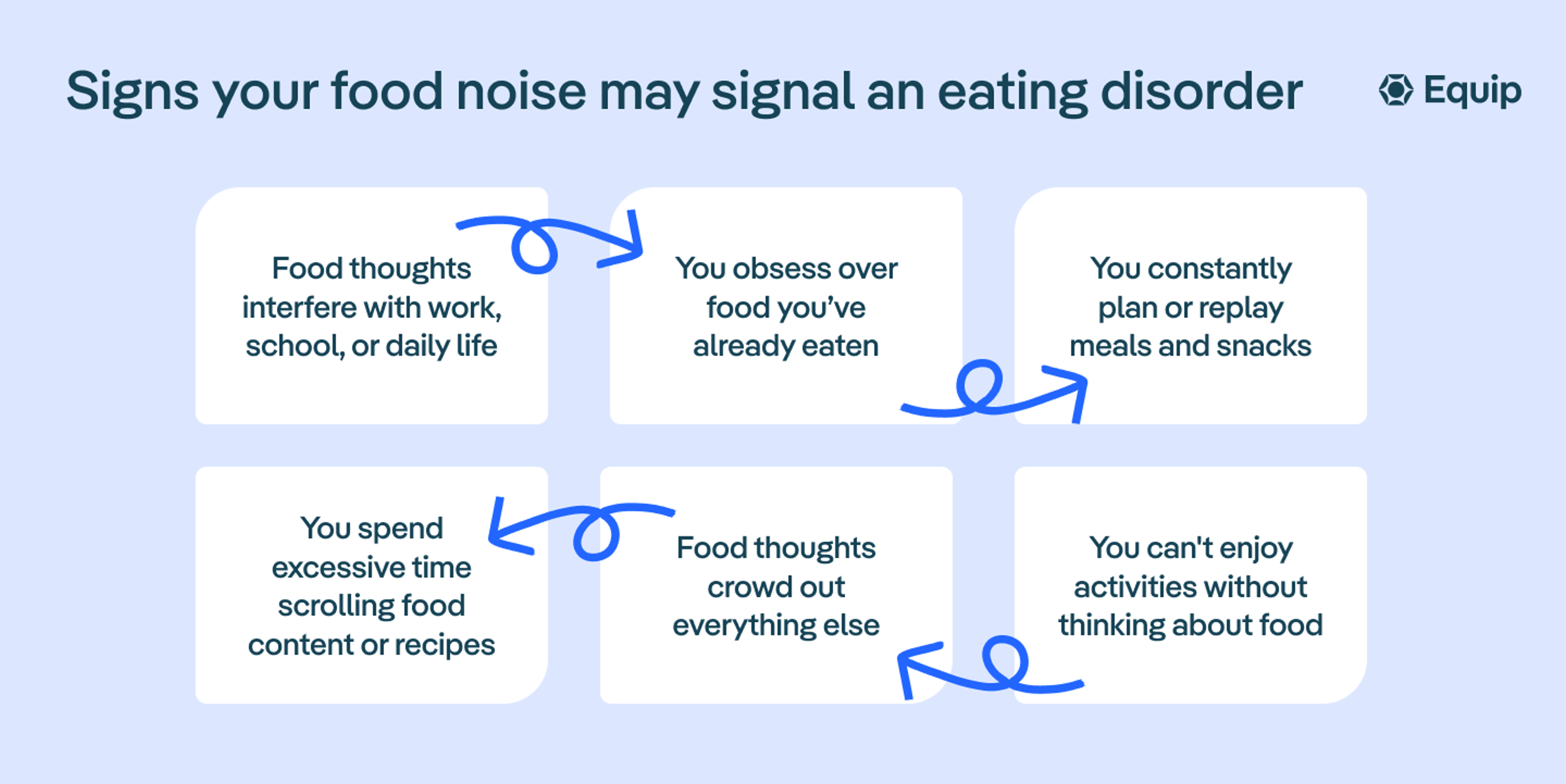
If more than one of these signs sounds familiar, it's worth reaching out for support or taking our free eating disorder assessment. An eating disorder-informed professional can help you better understand what's behind your food noise and whether treatment might help.
[GRAPHIC: Signs your food noise may signal an eating disorder]
- Food thoughts interfere with work, school, or daily life
- You can't enjoy activities without thinking about food
- You constantly plan or replay meals and snacks
- You obsess over food you've already eaten
- You spend excessive time scrolling food content or recipes
- Food thoughts crowd out everything else
How to quiet food noise
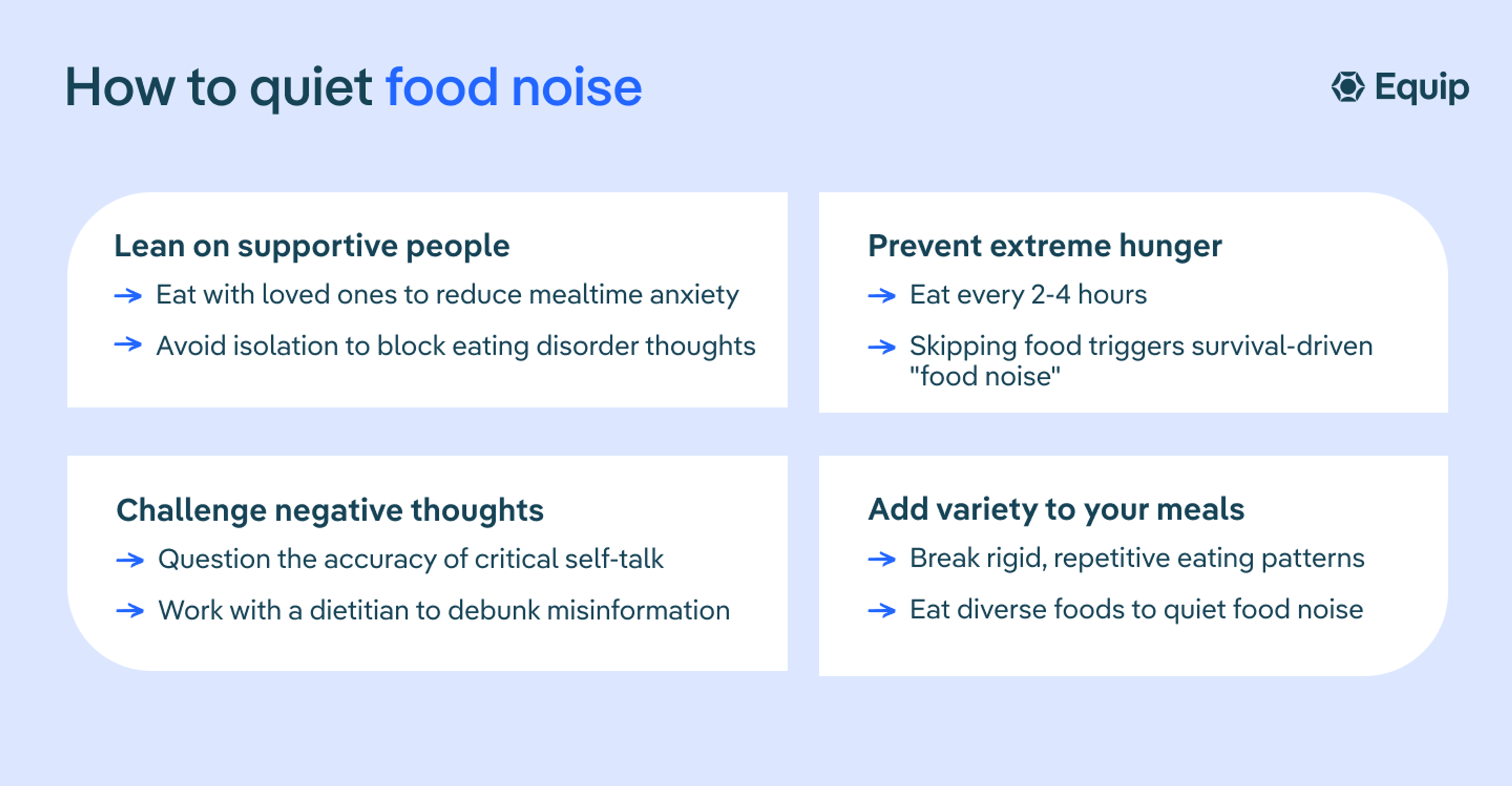
If food noise makes it hard to enjoy daily life, there are several evidence-backed ways to turn down the volume—without dieting or ignoring your hunger:
- Prevent extreme hunger. "Eat regularly throughout the day, which means eating a meal or snack every two to four hours during waking hours," Hargrave-Klein says. "When the body doesn't receive what it needs, it turns on food noise to encourage you to eat. It is a pretty cool system designed to save you."
- Lean on supportive people. Eating with loved ones can make meals feel less overwhelming and interrupt eating disorder thoughts. "I would ensure that after school, I had plans to eat lunch at someone's house or be around folks," Dowell says. "By not isolating myself, I ensured a protective barrier from the eating disorder."
- Add more variety to your meals. "Rigid or repetitive eating can trigger food noise," Hargrave-Klein says. "Adding variety and satisfying foods can turn down the volume of the food noise."
- Challenge negative or self-punishing thoughts. “Are the messages you hear accurate and truthful?” Hargrave-Klein asks. “Talk to a dietitian to debunk any misinformation wrapped up in the food noise.”
Dowell encourages anyone struggling with food noise to remember that recovery is possible.
"I thought I was going to live my life every day like this," she says. "Then my first therapist told me, 'Hey, did you know that it can be silenced?' I cried. I didn't know that I could even work my way to that form of peace."
To that point, it’s time to seek professional support if food noise is interfering with your ability to work, enjoy relationships, or meet your body's needs, Hargrave-Klein says.
Do GLP-1s like Ozempic quiet food noise?
For many people, yes. GLP-1 medications like Ozempic and Wegovy suppress appetite, which can make food noise less frequent or intense, according to research in Cureus. But if you have (or are at risk for) an eating disorder, quieter food noise doesn't necessarily mean the eating disorder itself has been treated.
That’s because reducing food noise isn't always the same as addressing what's driving it. If the thoughts stem from restriction, rigid food rules, anxiety, or an eating disorder, lowering your appetite may make them less noticeable without resolving the underlying issue.
It's also important to remember that while GLP-1s may decrease appetite and food noise, they don't decrease your body's nutritional needs.
"Your body still requires adequate energy, macronutrients, micronutrients, and hydration," says O'Connell. "Working with a registered dietitian is helpful when on these medications to ensure you are still reaching your daily nutrition prescription, regardless of how quiet the noise becomes."
That doesn't mean GLP-1s are inherently good or bad. They're simply one piece of the puzzle. For many people, lasting eating disorder recovery means addressing what's driving the food noise—and that often takes more than medication alone.
The bottom line
While thoughts about food are a normal part of life, persistent food noise is worth paying attention to. It can be driven by factors including hunger, restriction, stress, or an eating disorder, and understanding what's behind it is the first step toward finding relief.
If food noise is making it hard to enjoy your daily life, you don't have to figure it out alone. Start with Equip's free, 5-minute eating disorder assessment to see if an eating disorder may be present, or schedule a call to connect with an eating disorder-informed professional.
Frequently asked questions (FAQs)
What are the different types of food noise?
There’s no official food noise disorder, so the phenomenon doesn't have specific subtypes. Still, the experts say it can show up in different ways. For some people, it looks like constant thoughts about their next meal. For others, it's rigid food rules, guilt after eating, or obsessive thoughts about what they should or shouldn't eat.
Is food noise part of ADHD?
Food noise and ADHD don’t always go hand in hand, but some people with ADHD do experience food noise. Differences in attention, impulsivity, and interoception can all affect how someone experiences food and eating.
Does food noise ever go away?
For many people, yes. Getting enough nourishment and working through the thoughts, emotions, or behaviors contributing to food noise can quiet the mental chatter. If food noise is related to an eating disorder, working with a treatment team can help you address the underlying cause rather than simply trying to silence the thoughts.
Cook, Geoff. “Quieting "Food Noise": How GLP-1s and Mindfulness Rewire the Default Mode Network (DMN) and Reward Circuits.” Cureus vol. 18,1 e100818. 5 Jan. 2026, doi:10.7759/cureus.100818
Dhurandhar, Emily J et al. “Food noise: definition, measurement, and future research directions.” Nutrition & diabetes vol. 15,1 30. 8 Jul. 2025, doi:10.1038/s41387-025-00382-x
Dulloo, Abdul G. “Physiology of weight regain: Lessons from the classic Minnesota Starvation Experiment on human body composition regulation.” Obesity reviews : an official journal of the International Association for the Study of Obesity vol. 22 Suppl 2 (2021): e13189. doi:10.1111/obr.13189
Göz Tebrizcik, Burcu et al. “Interoceptive abilities in adults with attention deficit hyperactivity disorder.” Biological psychology vol. 202 (2025): 109161. doi:10.1016/j.biopsycho.2025.109161
Hayashi, Daisuke et al. “What Is Food Noise? A Conceptual Model of Food Cue Reactivity.” Nutrients vol. 15,22 4809. 17 Nov. 2023, doi:10.3390/nu15224809
Hopkins, Mark, et al. “The Regulation of Food Intake in Humans.” Nih.Gov, MDText.com, Inc., 30 Mar. 2022, https://www.ncbi.nlm.nih.gov/books/NBK278931/. Accessed 20 July 2026.